

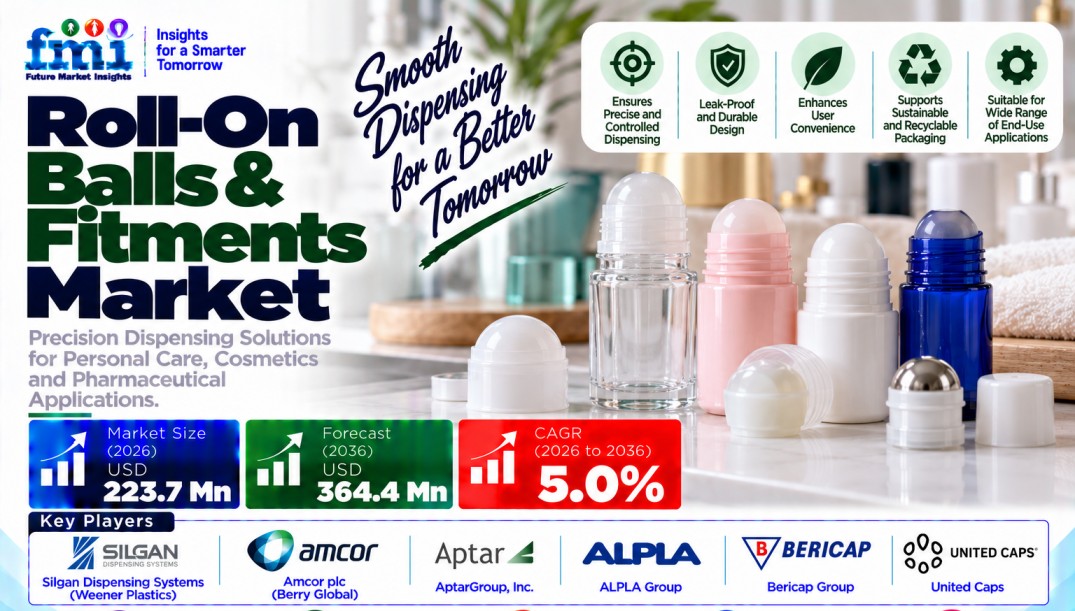
The global Roll-On Balls & Fitments Market is projected to grow from US$223.7 million in 2026 to US$364.4 million by 2036, registering a compound annual growth rate (CAGR) of 5.0%, according to Future Market Insights (FMI). The market was valued at US$213.0 million in 2025. The forecast represents an increase of US$140.7 million in market value between 2026 and 2036.
Roll-on balls and fitments are dispensing components used in personal care, skincare, and topical pharmaceutical packaging. As brands expand non-aerosol deodorants, eye serums, and topical gels, packaging suppliers face demand for applicators that deliver a smooth roll, controlled product application, and leak-resistant performance during storage and e-commerce distribution.
Roll-On Balls & Fitments Market: Key Forecast Highlights
- Market size in 2026: US$223.7 million
- Forecast market size by 2036: US$364.4 million
- CAGR (2026–2036): 5.0%
- Market size in 2025: US$213.0 million
- Leading format type: Standard two-piece ball and fitment housing assemblies, projected at 48.2% in 2026
- Leading neck finish: 24 mm to 28 mm, projected at 51.4% in 2026
- Leading material: Polypropylene (PP and PCR-PP), projected at 54.6% in 2026
- Leading end use: Personal care and antiperspirant deodorants, projected at 67.8% in 2026
- Leading sales channel: Direct brand and contract-filler agreements, projected at 58.4% in 2026
>> Get Detailed Market Forecasts, Competitive Benchmarking, and Pricing Trends: https://www.futuremarketinsights.com/reports/sample/rep-gb-35998
What Is Driving the Roll-On Balls & Fitments Market?
Demand for non-aerosol deodorants is a central growth driver. Roll-on formats allow liquid and emulsion products to be applied directly without aerosol propellants, creating recurring demand for rotating balls, seating components, and retaining housings.
Skincare brands are also using rollerball applicators for eye serums, facial treatments, and specialty beauty products. In topical healthcare, rollerball packaging can provide convenient application of products such as analgesic gels. These applications increase the need for precise component dimensions, consistent rolling action, and compatibility with different product viscosities.
Packaging performance and recyclability are shaping product development. Suppliers are working to reduce component weight and improve compatibility with polyolefin-based packaging structures, including designs incorporating post-consumer recycled resin. However, brands and contract fillers must validate leak resistance, ball movement, closure torque, and material compatibility before adopting new components at scale.
Standard Assemblies and Polypropylene Lead Key Segments
Standard two-piece ball and fitment housing assemblies are projected to account for 48.2% of format-type demand in 2026. Their appeal includes compatibility with established bottle and filling-line configurations, allowing manufacturers to integrate dispensing components into existing production systems.
The 24 mm to 28 mm neck-finish segment is expected to represent 51.4% of demand in 2026. Standardized neck interfaces can simplify sourcing and help brands use compatible packaging components across production facilities.
Polypropylene, including PP and PCR-PP, is forecast to account for 54.6% of material demand in 2026. The material is used in roll-on components requiring chemical resistance and precision molding. Personal care and antiperspirant deodorants remain the leading end-use segment at a projected 67.8%, while direct brand and contract-filler supply agreements are expected to account for 58.4% of sales-channel demand.
Regional Opportunities: South Korea Leads Growth Forecasts
FMI’s country forecasts identify South Korea as the fastest-growing profiled market, followed by the United Arab Emirates and Saudi Arabia.
- South Korea: 6.3% CAGR through 2036, supported by skincare and eye-serum rollerball applications and cosmetics exports.
- United Arab Emirates: 5.9%, with personal-care and fragrance-oil roll-on demand supporting component requirements.
- Saudi Arabia: 5.6%, reflecting opportunities in personal-care distribution and topical pharmaceutical packaging.
- United States: 5.2%, with non-aerosol deodorants and topical analgesic products contributing to demand.
- United Kingdom: 4.9%, where packaging-weight and recyclability considerations influence redesign.
- Germany: 4.6%, supported by demand for packaging compatible with recyclability requirements.
- France: 4.3%.
- Japan: 3.8%.
For suppliers, these forecasts can guide market prioritization, distributor development, and customer qualification. Companies should also evaluate local regulatory requirements, filling-line compatibility, resin availability, and the technical validation needed for each product category.
Top Players in the Roll-On Balls & Fitments Market
FMI identifies the following notable companies in the market:
- Silgan Dispensing Systems (incorporating Weener Plastics)
- Amcor plc (incorporating Berry Global)
- AptarGroup, Inc.
- ALPLA Group
- Bericap Group
- United Caps
- Guala Closures Group
- Sonoco Products Company
These companies operate across dispensing systems, plastic packaging, closure engineering, and component manufacturing. Their portfolios and roles differ; this list is not a ranking by market share.
Competitive differentiation depends on dimensional consistency, molding precision, material selection, and the ability to meet customer requirements for leak prevention and production-line efficiency. Suppliers that collaborate with brands and contract fillers early in product development may be better positioned to qualify components for long-term supply agreements.
>> Access Detailed Market Insights: https://www.futuremarketinsights.com/reports/roll-on-balls-and-fitments-market
Strategic Priorities for Packaging Decision-Makers
Three priorities stand out for manufacturers and procurement teams.
First, validate dimensional accuracy and sealing performance. Ball diameter, housing fit, and insertion force can affect rolling action and leak resistance. Qualification trials should cover multiple mold cavities and expected transport conditions.
Second, plan for material transitions carefully. PCR-containing and mono-polyolefin designs can support packaging-weight and recyclability goals, but new formulations must be tested for chemical compatibility, component durability, and consistent dispensing.
Third, collaborate with filling-line partners. Early coordination between component molders, bottle suppliers, brands, and contract fillers can reduce redesign costs and shorten the path from prototype to commercial production.
Nandini Roy Choudhury, Principal Consultant at Future Market Insights, said: “A roll-on ball is a dynamic mechanical valve whose equatorial seam finish and housing interference fit govern whether a deodorant or topical gel leaks in transit or stalls on the skin. Component molders that combine single-tool seam-free polypropylene spheres with fitment-free mono-material seating will secure multi-year personal care and OTC pharmaceutical contracts.”