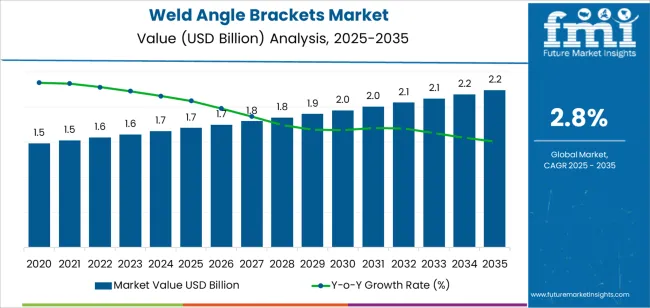
The global weld angle brackets market is projected to grow from USD 1.7 billion in 2025 to USD 2.2 billion by 2035, registering a compound annual growth rate (CAGR) of 2.8% during the forecast period. Market expansion is supported by construction activity and the growing emphasis on standardized structural fastening solutions that deliver consistent load-bearing performance across residential, commercial, and industrial structures.
Steel is expected to dominate the material segment with a 68.0% market share, while residential applications are projected to lead the application segment with a 55.0% share. These leading segments reflect the importance of durable bracket materials and dependable structural connections in building projects.
Get detailed market forecasts, competitive benchmarking, and technology trends: https://www.futuremarketinsights.com/reports/sample/rep-gb-28074
Construction Activity Supports Demand for Weld Angle Brackets
Weld angle brackets are used to connect and reinforce structural components in a range of construction applications. Their role in supporting structural fastening requirements makes them relevant to residential building projects and other construction environments where dependable connections are essential.
The market is increasingly shaped by a shift from site-fabricated fastening solutions toward pre-engineered, load-rated brackets. Standardized products can help improve consistency across installations and make it easier for construction professionals to select components based on defined structural requirements.
Several factors are influencing market demand:
- Construction activity: Residential and other building projects create demand for structural fastening and connection components.
- Standardized fastening requirements: Builders increasingly need consistent solutions that can be selected according to project specifications.
- Load-rated product adoption: Pre-engineered brackets provide defined performance characteristics for structural applications.
- Material durability: Steel remains an important material choice for brackets used in structural connections.
Where the Weld Angle Brackets Market Is Headed
The market is forecast to expand from USD 1.7 billion in 2025 to USD 2.2 billion by 2035, at a CAGR of 2.8%. This outlook points to steady growth as construction stakeholders continue to prioritize reliable fastening components and standardized structural solutions.
The transition toward pre-engineered brackets may also influence product selection and procurement practices. Rather than relying exclusively on site-fabricated solutions, construction teams can evaluate standardized products against project requirements, installation needs, and expected structural loads.
For manufacturers and suppliers, the opportunity lies in providing dependable products with clear specifications, consistent quality, and options suited to different building applications.
What Leads the Market?
Steel Accounts for 68.0% of the Material Segment
Steel is projected to hold a dominant 68.0% share of the weld angle brackets market by material. Its leading position highlights the importance of established structural materials in applications that require dependable fastening and connection performance.
For manufacturers, maintaining consistent material quality and providing clear product specifications can support purchasing decisions. Construction professionals need to select brackets appropriate to the intended application, structural requirements, and relevant project standards.
Residential Applications Represent 55.0% of Demand
The residential segment is projected to account for a leading 55.0% share of the application segment. Residential construction relies on structural connection components across a range of building requirements, making this segment a key part of the market outlook.
The segment’s leading share underscores the importance of serving residential construction supply chains with products that are easy to specify, consistent in quality, and suitable for intended installation conditions.
As construction projects increasingly emphasize repeatable processes and standardized components, suppliers that address residential builders’ procurement and specification requirements may be better positioned to serve this demand.
The Challenge: Balancing Structural Reliability, Cost, and Installation Requirements
Despite steady growth prospects, weld angle bracket manufacturers must address practical requirements that influence product selection. Brackets need to match the intended structural application, installation method, and specified load requirements.
Key considerations include:
- Load requirements: Product selection must reflect the intended structural connection and applicable engineering specifications.
- Material quality: Consistent material properties are important to product reliability and performance.
- Installation requirements: Bracket design and dimensions must suit the structure and installation method.
- Standardization: Clear specifications can help reduce uncertainty during product selection and procurement.
- Cost management: Buyers must balance purchase costs with the required quality and performance of the connection.
Manufacturers that combine consistent product quality with clear technical documentation can help construction buyers assess suitability and make informed procurement decisions.
What This Means for Weld Angle Bracket Manufacturers and Construction Buyers
The market outlook suggests that steady construction demand and the preference for standardized fastening solutions will remain important considerations through 2035.
For manufacturers and suppliers:
- Develop product portfolios aligned with common structural fastening requirements.
- Provide clear information on dimensions, materials, and applicable load ratings.
- Maintain consistent quality across standardized product ranges.
- Strengthen relationships with construction distributors, contractors, and procurement teams.
- Emphasize product suitability and specification support rather than relying on price alone.
For construction buyers:
- Match bracket specifications to engineering requirements and intended applications.
- Verify material and load-rating details before purchasing.
- Consider installation requirements when comparing standardized products with site-fabricated alternatives.
- Work with qualified professionals to ensure that selected components meet applicable building and structural requirements.
These priorities can help suppliers meet purchasing needs while supporting more consistent component selection across construction projects.
Analyst View
The weld angle brackets market is expected to record measured growth over the 2025–2035 forecast period, supported by construction activity and increasing emphasis on standardized structural fastening reliability.
The projected 68.0% share for steel and 55.0% share for residential applications highlight two important areas of market demand. For industry participants, product consistency, clearly defined specifications, and suitability for residential construction requirements are likely to remain central to market positioning.
Get the Complete Story—Read More About Our Latest Report: https://www.futuremarketinsights.com/reports/weld-angle-brackets-market
For detailed market estimates, forecast analysis, segment insights, and competitive information, explore Future Market Insights’ Weld Angle Brackets Market report.
Related Reports:
Industrial Cooling Systems Market: https://www.futuremarketinsights.com/reports/industrial-cooling-systems-market
Ductless Heating & Cooling Systems Market: https://www.futuremarketinsights.com/reports/ductless-heating-and-cooling-systems-market
Cooling Tower Fans Market: https://www.futuremarketinsights.com/reports/cooling-tower-fans-market
About Future Market Insights
Future Market Insights, Inc. (FMI) is an ESOMAR-certified market research and consulting firm headquartered in Delaware, USA, with offices in the United Kingdom, the United Arab Emirates and India. FMI delivers syndicated and custom research across food and beverage, healthcare, chemicals, technology, packaging, consumer goods and industrial sectors.
For Press & Corporate Inquiries
Rahul Singh
AVP – Marketing and Growth Strategy
Future Market Insights, Inc.
+91 8600020075
For Sales: sales@futuremarketinsights.com
For Media: Rahul.singh@futuremarketinsights.com
For Web: https://www.futuremarketinsights.com/