

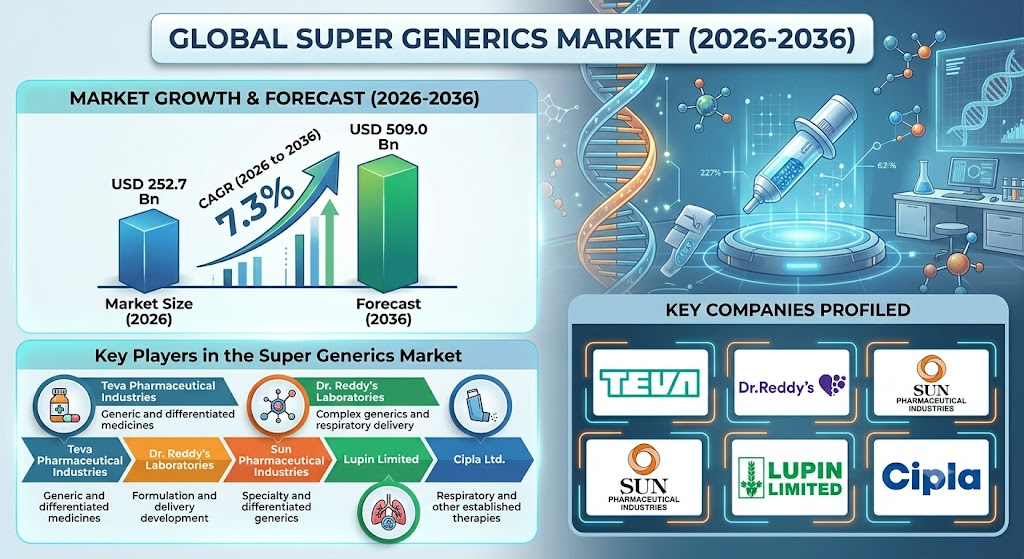
The global super generics market is projected to grow from USD 252.69 billion in 2026 to USD 509.03 billion by 2036, registering a compound annual growth rate (CAGR) of 7.3%, according to Future Market Insights (FMI). The market was valued at USD 235.6 billion in 2025, reflecting growing commercial interest in differentiated versions of established medicines that address specific formulation, administration, or delivery requirements.
Super generics generally involve modifications to existing medicines, such as changes in dosage form, strength, release characteristics, or delivery mechanisms. Unlike conventional generics that typically seek to demonstrate equivalence to a reference medicine, differentiated products may require additional development work and evidence depending on the nature of the change and the applicable regulatory pathway.
Get Detailed Market Forecasts, Competitive Benchmarking, and Pricing Trends
Key Market Highlights
- Market size in 2026: USD 252.69 billion
- Projected market size by 2036: USD 509.03 billion
- Market CAGR (2026–2036):3%
- Market value in 2025: USD 235.6 billion
- Leading drug type: Oral solid dosage forms, projected to account for 23.0% of drug-type demand in 2026
- Leading therapeutic area: Oncology, projected to account for 40.0% of therapeutic-area demand in 2026
- Fastest-growing profiled country: India, forecast to grow at a 7.1% CAGR
- Key companies: Teva Pharmaceutical Industries, Dr. Reddy’s Laboratories, Sun Pharmaceutical Industries, Lupin Limited, and Cipla Ltd.
What Is Driving Demand for Super Generics?
Demand is shaped by the need to make established medicines better suited to particular treatment and administration requirements. Changes to a formulation or delivery system can be commercially relevant when they address a defined challenge, such as the way a medicine is administered, its release characteristics, or its fit within routine treatment.
Pharmaceutical companies are therefore evaluating opportunities beyond conventional generic formulations. However, the value of a differentiated medicine depends on the specific product and the evidence supporting its intended use. A modified formulation does not automatically deliver improved clinical outcomes or guarantee a commercial advantage.
Manufacturing reliability, regulatory planning, and cost considerations also influence development decisions. Companies must assess whether a proposed modification justifies its additional development requirements and whether healthcare providers, patients, and purchasers have a clear reason to adopt the product.
Oral Solid Dosage Forms and Oncology Remain Important Segments
FMI projects oral solid dosage forms to account for 23.0% of drug-type demand in 2026. Oral formulations remain commercially relevant because many established medicines are taken repeatedly outside clinical facilities. Opportunities for differentiation may involve release characteristics or administration features, provided the product change is appropriate for the intended medicine and patient population.
By therapeutic area, oncology is projected to account for 40.0% of market demand in 2026. Cancer medicines can present specific formulation, administration, and access requirements, creating opportunities for differentiated presentations where the product rationale and supporting evidence are clear.
The development requirements for these products vary. Manufacturers must consider the intended treatment use, product quality, applicable regulatory route, and the evidence needed to support the proposed changes.
Country-Level Growth Outlook
FMI forecasts varying growth rates across five profiled markets between 2026 and 2036:
- India:1% CAGR, supported by its pharmaceutical manufacturing base and opportunities to develop differentiated formulations.
- Japan:2% CAGR, with treatment requirements associated with an aging population contributing to interest in suitable medicine presentations.
- Germany:6% CAGR, reflecting an established pharmaceutical market where product differentiation must demonstrate a clear rationale.
- United Kingdom:2% CAGR, with safe and effective medicine use and purchasing considerations shaping adoption.
- United States:4% CAGR, where development strategy depends partly on the product modification and applicable regulatory pathway.
India is projected to record the strongest growth among these profiled countries. Its established pharmaceutical production capabilities offer a platform for companies exploring differentiated products for domestic and international markets. Commercial success, however, will depend on appropriate product development, quality assurance, regulatory planning, and a convincing value proposition.
Competitive Landscape and Industry Developments
The competitive landscape includes pharmaceutical companies with established generic portfolios and capabilities in formulation development and differentiated medicines.
FMI profiles Teva Pharmaceutical Industries, Dr. Reddy’s Laboratories, Sun Pharmaceutical Industries, Lupin Limited, and Cipla Ltd. in its market analysis. These companies participate in pharmaceutical categories where formulation design, delivery characteristics, manufacturing capabilities, and therapeutic focus can influence product development and market positioning.
Competition is increasingly shaped by the ability to identify a meaningful product difference and support it with appropriate evidence. Development teams must also assess manufacturing feasibility, supply reliability, dispensing requirements, and the price purchasers may be willing to pay relative to conventional generic alternatives.
Regulatory considerations are central to this process. The European Medicines Agency distinguishes certain hybrid applications from conventional generic applications, while the United States Food and Drug Administration provides guidance on different application pathways. The appropriate route depends on the medicine and the proposed change; requirements should be assessed on a product-specific basis.
FMI Analyst Perspective
Anurag Sharma, Principal Analyst at Future Market Insights, describes super generics as modified versions of existing generic medicines that may incorporate changes in formulation, delivery mechanisms, or therapeutic use. This reflects the market’s focus on differentiated product development rather than simply reproducing established dosage forms.
Market Outlook Through 2036
The super generics market is projected to reach USD 509.03 billion by 2036, with growth supported by opportunities to adapt established medicines to specific treatment and administration needs. Oral solid dosage forms and oncology are important segments in FMI’s 2026 outlook, while India leads the profiled countries in projected growth.
For pharmaceutical companies, the opportunity lies in identifying product modifications that address a clearly defined need, validating the product appropriately, and building a feasible regulatory and manufacturing strategy. Differentiation will be most commercially meaningful when it is supported by relevant evidence and a clear rationale for use.
Access the Full Report: https://www.futuremarketinsights.com/reports/super-generics-market
Frequently Asked Questions
- What is the projected size of the super generics market by 2036?
FMI projects the global market to reach USD 509.03 billion by 2036.
- What is the expected CAGR from 2026 to 2036?
The market is forecast to grow at a CAGR of 7.3%.
- Which drug type leads the market?
Oral solid dosage forms are projected to account for 23.0% of drug-type demand in 2026.
- Which therapeutic area leads the market?
Oncology is projected to account for 40.0% of therapeutic-area demand in 2026.
- Which country is expected to grow fastest?
India is forecast to register a 7.1% CAGR between 2026 and 2036 among the profiled countries.
- Who are the key companies in the market?
Key companies profiled by FMI include Teva Pharmaceutical Industries, Dr. Reddy’s Laboratories, Sun Pharmaceutical Industries, Lupin Limited, and Cipla Ltd.
Related Reports
- Temporary Pacing Leads Market – https://www.futuremarketinsights.com/reports/temporary-pacing-leads-market
- Critical Care Drugs Market – https://www.futuremarketinsights.com/reports/critical-care-drugs-market
- Varicella Vaccines Market – https://www.futuremarketinsights.com/reports/varicella-vaccines-market
About Future Market Insights (FMI)
Future Market Insights (FMI) is the publisher of the Antibody Market research report. Its report provides market forecasts, company share analysis, competitive intelligence, market dynamics, challenges and strategic growth initiatives to support business planning and investment decisions.
Media and Business Enquiries
Future Market Insights
Email: sales@futuremarketinsights.com
Phone: +1 347 918 3531
Website: https://www.futuremarketinsights.com/