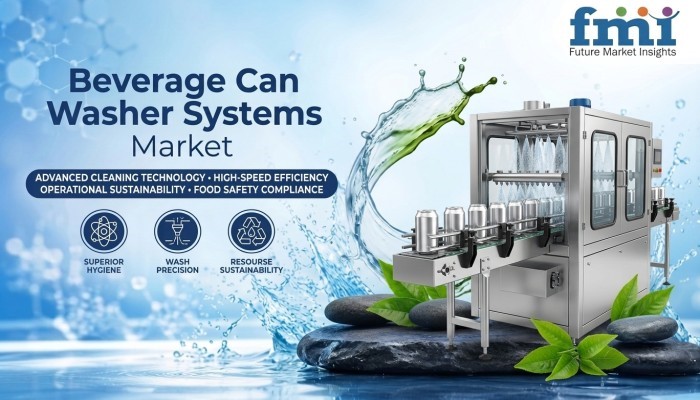
The global beverage can washer systems market is projected to increase from USD 284.7 million in 2026 to USD 441.6 million by 2036, registering a compound annual growth rate (CAGR) of 4.5% during the forecast period. The market was valued at USD 273.1 million in 2025. According to Future Market Insights (FMI), demand is supported by investments in beverage can manufacturing capacity, front-end production line rebuilds and equipment upgrades designed to improve cleaning consistency and reduce operational resource consumption.
Beverage can washer systems are essential equipment in two-piece can manufacturing lines. They remove forming lubricants, coolants, metal fines and oxide residues from drawn can bodies before decoration and protective coating. Their performance directly influences printing adhesion, surface quality and production throughput.
The market assessment includes new equipment installations, major line rebuilds, controls retrofits and heat-recovery packages. Downstream filler sanitizers and crate washers are excluded from the market definition.
Get detailed market forecasts, competitive benchmarking, and pricing trends:
https://www.futuremarketinsights.com/reports/sample/rep-gb-35586
Beverage Can Washer Systems Market Snapshot
- Market value (2026): USD 284.7 million
- Forecast value (2036): USD 441.6 million
- CAGR (2026–2036): 4.5%
- Leading configuration: Multi-stage conveyor washers, with 48.0% share
- Leading material: Aluminum cans, with 86.0% share
- Leading line position: Post-bodymaker, pre-decoration, with 57.0% share
- Leading buyer category: Integrated can manufacturers, with 62.0% share
- Highest-growth country: India, with a 7.1% CAGR
Production Quality and Resource Efficiency Drive Equipment Investments
The expansion of beverage can manufacturing capacity remains a primary demand driver. New production lines and front-end rebuilds require washing equipment capable of matching bodymaker output while maintaining consistent cleaning performance.
Multi-stage conveyor washers are expected to account for 48.0% of washer configuration demand in 2026. These systems use sequential pre-rinse, chemical cleaning, deoxidizing and deionized water rinsing stages to remove manufacturing residues. Their ability to minimize chemical carryover and maintain consistent surface preparation makes them suitable for high-speed production environments.
Aluminum cans are projected to represent 86.0% of processed substrate demand in 2026. Aluminum’s established position in two-piece beverage can manufacturing creates substantial requirements for surface cleaning before printing and internal protective coating applications.
Post-bodymaker, pre-decoration installations are expected to capture 57.0% of line-position demand. Cleaning immediately after trimming helps prevent forming lubricants, coolant emulsions and metal particles from reaching downstream equipment, where they can contribute to surface defects and printing failures.
Throughput requirements also influence equipment procurement. Systems rated above 3,000 cans per minute are forecast to account for 43.0% of throughput demand in 2026. These installations require appropriately sized conveyors, pumping systems and can-stabilization mechanisms to maintain cleaning performance at higher production speeds.
Integrated can manufacturers are expected to represent 62.0% of buyer demand in 2026, reflecting their responsibility for coordinating can-forming operations and downstream decoration quality.
Water and Energy Management Create Retrofit Opportunities
High water consumption, chemical replenishment requirements and natural gas usage remain important operational constraints for beverage can washer installations. Manufacturers must also manage effluent treatment requirements and maintain chemical stability across successive washing stages.
These operating costs create opportunities for equipment suppliers offering resource-efficiency improvements. Closed-loop rinse recovery, high-efficiency heat exchangers, vacuum carryover control and optimized spray nozzle configurations can support brownfield upgrades without requiring complete washer replacement.
For plant operators, investment decisions increasingly involve evaluating lifecycle operating expenses alongside initial equipment costs. Washer performance also affects decorator efficiency, production scrap and the consistency of finished can surfaces.
India and China Lead Country-Level Growth Opportunities
Regional demand varies according to beverage can production capacity, manufacturing investment and the maturity of existing industrial installations. FMI identifies India and China as the fastest-growing national markets during the forecast period.
The projected country-level CAGRs for 2026–2036 are:
- India: 7.1% – Expanding beverage packaging infrastructure and investment in turnkey production lines support equipment demand.
- China: 5.8% – High container production volumes sustain procurement across new installations and replacement cycles.
- Mexico: 5.3% – Integration with North American beverage supply networks supports investment in high-speed canmaking facilities.
- Brazil: 5.0% – Beverage production volumes sustain demand for reliable washing systems across existing manufacturing operations.
- United States: 4.4% – Established manufacturing facilities prioritize retrofits focused on reducing water, chemical and thermal consumption.
- Germany: 3.8% – Industrial utility costs and effluent management requirements influence equipment replacement decisions.
- Japan: 3.3% – Manufacturers emphasize reliable retrofits that maintain established production and surface-quality standards.
These growth rates represent the beverage can washer systems market rather than the broader beverage packaging or metal container industries.
Top Players in the Beverage Can Washer Systems Market
The competitive landscape includes dedicated washer manufacturers, can-line equipment suppliers and engineering specialists supporting production integration and process control.
The ten notable companies profiled by FMI are:
- International Thermal Systems
- Cincinnati Industrial Machinery
- Stolle Machinery
- Belvac
- CarnaudMetalbox Engineering
- SLAC Precision Equipment
- Can Systems Worldwide
- Greenbank Technology
- Prime Controls
- BW Integrated Systems
International Thermal Systems, Cincinnati Industrial Machinery and Stolle Machinery are identified among the direct can washer suppliers. Their competitive positioning reflects washer engineering, equipment integration and resource-efficiency capabilities.
Belvac, CarnaudMetalbox Engineering and SLAC Precision Equipment participate through broader can-line equipment platforms. Greenbank Technology, Prime Controls and BW Integrated Systems contribute through thermal equipment, process controls and production integration capabilities.
FMI’s competitive benchmarking evaluates companies across direct washer evidence, resource-efficiency options, line integration and geographic reach. The assessment does not establish a ranked market-share hierarchy among the profiled participants.
Market Outlook: Equipment Performance Becomes a Capital Investment Priority
The beverage can washer systems market is expected to remain closely connected to investment cycles in two-piece beverage can manufacturing. FMI values the broader drink cans market at USD 69.4 billion in 2026, providing context for the manufacturing infrastructure supporting washer equipment demand.
For equipment manufacturers, opportunities include developing high-throughput washing configurations, improving thermal efficiency and strengthening process control capabilities. For can producers, procurement decisions will depend on cleaning consistency, production compatibility, maintenance requirements and measurable reductions in water and energy consumption.
As beverage can manufacturers expand production capacity and upgrade existing lines, washer systems will remain an important component of front-end manufacturing quality and operational efficiency.
About the Beverage Can Washer Systems Market Report
Future Market Insights’ Beverage Can Washer Systems Market report examines market size, forecast growth, industry drivers, restraints, opportunities, regional developments and competitive positioning from 2026 to 2036.
The study segments the market by washer configuration, can material, line position, rated throughput, buyer type and region. Its geographic assessment covers North America, Latin America, Western Europe, Eastern Europe, East Asia, South Asia and Pacific, and the Middle East and Africa.
The research uses a bottom-up market-sizing methodology based on can-line counts, washer equipment values, new production line additions, rebuild cycles and regional beverage can output.
Explore the complete market assessment, regional forecasts and competitive analysis: https://www.futuremarketinsights.com/reports/beverage-can-washer-systems-market
Explore More Related Reports Links:
https://www.openpr.com/news/4669888/old-corrugated-container-market-is-anticipated-to-reach-usd-64-4
https://www.openpr.com/news/4669912/folding-boxboard-market-is-expected-to-grow-usd-140-400-0
https://www.openpr.com/news/4669922/luxury-rigid-box-market-set-to-reach-usd-15-8-billion-by-2036
FMI Custom Research: Strategic Intelligence for Confident Decision-Making
In today’s rapidly evolving business environment, leadership teams need more than market data—they need clear, actionable intelligence tailored to their strategic objectives. FMI’s Custom Research solutions are designed around the specific business questions organizations need answered, enabling executives to evaluate growth opportunities, validate investments, assess competitive dynamics, and reduce uncertainty before making critical decisions. By combining deep industry expertise, primary research, and proprietary market intelligence, FMI delivers insights that help organizations move from assumptions to evidence-based strategies with greater speed and confidence.
Business Impact
FMI helps organizations transform market complexity into strategic clarity, enabling leadership teams to identify growth opportunities faster, optimize resource allocation, strengthen competitive positioning, and make high-stakes business decisions with confidence.
To explore how FMI Custom Research can support your strategic priorities, please connect with our team at – sales@futuremarketinsights.com
About Future Market Insights (FMI)
Future Market Insights, Inc. (FMI) is an ESOMAR-certified, ISO 9001:2015 market research and consulting organization, trusted by Fortune 500 clients and global enterprises. With operations in the U.S., UK, India, and Dubai, FMI provides data-backed insights and strategic intelligence across 30+ industries and 1200 markets worldwide.
Contact Us:
Future Market Insights Inc.
Christiana Corporate, 200 Continental Drive,
Suite 401, Newark, Delaware – 19713, USA
T: +1-347-918-3531
For Sales Enquiries: sales@futuremarketinsights.com
Website: https://www.futuremarketinsights.com
LinkedIn| Twitter| Blogs | YouTube