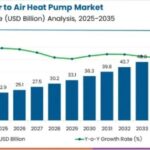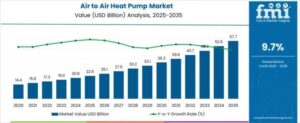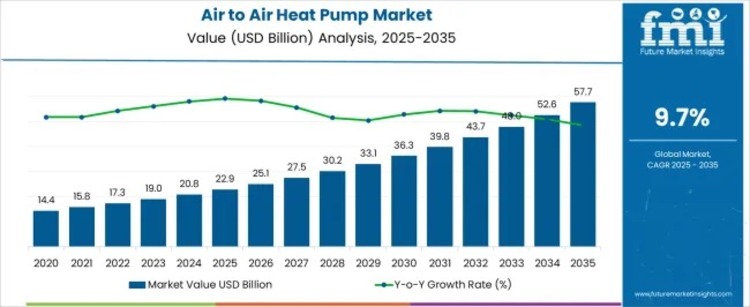
The global air to air heat pump market is projected to grow from USD 22.9 billion in 2025 to USD 57.7 billion by 2035, registering a compound annual growth rate (CAGR) of 9.7%, according to Future Market Insights (FMI).
Rising demand for energy-efficient heating and cooling systems, increasing adoption of electrified building technologies, and growing interest in reducing conventional heating fuel consumption are supporting market expansion. As residential and commercial building owners prioritize energy performance and year-round indoor comfort, air to air heat pumps are becoming an important option for modern heating and cooling infrastructure.
Get detailed market forecasts, competitive benchmarking, and technology trends: https://www.futuremarketinsights.com/reports/sample/rep-gb-25348
Energy-efficient heating and cooling drive heat pump adoption
Air to air heat pumps transfer heat between outdoor air and indoor spaces to provide heating or cooling. Their ability to serve both functions makes them an attractive option for buildings seeking flexible climate control and alternatives to conventional heating systems.
Demand is being shaped by building electrification, energy efficiency initiatives, equipment replacement, and the need for adaptable indoor climate solutions. Residential applications remain particularly important, while commercial buildings also present opportunities as property owners modernize heating, ventilation, and air conditioning (HVAC) infrastructure.
Key factors influencing market growth include:
- Building electrification: Property owners are increasingly considering electrically powered heating and cooling systems as part of broader energy transition strategies.
- Energy efficiency priorities: Heat pumps can transfer heat rather than generate it directly, potentially reducing energy consumption compared with conventional systems under suitable operating conditions.
- Residential modernization: Homeowners replacing older heating and cooling equipment create opportunities for heat pump installations.
- Year-round climate control: Reversible systems provide both heating and cooling, supporting demand across different seasons.
- Commercial building upgrades: Offices, retail facilities, and other commercial properties can adopt heat pumps to modernize indoor climate control systems.
Where the market is headed
According to FMI, the air to air heat pump market is expected to increase from USD 22.9 billion in 2025 to USD 57.7 billion by 2035, registering a CAGR of 9.7%.
The forecast indicates substantial expansion over the decade, with market growth accelerating during the second half of the forecast period. FMI’s supplied outlook places the market at USD 33.1 billion in 2030 before projecting further growth to USD 57.7 billion in 2035.
This trajectory highlights the growing importance of heating and cooling technologies in residential and commercial building infrastructure. Equipment manufacturers have opportunities to serve customers seeking efficient climate control, flexible installation options, and solutions suited to different building layouts.
The pace of adoption will also depend on installation costs, local climate conditions, electricity prices, building insulation, available incentives, and the suitability of heat pump systems for individual properties.
What leads the market
FMI identifies ductless systems as the leading product category and residential applications as the leading application segment.
- Ductless systems — 57.8% share: Ductless air to air heat pumps are projected to account for 57.8% of the market in 2025. Their position highlights the importance of systems that can provide heating and cooling without requiring conventional ductwork throughout a building.
- Residential applications — 46.3% share: The residential segment is expected to hold a 46.3% market share in 2025, demonstrating the importance of household heating and cooling demand in the market’s development.
These segment shares highlight the significance of installation flexibility and residential climate control requirements. Ductless systems can be suitable for homes without existing ductwork and for buildings where room-by-room temperature control is desirable. However, the right configuration depends on building design, room layout, insulation, climate, and required heating or cooling capacity.
The challenge: balancing efficiency, installation costs, and performance
Heat pump manufacturers and buyers must balance energy performance with upfront investment, installation requirements, and dependable operation across seasonal conditions. Although heat pumps can offer efficiency advantages, actual performance depends on the equipment, climate, system sizing, and building characteristics.
Several factors influence purchasing and deployment decisions:
- Initial installation costs: Equipment, electrical upgrades, and installation work can affect the affordability of heat pump adoption.
- Climate performance: Outdoor temperatures influence heat pump performance, making appropriate equipment selection important for local conditions.
- Building compatibility: Insulation, room configuration, and existing HVAC infrastructure affect system sizing and installation requirements.
- Operating expenses: Electricity prices and equipment efficiency influence the overall cost of heating and cooling.
- Installer availability: Qualified installation and maintenance services are important for ensuring proper system performance and reliability.
As the market expands, manufacturers and distributors must address these considerations to help customers understand the long-term value of heat pump technology.
What this means for heat pump manufacturers and building owners
- Strengthen ductless product offerings. With ductless systems projected to account for 57.8% of market demand in 2025, manufacturers should focus on installation flexibility, performance, and solutions suited to different building layouts.
- Prioritize the residential segment. Residential applications are projected to represent 46.3% of the market in 2025. Suppliers should address homeowner requirements for comfort, energy efficiency, installation convenience, and manageable operating costs.
- Highlight year-round functionality. Heating and cooling capabilities can make air to air heat pumps attractive to customers seeking a single system for multiple climate control needs.
- Support efficient installation and servicing. Manufacturers, distributors, and installers should help customers select appropriately sized systems and maintain equipment performance throughout its service life.
- Prepare for accelerating market demand. With the forecast showing stronger expansion between 2030 and 2035, suppliers should monitor changes in building electrification, customer preferences, and regional heating and cooling requirements.
Analyst view
The air to air heat pump market is positioned for strong growth as residential and commercial customers increasingly consider energy-efficient heating and cooling technologies. With the market projected to reach USD 57.7 billion by 2035 at a CAGR of 9.7%, installation flexibility, seasonal performance, and operating efficiency will remain important considerations for manufacturers, distributors, and building owners.
Ductless systems, with a projected 57.8% market share, and residential applications, with a projected 46.3% share, represent important components of the market landscape. Suppliers that combine suitable system configurations with reliable performance, installation support, and effective customer service can strengthen their competitive position as demand evolves.
Get the Complete Story—Read More About Our Latest Report: https://www.futuremarketinsights.com/reports/air-to-air-heat-pump-market
Explore detailed forecasts, market segmentation, competitive analysis, and strategic insights in FMI’s Air to Air Heat Pump Market report:
Related Reports
Commercial Refrigeration System Market- https://www.futuremarketinsights.com/reports/commercial-refrigeration-system-market
Commercial Heat Pump Market- https://www.futuremarketinsights.com/reports/commercial-heat-pump-market
Commercial Air to Water Heat Pump Market- https://www.futuremarketinsights.com/reports/commercial-air-to-water-heat-pump-market
About Future Market Insights
Future Market Insights, Inc. (FMI) is an ESOMAR-certified market research and consulting firm headquartered in Delaware, USA, with offices in the United Kingdom, the United Arab Emirates and India. FMI delivers syndicated and custom research across food and beverage, healthcare, chemicals, technology, packaging, consumer goods and industrial sectors.
For Press & Corporate Inquiries
Rahul Singh
AVP – Marketing and Growth Strategy
Future Market Insights, Inc.
+91 8600020075
For Sales: sales@futuremarketinsights.com
For Media: Rahul.singh@futuremarketinsights.com
For Web: https://www.futuremarketinsights.com/