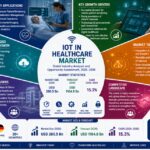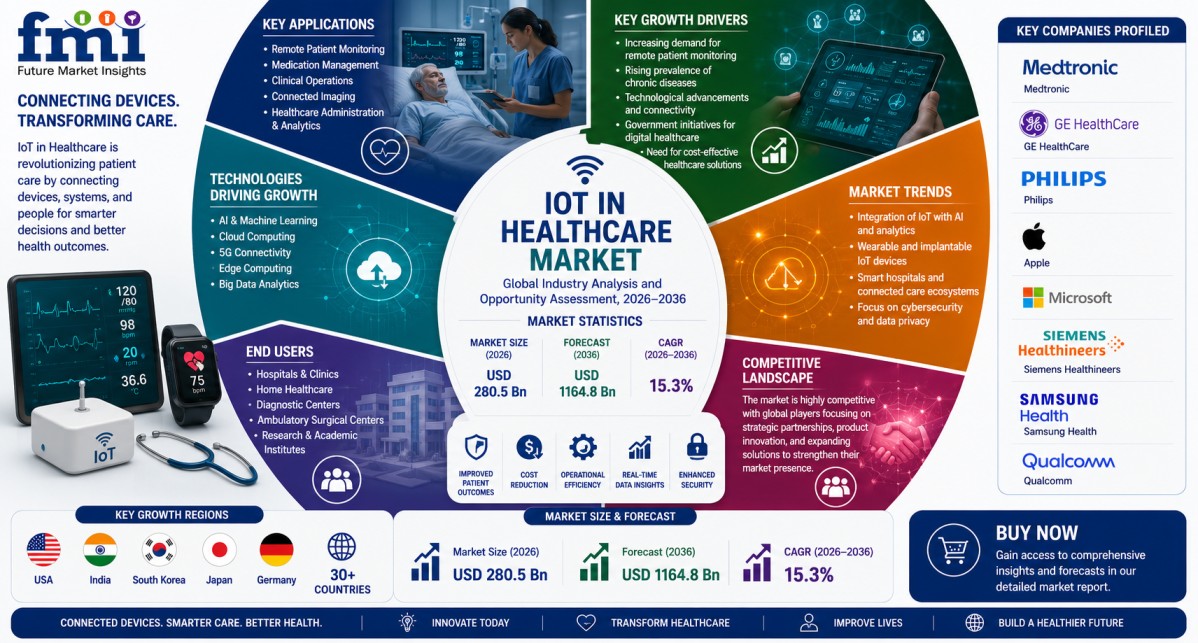
According to Future Market Insights (FMI), the global Internet of Things (IoT) in healthcare market is projected to increase from USD 280.5 billion in 2026 to USD 1,164.8 billion by 2036, registering a compound annual growth rate (CAGR) of 15.3%. The market is expected to generate an incremental opportunity of USD 884.3 billion over the forecast period as healthcare providers expand connected medical infrastructure, deploy remote monitoring solutions and integrate digital technologies into clinical and operational workflows.
Demand for IoT in healthcare is being supported by the growing use of connected medical devices, wearable health monitors, smart hospital systems and remote patient monitoring platforms. These technologies enable healthcare providers to collect and transmit patient and equipment data, support continuous monitoring and improve visibility across care delivery environments. The integration of cloud computing, artificial intelligence (AI), edge computing and advanced connectivity is also creating opportunities for more responsive and data-driven healthcare services.
👉 Get Detailed Market Forecasts, Competitive Benchmarking, and Pricing Trends:
https://www.futuremarketinsights.com/reports/sample/rep-gb-14639
Key Market Takeaways
- Market size in 2026: USD 280.5 billion.
- Forecast value in 2036: USD 1,164.8 billion.
- Forecast CAGR:3% from 2026 to 2036.
- Incremental market opportunity: USD 884.3 billion over the forecast period.
- Leading product segment: IoT healthcare hardware, accounting for 46.0% of the product segment in 2026.
- Leading application segment: Telemedicine, projected to account for 32.0% of the market in 2026.
- Fastest-growing profiled country: India, with a projected 18.7% CAGR through 2036.
- Other profiled markets: South Korea at 16.4% CAGR, Germany at 14.0%, Japan at 8.2% and the United States at 7.0%.
Country Growth Outlook
FMI’s country-level analysis highlights differences in growth prospects across the profiled markets, reflecting variations in digital health investment, healthcare infrastructure, connected device adoption and government initiatives.
- India: Projected to grow at an 18.7% CAGR through 2036, supported by digital health initiatives, expanding telemedicine services, private healthcare investment and rising demand for remote patient monitoring.
- South Korea: Expected to register a 16.4% CAGR, driven by smart hospital programs, digital health infrastructure investment and the development of connected medical technologies.
- Germany: Forecast to expand at a 14.0% CAGR, supported by hospital digitalization, healthcare data infrastructure and growing integration of connected devices.
- Japan: Expected to record an 8.2% CAGR, with an aging population, remote care requirements and smart hospital investments supporting adoption.
- United States: Projected to grow at a 7.0% CAGR, supported by remote patient monitoring, connected care platforms and value-based healthcare initiatives.
These estimates represent selected country markets specifically highlighted in FMI’s forecast analysis and are not intended to constitute a complete ranking of all countries covered by the study.
IoT Healthcare Hardware Supports Market Expansion
IoT healthcare hardware is projected to account for 46.0% of the product segment in 2026, according to FMI. This category includes connected medical devices, wearable patient monitors, sensor-enabled clinical equipment and smart hospital infrastructure.
Connected devices such as cardiac monitors, insulin pumps, infusion systems, continuous glucose monitors, electrocardiogram (ECG) patches and pulse oximeters support the collection and transmission of health-related data. In clinical settings, connected equipment can also support asset tracking, environmental monitoring and facility management.
Healthcare organizations are evaluating these technologies to improve the availability of operational information, support remote observation of patients and connect devices with digital health platforms. The growing use of cloud-based systems and edge computing is also creating opportunities to process and analyze information across distributed healthcare environments.
However, successful implementation depends on device reliability, interoperability, cybersecurity, regulatory compliance and integration with existing clinical information systems. Healthcare providers must assess these requirements when selecting and deploying connected technologies.
Telemedicine and Remote Patient Monitoring Expand Application Opportunities
Telemedicine is projected to account for 32.0% of the IoT in healthcare market’s application segment in 2026. The segment reflects the growing role of connected technologies in extending healthcare services beyond conventional hospital and clinic settings.
IoT-enabled remote patient monitoring allows healthcare professionals to receive information from connected devices used in hospitals, outpatient facilities and patients’ homes. Depending on the device and clinical application, these systems can help monitor vital signs, glucose levels, cardiac rhythm and other health parameters.
The technology is particularly relevant to chronic disease management, post-discharge follow-up and ongoing patient observation. Connected monitoring solutions may help healthcare teams identify changes that warrant further assessment, although clinical decisions continue to depend on appropriate interpretation of data and established care protocols.
Other applications include clinical operations, healthcare asset management, telehealth services and supply chain monitoring. These use cases provide opportunities for technology providers to develop solutions that connect medical devices, healthcare information systems and operational platforms.
Healthcare Providers Drive Adoption of Connected Technologies
Healthcare providers represent a major end-user group in the IoT in healthcare market. Hospitals and clinics are deploying connected systems to support patient monitoring, equipment management and operational coordination.
IoT solutions can help healthcare organizations obtain information from multiple connected devices and make it available to authorized clinical and operational teams. In larger healthcare networks, connected infrastructure can also support visibility across multiple facilities and care locations.
Adoption decisions depend on implementation costs, compatibility with existing systems, clinical workflow requirements and the ability to protect sensitive patient information. Healthcare organizations must also consider staff training, ongoing maintenance and the technical resources needed to manage connected device networks.
The report examines the market across product, application, technology, end-user and deployment categories, reflecting the range of solutions and purchasing requirements in the healthcare IoT ecosystem.
Growth Drivers, Restraints and Opportunities
- Growth drivers: Increasing adoption of remote patient monitoring, rising investment in smart hospital infrastructure and the expansion of connected medical devices are supporting market growth. Digital health initiatives, chronic disease management requirements and advances in AI-enabled analytics are also encouraging healthcare organizations to explore connected care solutions.
- Market restraints: Cybersecurity risks, concerns about sensitive patient data and interoperability challenges can complicate implementation. Integrating devices from different manufacturers with existing healthcare IT systems may require additional investment, technical expertise and compliance planning.
- Market opportunities: Technology providers can address demand by developing interoperable connected devices, secure data platforms, AI-enabled analytics and solutions designed for remote care delivery. Growing healthcare infrastructure investment in India and other developing markets may create opportunities for providers of connected monitoring equipment and smart hospital technologies.
Industry Developments Identified by FMI
FMI’s market analysis highlights developments in connected medical devices and patient monitoring technology, including:
- Medtronic: Expansion of connected cardiac monitoring capabilities, including AI-supported arrhythmia detection and integration with hospital information systems.
- Philips: Development of patient monitoring platforms with broader wearable device integration to support continuity of care between hospitals and home settings.
These examples illustrate activity in the wider connected healthcare technology sector. They should be interpreted as developments cited in the report’s market analysis rather than a comprehensive account of all recent industry announcements.
Competitive Landscape
FMI identifies major participants across connected medical devices, healthcare technology platforms, diagnostic equipment and connectivity infrastructure.
Key companies profiled in the report include:
- Medtronic
- GE HealthCare
- Philips
- Apple
- Microsoft
- Siemens Healthineers
- Samsung Health
- Qualcomm
The competitive landscape spans medical device manufacturers, technology companies and providers of connectivity infrastructure. Competitive positioning depends on connected device portfolios, platform capabilities, integration with clinical systems, regulatory compliance and geographic reach.
Healthcare customers also evaluate data security, reliability, technical support and compatibility with existing infrastructure. As connected healthcare systems expand, the ability to integrate devices and data platforms into clinical workflows is expected to remain an important consideration in supplier selection.
Access the Full Report: https://www.futuremarketinsights.com/reports/iot-in-healthcare-market
About the IoT in Healthcare Market Report
The FMI report analyzes the global IoT in healthcare market by product, application, technology, end user, deployment and region. Product categories include IoT healthcare hardware, software and services. Applications include remote patient monitoring, clinical operations, telehealth and supply chain management.
The study covers North America, Latin America, Western Europe, Eastern Europe, East Asia, South Asia and Pacific, and the Middle East and Africa. It includes country-level forecasts, market growth analysis and competitive assessments of key industry participants.
The report provides historical analysis and forecasts covering 2021 to 2036, with 2025 as the base year and 2026 to 2036 as the forecast period.
Related Reports:
- Digital Healthcare Market – https://www.futuremarketinsights.com/reports/digital-healthcare-market
- Healthcare Business Intelligence Market – https://www.futuremarketinsights.com/reports/healthcare-business-intelligence-market
- Real-Time E-Healthcare System Market – https://www.futuremarketinsights.com/reports/real-time-e-healthcare-system-market
About Future Market Insights (FMI)
Future Market Insights (FMI) is a global market intelligence and consulting firm providing comprehensive market research, competitive intelligence, and strategic business insights across industries. The firm delivers detailed forecasts, technology analysis, and data-driven recommendations that support informed decision-making for manufacturers, investors, distributors, and policymakers worldwide.
For Press & Corporate Inquiries
Rahul Singh
AVP – Marketing and Growth Strategy
Future Market Insights, Inc.
+91 8600020075
For Sales – sales@futuremarketinsights.com
For Media – Rahul.singh@futuremarketinsights.com
For Web – https://www.futuremarketinsights.com