

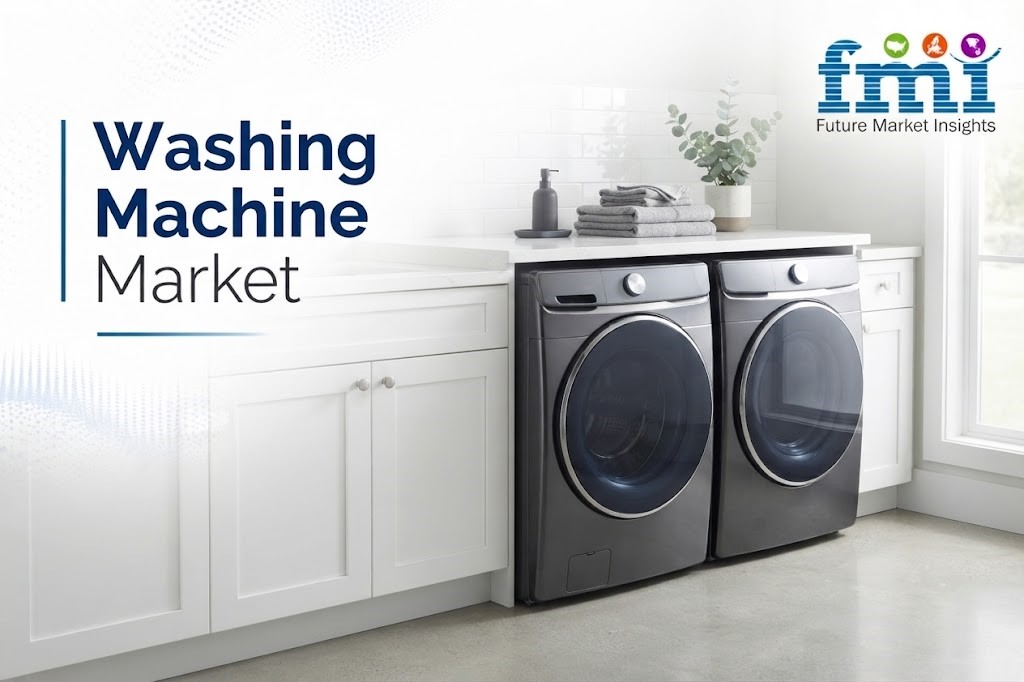
The global washing machine market is projected to grow from USD 72.22 billion in 2025 to USD 75.47 billion in 2026, reaching USD 117.20 billion by 2036, according to Future Market Insights (FMI). The market is expected to register a compound annual growth rate (CAGR) of 4.5% from 2026 to 2036, supported by demand for energy-efficient appliances, automatic washing machines, and larger-capacity models.
Washing Machine Market: Size and Growth Forecast
FMI’s latest washing machine market analysis highlights the following indicators:
- 2025 Market Size: USD 72.22 billion
- 2026 Estimated Market Size: USD 75.47 billion
- 2036 Projected Market Size: USD 117.20 billion
- CAGR (2026–2036): 4.5%
- Incremental Revenue Opportunity: USD 41.73 billion
- Market Expansion Multiple: 1.6x
The market outlook reflects steady demand across residential and commercial applications. Replacement purchases in mature economies and first-time appliance ownership in emerging markets will influence sales through 2036.
India is expected to record the fastest growth among the profiled countries, while Germany is projected to grow at the slowest rate. Manufacturers will need to balance product efficiency, capacity, and affordability to serve markets with different purchasing priorities.
Get detailed market forecasts, segment analysis, and competitive insights: https://www.futuremarketinsights.com/reports/sample/rep-gb-18754
Key Washing Machine Market Segments
Glass Door Models and Front Load Machines Lead
Glass door washing machines are expected to account for 58.6% of door-type sales in 2026, compared with an estimated 41.4% for sheet door models. Glass door designs are closely associated with front load machines, which hold a 54.2% share of product sales. Top load machines account for an estimated 45.8%.
Energy efficiency remains an important consideration in product development. Samsung Electronics announced a 9kg Bespoke AI Washer with an energy efficiency index of 18.2, compared with a Class A threshold of 52 for 9kg models in Europe.
Automatic Machines Maintain the Technology Lead
Automatic washing machines are projected to represent 71.8% of technology sales in 2026, while semi-automatic models account for an estimated 28.2%. Automatic machines appeal to households seeking convenient washing cycles and reduced manual intervention.
Capacity preferences are also evolving. Machines below 8 kg hold a 63.5% share in 2026, compared with an estimated 36.5% for machines above 8 kg. FMI identifies larger-capacity automatic machines with efficient motors as an important opportunity for manufacturers targeting buyers upgrading their household appliances.
Offline Retail Remains the Main Sales Channel
Offline retail is expected to account for 76.4% of washing machine sales in 2026, with online channels representing an estimated 23.6%. Physical stores allow consumers to compare product specifications, inspect appliance designs, and arrange installation. Online retailers can compete by improving product information, financing options, delivery, and installation services.
Residential applications dominate the market, representing 88.9% of sales in 2026. Commercial applications, including laundromats, hotels, and care facilities, account for an estimated 11.1%.
Regional Growth: India Leads Country-Level Forecasts
FMI projects different growth rates across its profiled national markets for 2026 to 2036:
- India: 9.0% CAGR, supported by first-time buyers, rising adoption of automatic machines, and demand for larger capacities.
- United Kingdom: 8.8% CAGR, reflecting replacement demand and upgrades to higher-rated front load machines.
- United States: 8.7% CAGR, supported by replacement purchases and demand for larger-capacity models.
- Japan: 8.4% CAGR, with compact machines and washer-dryers serving household needs.
- Germany: 3.0% CAGR, reflecting a mature, replacement-led market.
India’s growth outlook is also influenced by the Bureau of Energy Efficiency’s Appliance Labelling Regulations, 2025, notified on July 10, 2025. In the United States, the Department of Energy proposed changes to amended residential clothes washer water-use standards on May 16, 2025. These regulatory developments form part of the operating environment for appliance manufacturers.
Major Market Trends and Growth Drivers
Energy efficiency and product innovation: Manufacturers are developing efficient motors, improved washing programmes, and connected features. These technologies can help brands differentiate products while addressing consumer interest in running costs.
Replacement demand and first-time ownership: Mature markets depend heavily on replacement cycles, which FMI identifies as typically spanning 8 to 12 years. Emerging markets such as India offer additional demand from households purchasing washing machines for the first time.
Capacity upgrades: Demand for machines with capacities of 8 kg and above creates opportunities for brands offering efficient, larger-drum models. LG Electronics India reported Home Appliances and Air Solution revenue of ₹55.77 billion in Q1 FY27, up 13.6%, and highlighted demand for larger-capacity washing machines.
Cost and market pressures: Tariffs, higher input costs, price sensitivity, and weak housing activity can constrain premium appliance sales. Manufacturers must balance product improvements with competitive pricing.
Competitive Landscape: Top Washing Machine Companies
The washing machine market includes established multinational manufacturers and regional producers competing through product efficiency, pricing, capacity options, and distribution.
Key companies profiled by FMI include:
- Haier Group
- Whirlpool Corporation
- Samsung Electronics
- LG Electronics
- Bosch
- Electrolux
- Panasonic Corporation
- Midea Group
- Hitachi Appliances
- TCL Corporation
- Hisense
- Godrej and Boyce
- IFB Industries
- Beko (Arcelik)
Competitive priorities include expanding efficient product ranges, introducing connected features, and developing models suited to local purchasing preferences. Manufacturers serving India may focus on accessible automatic machines and larger capacities, while established European markets place importance on replacement demand and energy ratings.
Analyst Perspective
“The 8 kg and larger automatic front loader with an efficient motor is the clearest growth opportunity I see in washing machines through 2036. Brands that bring top label ratings to mid-priced models in India and the USA will capture the next wave of replacement and first-time buyers.”
— Rahul Pandita, Principal Consultant, Future Market Insights
About Future Market Insights (FMI)
Future Market Insights (FMI) is an ESOMAR-certified market research and consulting organization providing market intelligence, industry analysis, and strategic insights across sectors including food and beverage, healthcare, chemicals, technology, packaging, consumer goods, and industrial markets. FMI serves clients globally, with its headquarters in Delaware and offices in the United Kingdom, the United Arab Emirates, and India.
Media Contact:
Corporate Communications Team
Future Market Insights (FMI)
Email: sales@futuremarketinsights.com
Phone: +1-347-918-3531
Official Report Page: Washing Machine Market — Future Market Insights