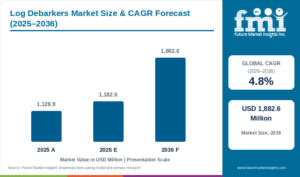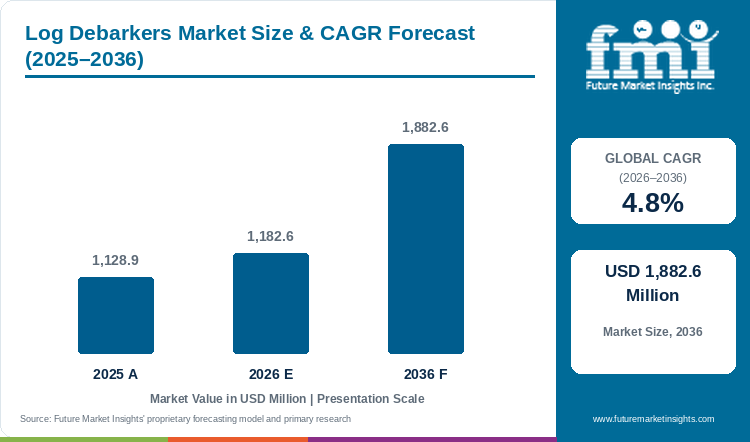
The global log debarkers market is projected to grow from USD 1,128.9 million in 2025 to USD 1,182.6 million in 2026, reaching USD 1,882.6 million by 2036, at a compound annual growth rate (CAGR) of 4.8%. Market growth is supported by investments in sawmill and wood-processing capacity, rising emphasis on lumber recovery, and the need for consistent bark removal before logs enter downstream processing.
Ring debarkers are expected to account for 31.0% of debarker type revenue in 2026, while medium logs are projected to represent 39.0% of log size demand. Sawmills are anticipated to lead end-use demand with a 34.0% share. These segments highlight the importance of effective log preparation, compatibility with common feed systems, and maintaining production line efficiency.
Get detailed market forecasts, competitive benchmarking, and technology trends: https://www.futuremarketinsights.com/reports/sample/rep-gb-35655
Sawmill Investment Supports Log Debarker Demand
Log debarkers remove bark from harvested logs before they move into sawing and other wood-processing stages. Effective debarking helps prepare logs for further processing and can support consistent material handling throughout a sawmill’s production line.
Bark removal is an important part of log preparation because damage to usable wood fiber can affect saleable lumber recovery. In addition, inconsistent preparation can create operational challenges for downstream equipment and disrupt production flow.
Several factors are shaping market demand:
- Sawmill modernization: Investments in wood-processing facilities can increase demand for equipment used in primary log preparation.
- Lumber recovery: Effective debarking can help reduce avoidable loss of usable wood before sawing.
- Production line efficiency: Consistent log preparation supports smoother movement through downstream processing stages.
- Feed system compatibility: Debarker selection must match log dimensions, feed arrangements, and processing requirements.
- Wood-processing capacity expansion: New and upgraded facilities create opportunities for equipment suppliers serving primary timber processing.
For mill operators, the value of a debarker depends on the characteristics of incoming logs, processing volumes, bark removal requirements, and the configuration of the wider production line.
Where the Log Debarkers Market Is Headed
The log debarkers market is forecast to expand from USD 1,182.6 million in 2026 to USD 1,882.6 million by 2036, registering a CAGR of 4.8%. The projected growth reflects continued demand for equipment that supports efficient log preparation and the processing requirements of sawmills.
The market is also expected to benefit from investment in primary wood-processing capacity. When mills expand or upgrade their operations, equipment decisions often consider how each stage of processing affects overall throughput, product quality, and operating costs.
Log debarkers work alongside other sawmill equipment, including headrig systems and board edgers. Coordinating the performance and capacity of these machines can help mills manage production flow and reduce bottlenecks.
For suppliers, the opportunity lies in offering equipment suited to different log sizes, feed systems, and operating requirements, supported by clear technical specifications and maintenance guidance.
What Leads the Market?
Ring Debarkers Account for 31.0% of Debarker Type Revenue
Ring debarkers are expected to hold a 31.0% share of debarker type revenue in 2026. Their projected position reflects the importance of controlled bark removal in sawmill operations, where logs need to be prepared before entering the sawing process.
Selecting a debarker requires consideration of the log characteristics, required bark removal performance, processing capacity, and integration with the existing line. Mills must also evaluate how the equipment handles their expected mix of log dimensions and operating conditions.
For manufacturers, clearly communicating equipment capacity, application suitability, and integration requirements can help sawmills compare solutions and select equipment that fits their production needs.
Medium Logs Represent 39.0% of Log Size Demand
Medium logs are projected to account for 39.0% of demand by log size in 2026. This segment is supported by compatibility with common feed systems, making the ability to process frequently handled log dimensions an important equipment consideration.
Log size influences machine configuration, feeding arrangements, and processing requirements. A debarker must be suitable for the dimensions and characteristics of the logs entering the facility to support consistent operation.
Suppliers that provide suitable configurations for common log sizes can address the needs of sawmills seeking to balance processing efficiency with equipment flexibility.
Sawmills Lead with 34.0% of End-Use Demand
Sawmills are projected to represent 34.0% of log debarker end-use demand in 2026. Debarking is an important preparatory stage because the condition of logs before sawing can influence lumber recovery and the performance of downstream equipment.
For sawmill operators, consistent log preparation can support production planning and help reduce disruptions associated with material handling. Equipment selection therefore needs to account for the relationship between debarking capacity, sawing throughput, and overall line performance.
The segment’s leading share underscores the importance of supplying solutions that meet the operating requirements of primary wood-processing facilities.
The Challenge: Balancing Bark Removal, Wood Recovery, and Throughput
Despite steady market growth prospects, sawmills must ensure that debarking equipment is suited to the logs being processed and the performance requirements of the wider production line.
Key considerations include:
- Wood recovery: Equipment should remove bark while limiting unnecessary damage to usable wood fiber.
- Log size variability: Differences in log diameter, length, and shape can affect feeding and processing requirements.
- Production throughput: Debarker capacity must align with upstream log handling and downstream sawing equipment.
- Equipment integration: Installation and operation should fit the mill’s existing feed systems and production layout.
- Maintenance and uptime: Inspection, servicing, and timely maintenance are important for dependable operation.
- Operating costs: Buyers must assess equipment investment alongside maintenance, energy use, labor, and potential production benefits.
A thorough evaluation of log characteristics, processing volumes, and production line requirements can help mill operators select equipment that supports their operational objectives.
What This Means for Log Debarker Manufacturers and Sawmill Operators
The market outlook suggests that log preparation will remain an important investment area as sawmills seek to improve processing efficiency and manage the quality of incoming material.
For manufacturers and suppliers:
- Develop debarking solutions suited to different log sizes and feed configurations.
- Provide clear specifications for processing capacity and application requirements.
- Emphasize controlled bark removal and protection of usable wood fiber.
- Support customers with installation planning, maintenance guidance, and technical service.
- Help sawmills evaluate equipment integration within their existing production lines.
For sawmill operators and buyers:
- Assess log dimensions and variability before choosing a debarker.
- Match debarking capacity with the throughput of downstream sawing equipment.
- Evaluate how bark removal affects lumber recovery and production consistency.
- Include maintenance and operating requirements in total cost assessments.
- Consider equipment compatibility when expanding or modernizing wood-processing facilities.
These priorities can help mills make informed equipment decisions while enabling suppliers to address the specific requirements of primary wood processing.
Analyst View
The log debarkers market is projected to grow at a CAGR of 4.8% through 2036, supported by investment in sawmill capacity and the need for efficient log preparation. The projected 31.0% share for ring debarkers, 39.0% share for medium logs, and 34.0% share for sawmills highlight the importance of debarker configuration, log size compatibility, and primary wood-processing applications.
For market participants, the key opportunity lies in helping sawmills achieve reliable bark removal while maintaining wood recovery and production line efficiency. Equipment performance, compatibility, and maintenance support will remain important considerations in purchasing decisions.
Get the Complete Story—Read More About Our Latest Report: https://www.futuremarketinsights.com/reports/log-debarkers-market
For detailed market estimates, forecast analysis, segment insights, and competitive information, explore Future Market Insights’ Log Debarkers Market report.
Related Reports:
Low Voltage Commercial Electric Boiler Market- https://www.futuremarketinsights.com/reports/low-voltage-commercial-electric-boiler-market
Low Voltage Electric Boiler Market- https://www.futuremarketinsights.com/reports/low-voltage-electric-boiler-market
Low Vibration Thermostat Market- https://www.futuremarketinsights.com/reports/low-vibration-thermostat-market
About Future Market Insights
Future Market Insights, Inc. (FMI) is an ESOMAR-certified market research and consulting firm headquartered in Delaware, USA, with offices in the United Kingdom, the United Arab Emirates and India. FMI delivers syndicated and custom research across food and beverage, healthcare, chemicals, technology, packaging, consumer goods and industrial sectors.
For Press & Corporate Inquiries
Rahul Singh
AVP – Marketing and Growth Strategy
Future Market Insights, Inc.
+91 8600020075
For Sales: sales@futuremarketinsights.com
For Media: Rahul.singh@futuremarketinsights.com
For Web: https://www.futuremarketinsights.com/