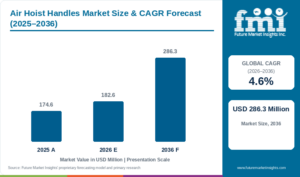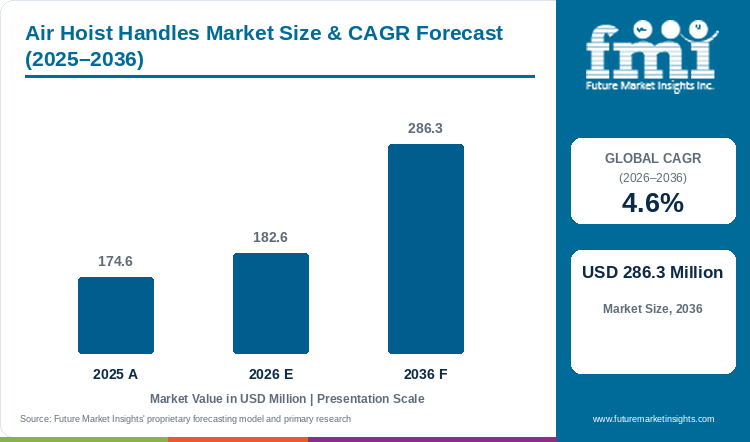
The global air hoist handles market is projected to grow from USD 174.6 million in 2025 to USD 182.6 million in 2026, reaching USD 286.3 million by 2036, at a compound annual growth rate (CAGR) of 4.6%. Market growth is supported by industrial activity, manufacturing facility expansion, and the need to maintain reliable pneumatic hoist controls in lifting operations.
Pendant control handles are projected to account for 36.0% of handle type demand in 2026. Within their respective segments, the 0.5–2 ton capacity category is expected to represent 42.0% of demand, while steel is projected to account for 31.0% of the material segment. These figures highlight the importance of control accessibility, suitable lifting capacity, and durable materials in industrial handling environments.
Get detailed market forecasts, competitive benchmarking, and technology trends: https://www.futuremarketinsights.com/reports/sample/rep-gb-35649
Industrial Activity Supports Air Hoist Handle Demand
Air hoist handles are used to control pneumatic lifting equipment, allowing operators to manage lifting movements and, depending on the control configuration, hoist speed and stopping functions. Because these controls are regularly handled during lifting operations, wear, damage, and maintenance requirements can create replacement demand.
Manufacturing facilities and other industrial environments rely on material handling equipment to move loads during production, assembly, maintenance, and related activities. As facilities expand or maintain existing equipment, replacement handles and compatible control components remain important for supporting reliable operation.
Several factors are shaping market demand:
- Manufacturing facility expansion: Investment in industrial assets can increase the installed base of lifting and material handling equipment.
- Replacement requirements: Frequently used controls may require inspection, servicing, or replacement due to wear and operating conditions.
- Operational reliability: Suitable handles and control components help operators manage pneumatic hoists during lifting activities.
- Equipment compatibility: Buyers need components that match existing valves, hoses, and control layouts.
The choice of replacement handle depends on the hoist model, lifting application, control configuration, and manufacturer’s specifications.
Where the Air Hoist Handles Market Is Headed
The market is forecast to expand from USD 182.6 million in 2026 to USD 286.3 million by 2036, registering a CAGR of 4.6%. This growth outlook reflects the continued need for compatible control components across industrial lifting applications.
Air hoist handles are relatively small components within a broader material handling system, but their function is directly connected to operator interaction and equipment control. Buyers therefore need to consider more than the purchase price when selecting replacements. Compatibility with the installed hoist, control response, operating environment, and maintenance requirements can all influence purchasing decisions.
For suppliers, the opportunity lies in providing suitable replacement parts, accurate technical documentation, and product support that helps maintenance teams identify the correct components for existing equipment.
What Leads the Market?
Pendant Control Handles Account for 36.0% of Handle Type Demand
Pendant control handles are projected to represent 36.0% of air hoist handle type demand in 2026. These controls allow operators to issue commands through a handheld or suspended control arrangement, depending on the equipment design.
Their role in directing hoist movements makes suitability and usability important considerations. Buyers must ensure that the selected handle matches the hoist’s control system and supports the required operating functions.
For manufacturers and distributors, clear product identification and documentation can help maintenance teams select replacement handles without compromising compatibility with existing equipment.
The 0.5–2 Ton Category Represents 42.0% of Its Segment
The 0.5–2 ton capacity category is projected to account for 42.0% of its parent segment in 2026. This highlights the relevance of air hoist applications within the specified lifting-capacity range.
The appropriate handle and control arrangement must match the hoist’s rated capacity and intended use. Lifting capacity alone does not determine handle compatibility; buyers must also verify the model, control system, and manufacturer’s requirements.
Suppliers that provide accurate compatibility information can help industrial customers reduce purchasing errors and streamline maintenance activities.
Steel Accounts for 31.0% of Material Demand
Steel is projected to represent 31.0% of the material segment in 2026. Material selection can influence durability, resistance to operating conditions, weight, and the suitability of a handle for its intended environment.
Industrial buyers must consider how a handle will be used, including frequency of operation and exposure to dust, moisture, impact, or other workplace conditions. The material should be assessed alongside the handle’s design and the requirements of the complete hoist control system.
For manufacturers, consistent material quality and clearly stated product specifications can support purchasing confidence and maintenance planning.
The Challenge: Compatibility, Wear, and Safe Operation
Despite steady growth prospects, air hoist handle suppliers face practical challenges related to replacement selection and equipment maintenance. A handle that appears similar to an existing component may not be suitable if its control functions, connections, or configuration differ.
Key considerations include:
- Control compatibility: Replacement handles must match the hoist’s control system, valves, hoses, and connection requirements.
- Wear and maintenance: Frequent use can make routine inspection and timely replacement important.
- Operating environment: Material and design selection should reflect workplace conditions and expected handling demands.
- Documentation: Technical specifications and model identification help buyers verify that a replacement component is appropriate.
- Operational safety: Controls must be selected, installed, inspected, and maintained in accordance with the equipment manufacturer’s instructions and applicable safety requirements.
- Procurement efficiency: Accurate part identification can reduce delays caused by ordering incompatible components.
Manufacturers and distributors can help address these challenges by maintaining clear product catalogues, providing compatibility guidance, and supporting customers during replacement planning.
What This Means for Air Hoist Handle Manufacturers and Industrial Buyers
The market outlook points to ongoing demand for air hoist handles as industrial operators maintain lifting equipment and replace components subject to regular use.
For manufacturers and suppliers:
- Offer product ranges compatible with clearly identified hoist models and control configurations.
- Provide detailed specifications for connections, materials, and operating functions.
- Support distributors and maintenance teams with accurate part identification.
- Emphasize durability and suitability for the intended industrial environment.
- Maintain dependable availability of commonly required replacement components.
For industrial buyers and maintenance teams:
- Confirm the hoist model and manufacturer specifications before ordering replacement handles.
- Inspect controls regularly and replace worn or damaged parts as required.
- Verify compatibility with valves, hoses, and the installed control arrangement.
- Consider operating conditions and maintenance requirements when comparing products.
- Follow manufacturer instructions and applicable safety procedures during installation and use.
These practices can help industrial facilities manage replacement needs while maintaining appropriate control functionality across their pneumatic lifting equipment.
Analyst View
The air hoist handles market is projected to grow at a 4.6% CAGR through 2036, supported by industrial equipment requirements and ongoing demand for compatible replacement components. The market’s outlook reflects the importance of maintaining reliable controls within material handling operations.
The projected 36.0% share for pendant control handles, 42.0% share for the 0.5–2 ton capacity category, and 31.0% share for steel highlight important product and material considerations. For market participants, product compatibility, clear documentation, and reliable replacement support will remain central to serving industrial customers.
Get the Complete Story—Read More About Our Latest Report: https://www.futuremarketinsights.com/reports/air-hoist-handles-market
For detailed market estimates, forecast analysis, segment insights, and competitive information, explore Future Market Insights’ Air Hoist Handles Market report.
Related Reports
Biomass Boiler Market
https://www.futuremarketinsights.com/reports/biomass-boiler-market
Industrial Cooling Systems Market: https://www.futuremarketinsights.com/reports/industrial-cooling-systems-market
Ductless Heating & Cooling Systems Market: https://www.futuremarketinsights.com/reports/ductless-heating-and-cooling-systems-market
About Future Market Insights
Future Market Insights, Inc. (FMI) is an ESOMAR-certified market research and consulting firm headquartered in Delaware, USA, with offices in the United Kingdom, the United Arab Emirates and India. FMI delivers syndicated and custom research across food and beverage, healthcare, chemicals, technology, packaging, consumer goods and industrial sectors.
For Press & Corporate Inquiries
Rahul Singh
AVP – Marketing and Growth Strategy
Future Market Insights, Inc.
+91 8600020075
For Sales: sales@futuremarketinsights.com
For Media: Rahul.singh@futuremarketinsights.com
For Web: https://www.futuremarketinsights.com/