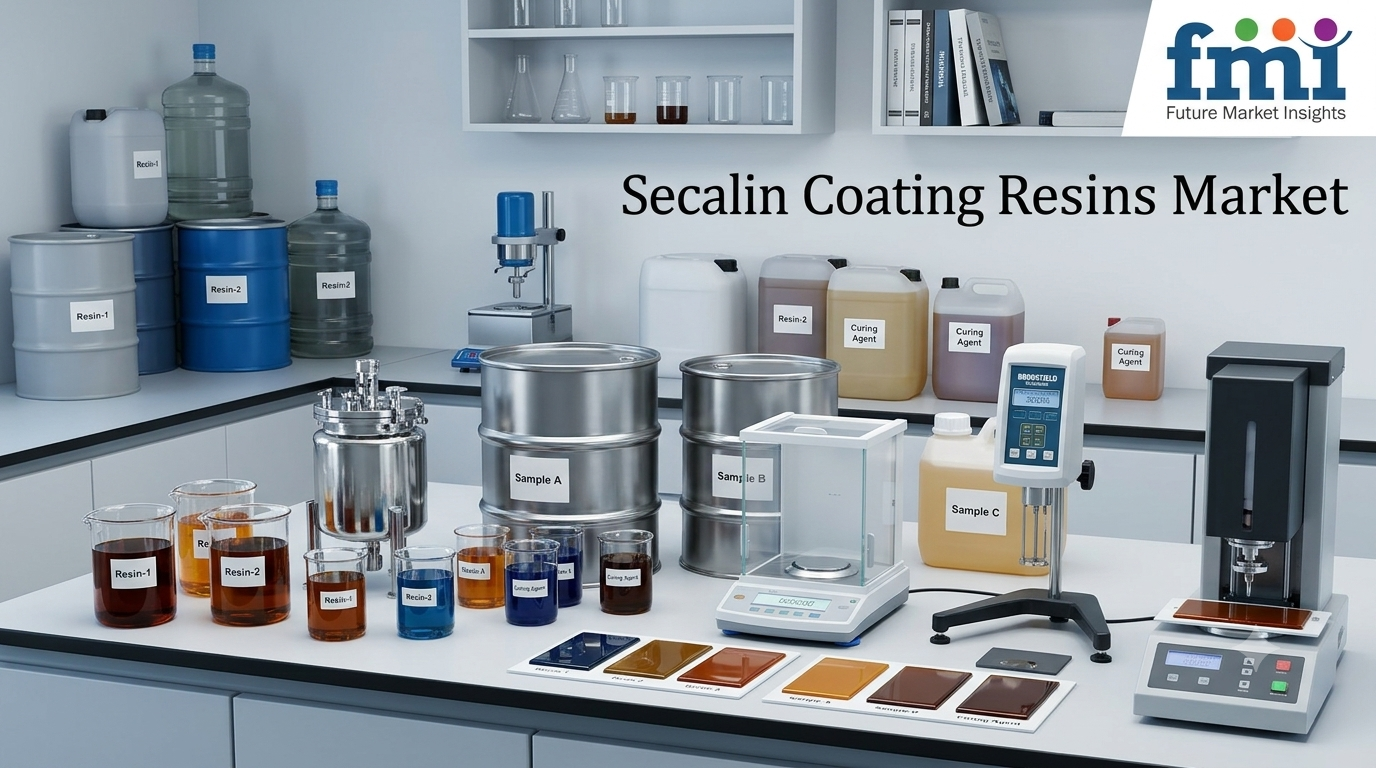
The global secalin coating resins market is projected to increase from USD 14.8 million in 2026 to USD 35.7 million by 2036, registering a compound annual growth rate (CAGR) of 9.2% over the forecast period, according to Future Market Insights (FMI). The market was valued at USD 13.5 million in 2025 and is expected to generate an additional USD 20.9 million in market value between 2026 and 2036.
Secalin coating resins are derived from secalin, a storage protein found in rye. Their film-forming properties offer potential applications in agricultural seed treatments, nutraceutical tablet coatings, specialty paper sizing and controlled-release fertilizer coatings. As manufacturers explore alternatives to conventional synthetic polymers, rye-based resins are gaining attention for their potential to support biodegradable coating formulations.
What Is Driving the Secalin Coating Resins Market?
Regulatory changes, agricultural applications and the use of grain-processing by-products are shaping demand for secalin coating resins.
The European Union’s restrictions on synthetic polymer microparticles under Commission Regulation (EU) 2023/2055, which includes a transition affecting certain seed coatings from October 17, 2028, are encouraging formulators to assess alternative coating materials. Rye-based protein binders offer a potential route to developing soil-degradable coatings for treated seeds and fertilizer products.
Integrated grain biorefineries also present a supply opportunity. Facilities processing rye for bioethanol and other products can explore the recovery of secalin from grain-processing streams, linking coating resin production with existing agricultural processing infrastructure.
In pharmaceutical and nutraceutical applications, secalin formulations may offer alternatives to shellac and selected synthetic enteric coating materials. However, commercial adoption depends on formulation performance, processing economics and application-specific qualification.
Which Segments Lead the Secalin Coating Resins Market?
FMI identifies five leading segments for 2026:
- Secalin molecular class: Gamma-75k Secalin Enriched Resins are projected to account for 44.6% of the segment.
- Formulation system: Aqueous-Alcoholic Spray Dispersions are estimated to hold a 51.4% share.
- End-use application: Microplastics-Free Seed Coatings are expected to account for 39.9%.
- Purity grade: Technical Agricultural & Paper Grade is forecast to represent 62.2%.
- Sales channel: Direct Grain Biorefinery B2B Supply is anticipated to account for 53.4%.
These segment forecasts point to opportunities in seed treatment, specialty paper coatings and industrial protein processing. Gamma-75k formulations are associated with film strength, while aqueous-alcoholic dispersions support the extraction and application of rye proteins.
Which Countries Offer the Strongest Growth Opportunities?
China is projected to record the fastest growth among the evaluated national markets, while Germany and Poland are positioned for expansion through their rye-processing and agricultural coating industries.
China’s outlook is supported by hybrid corn and vegetable seed pelleting, alongside opportunities in nutraceutical and probiotic tablet coatings.
Germany benefits from rye biorefinery infrastructure and seed-treatment demand. Poland’s domestic rye supply supports potential applications in agricultural binders and controlled-release fertilizer coatings. Sweden offers opportunities through cereal biorefinery integration and specialty paper applications.
In the USA, demand may develop through agricultural seed treatments and plant-derived nutraceutical coatings. France, Canada and the UK present additional opportunities in seed enhancement, grain processing and pharmaceutical coating formulations.
Top Companies in the Secalin Coating Resins Market
FMI identifies eight notable companies and industry participants in the secalin coating resins market:
- Verbio SE
- Lantmännen Biorefineries
- Croda International plc (Incotec)
- GoodMills Group GmbH (GoodMills Innovation)
- Crespel & Deiters Group
- Colorcon, Inc.
- Sensient Technologies Corporation
- Novonesis
The competitive landscape includes grain biorefineries, cereal processors, agricultural seed-coating specialists, pharmaceutical coating suppliers and industrial enzyme companies.
Verbio SE and Lantmännen Biorefineries are associated with rye processing and integrated biorefinery operations. GoodMills Group and Crespel & Deiters Group participate in the grain-processing and plant-protein supply ecosystem.
Croda International’s Incotec platform and Sensient Technologies are identified in the agricultural and specialty coating category. Colorcon is associated with pharmaceutical coating applications, while Novonesis provides enzyme technologies relevant to grain fractionation and processing.
These companies operate across different parts of the value chain. Their inclusion does not establish that every company currently sells commercial secalin coating resins, nor does it imply a ranking by market share.
Key Industry Developments
FMI highlights the following developments as relevant to the wider supply chain and coating market:
- September 2025: Verbio SE’s 2024/2025 Annual Report described operations and co-product valorization at its rye biorefineries in Schwedt and Zörbig, Germany.
- February 2025: Lantmännen reported cereal biorefinery and plant-protein fractionation investments associated with its Norrköping and Lidköping facilities in Sweden.
- September 2025: Mondi and European specialty paper converters were reported to be expanding aqueous biopolymer barrier-sizing applications in response to paper recyclability requirements.
These developments provide context for grain fractionation, plant-protein recovery and specialty paper coating opportunities. They should not be interpreted as direct evidence of secalin-specific commercial sales.
Business Outlook: What Should Manufacturers and Investors Monitor?
Companies assessing the secalin coating resins market should focus on three priorities.
Secure reliable feedstock supplies. Partnerships with rye processors and integrated biorefineries may improve access to suitable protein fractions and help manage raw material costs.
Optimize extraction and formulation. Rye proteins must be separated from other grain components, including water-binding arabinoxylans. Process improvements and enzyme-assisted extraction could help address viscosity and filtration challenges.
Prioritize application-specific testing. Agricultural seed binders require suitable adhesion, abrasion resistance and soil degradation. Pharmaceutical applications require separate evaluation of coating stability, dissolution and relevant quality standards.
The market’s growth potential will depend on manufacturers’ ability to translate the properties of rye proteins into consistent commercial formulations while managing extraction costs and application qualification.
Analyst Perspective
Nikhil Kaitwade, Principal Consultant at Future Market Insights, states:
“With the European Union banning non-biodegradable synthetic polymer microparticles in seed coatings from October 2028, agrochemical formulators need a tough, water-resistant bio-binder that will not clog spray nozzles. Rye gamma-75k secalin recovered from Central European bioethanol side streams delivers the exact disulfide film tenacity and soil protease degradability required by hybrid seed breeders.”
Frequently Asked Questions
What is the projected size of the secalin coating resins market by 2036?
The market is forecast to reach USD 35.7 million by 2036, compared with USD 14.8 million in 2026.
What is the expected CAGR of the secalin coating resins market?
FMI projects a CAGR of 9.2% between 2026 and 2036.
Which country is expected to grow fastest?
China leads the eight listed national markets, with a projected CAGR of 10.2% through 2036.
Who are the key companies identified in the market?
The report identifies Verbio SE, Lantmännen Biorefineries, Croda International, GoodMills Group, Crespel & Deiters Group, Colorcon, Sensient Technologies and Novonesis.
Related Report:
https://www.openpr.com/news/4673546/top-players-in-the-vitrimer-resins-market-fmi-forecasts-us
https://www.openpr.com/news/4673552/top-players-in-the-suberin-waterproof-coatings-market-fmi
https://www.openpr.com/news/4673555/top-players-in-the-seed-hydration-coatings-market-fmi-forecasts
https://www.openpr.com/news/4673558/top-players-in-the-nitrogen-efficiency-biologics-market-fmi
About Future Market Insights
Future Market Insights (FMI) is an ESOMAR-certified market research and consulting firm providing syndicated, customized, investment, and social media research across industries, including food and beverage, healthcare, chemicals, technology, and consumer markets. FMI delivers market intelligence, competitive analysis, and strategic insights to help organizations evaluate emerging opportunities and make informed business decisions. The company has offices in the United States, the United Kingdom, the UAE, and India.
For Press & Corporate Inquiries
Rahul Singh
AVP – Marketing and Growth Strategy
Future Market Insights, Inc.
Phone: +91 8600020075
For Sales: sales@futuremarketinsights.com
For Media: Rahul.singh@futuremarketinsights.com
Website: https://www.futuremarketinsights.com/