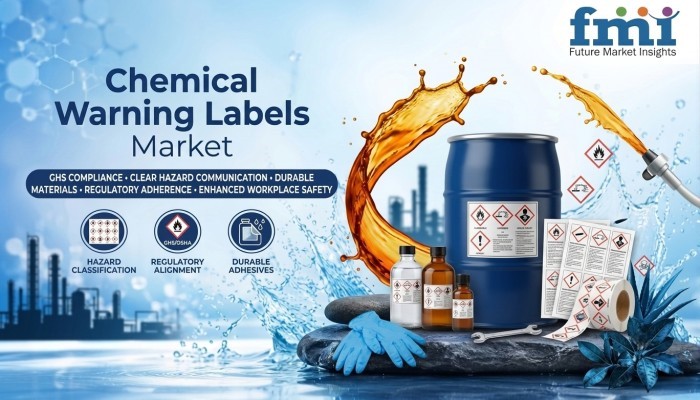
The global chemical warning labels market is projected to grow from USD 720.6 million in 2026 to USD 1,230.9 million by 2036, registering a compound annual growth rate (CAGR) of 5.5% over the forecast period, according to Future Market Insights (FMI). Demand is supported by recurring label revisions, workplace chemical safety requirements, and the need to maintain readable hazard information across containers, industrial packaging, and handling environments.
Regulatory updates are keeping label approval and replacement activity on procurement agendas. Chemical manufacturers and importers must coordinate hazard information, approved artwork, printing processes, and material performance. Requirements also differ across markets, making accurate label version control important for suppliers serving multiple jurisdictions.
Get detailed market forecasts, competitive benchmarking, and pricing trends:
https://www.futuremarketinsights.com/reports/sample/rep-gb-35496
KEY MARKET TAKEAWAYS
- Market Valuation: The chemical warning labels market is forecast to increase from USD 720.6 million in 2026 to USD 1,230.9 million by 2036.
- Growth Rate: The market is expected to expand at a CAGR of 5.5% from 2026 to 2036.
- Leading Label Type: GHS hazard labels are projected to account for 34.0% of the label type segment in 2026.
- Fastest-Growing Country: Brazil is forecast to record the highest country-level growth among the profiled markets, at a 5.9% CAGR.
- Core Growth Driver: Changes to chemical hazard communication requirements generate recurring demand for updated warning content and replacement labels.
INDUSTRY SHIFTS & MARKET DYNAMICS
Regulatory compliance remains a central source of demand for chemical warning labels. Manufacturers need to update labels when hazard classifications, required statements, or other warning information changes. OSHA’s January 15, 2026, update to the compliance dates for its revised Hazard Communication Standard has prompted chemical makers and importers to review label requirements and replacement schedules. The UNECE Globally Harmonized System of Classification and Labelling of Chemicals, Revision 10, also reinforces the role of labels and safety data sheets in communicating chemical hazards.
Material selection is another important purchasing consideration. Polyester is projected to represent 29.0% of material demand in 2026 because its film strength helps preserve warning text during routine handling and exposure to moisture or splashes. Thermal transfer printing is expected to lead the printing method segment with a 31.0% share, supported by its ability to produce clear, variable information for changing label jobs. Chemical manufacturing is forecast to account for 31.0% of end-use demand, while industrial label suppliers are projected to hold a 36.0% share of sales channels.
However, qualification requirements can delay label changes. New warning text may require checks involving adhesives, films, print quality, and the surfaces on which labels are applied. Suppliers operating across jurisdictions must also control different approved content versions. Germany follows the European Union’s CLP framework, while Great Britain maintains its own GB CLP system. These differences create additional artwork and approval responsibilities for companies selling into both markets.
On-demand printing presents an opportunity to reduce obsolete inventory and shorten the transition to updated warning information. Approved templates, suitable label materials, and controlled print workflows can help manufacturers produce revised labels without replacing an entire stock of pre-printed material. Any efficiency gains still depend on compliance checks, material suitability, and documented approval processes.
REGIONAL MARKET SUMMARY
Country-level forecasts show differing growth rates across the profiled markets:
- Brazil: The market is projected to grow at a 5.9% CAGR through 2036, supported by chemical hazard labeling requirements under the country’s GHS-based workplace safety framework.
- Mexico: A 5.6% CAGR is forecast as industrial suppliers manage Spanish-language hazard communication under national requirements.
- United Kingdom: The market is expected to expand at a 5.2% CAGR. Suppliers must account for GB CLP requirements, particularly when products are also sold in the European Union.
- United States: The market is forecast to grow at a 4.9% CAGR, with revised Hazard Communication Standard requirements contributing to ongoing label review and replacement work.
- Germany: A 4.5% CAGR is projected as chemical suppliers maintain label content and language requirements under EU CLP rules.
ANALYST INSIGHTS
“Suppliers win repeat orders by handling rule changes and label strength together. Buyers save time by approving strong label stock that can take new artwork without full retesting,” stated Nandini Roy Choudhury, Principal Consultant at Future Market Insights.
The outlook highlights the commercial value of combining compliant label content with durable materials and controlled printing. Suppliers that help customers manage artwork revisions while preserving proven material performance can address recurring procurement needs across chemical manufacturing, laboratories, logistics, oil and gas, and pharmaceutical applications.
COMPETITIVE LANDSCAPE
The competitive landscape includes safety-label specialists, durable label-material suppliers, converters, and industrial printing providers. Key companies profiled in the market include Brady Corporation, Avery Dennison, 3M, CCL Industries, UPM Adhesive Materials, TSC Auto ID, SATO, Labelmaster, Seton, and Weber Packaging Solutions.
Competition spans hazard-label solutions, adhesive and film performance, and support for printing changing data. Brady Corporation and Labelmaster serve safety-label requirements, while Avery Dennison, 3M, CCL Industries, and UPM Adhesive Materials participate in label materials and converting. TSC Auto ID and SATO support industrial printing and automatic identification applications.
Developments during 2026 include UPM Adhesive Materials’ announcement of a cutting and distribution terminal near New Delhi in March, and Weber Packaging Solutions’ acquisition of AT Information Products in March. In August 2026, Brady Corporation completed its acquisition of Honeywell Technologies’ Productivity Solutions and Services business, adding mobile computing, scanning, RFID, and workflow software to its identification platform.
ABOUT THE REPORT
Future Market Insights’ Chemical Warning Labels Market report examines market size and forecasts for 2026 to 2036, with segmentation by label type, material, printing method, end use, sales channel, and region. It covers major markets including Brazil, Mexico, the United Kingdom, the United States, and Germany, alongside additional countries and regions. The report profiles key companies and evaluates market conditions using primary and secondary research, market triangulation, and data validation.
For more information on the full report, visit the Future Market Insights website and search for the Chemical Warning Labels Market report: https://www.futuremarketinsights.com/reports/chemical-warning-labels-market
FREQUENTLY ASKED QUESTIONS
Q: What is the projected size of the Chemical Warning Labels Market by 2036?
A: The market is valued at USD 720.6 million in 2026 and is projected to reach USD 1,230.9 million by 2036, growing at a CAGR of 5.5%.
Q: Which segment holds the leading market share?
A: GHS hazard labels are projected to lead the label type category, accounting for 34.0% of its share in 2026.
Q: Which country exhibits the highest growth rate?
A: Brazil is forecast to record the highest CAGR among the profiled countries, at 5.9% through 2036.
Q: Which material is expected to lead demand?
A: Polyester is projected to account for 29.0% of material demand in 2026, supported by its film strength and ability to preserve warning text during routine industrial use.
FMI Custom Research: Strategic Intelligence for Confident Decision-Making
In today’s rapidly evolving business environment, leadership teams need more than market data—they need clear, actionable intelligence tailored to their strategic objectives. FMI’s Custom Research solutions are designed around the specific business questions organizations need answered, enabling executives to evaluate growth opportunities, validate investments, assess competitive dynamics, and reduce uncertainty before making critical decisions. By combining deep industry expertise, primary research, and proprietary market intelligence, FMI delivers insights that help organizations move from assumptions to evidence-based strategies with greater speed and confidence.
Business Impact
FMI helps organizations transform market complexity into strategic clarity, enabling leadership teams to identify growth opportunities faster, optimize resource allocation, strengthen competitive positioning, and make high-stakes business decisions with confidence.
To explore how FMI Custom Research can support your strategic priorities, please connect with our team at – sales@futuremarketinsights.com
About Future Market Insights (FMI)
Future Market Insights, Inc. (FMI) is an ESOMAR-certified, ISO 9001:2015 market research and consulting organization, trusted by Fortune 500 clients and global enterprises. With operations in the U.S., UK, India, and Dubai, FMI provides data-backed insights and strategic intelligence across 30+ industries and 1200 markets worldwide.
Contact Us:
Future Market Insights Inc.
Christiana Corporate, 200 Continental Drive,
Suite 401, Newark, Delaware – 19713, USA
T: +1-347-918-3531
For Sales Enquiries: sales@futuremarketinsights.com
Website: https://www.futuremarketinsights.com
LinkedIn| Twitter| Blogs | YouTube