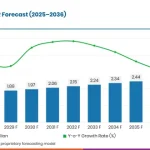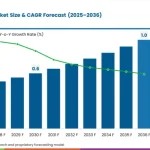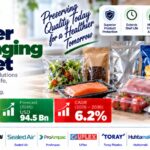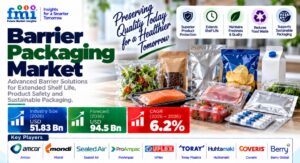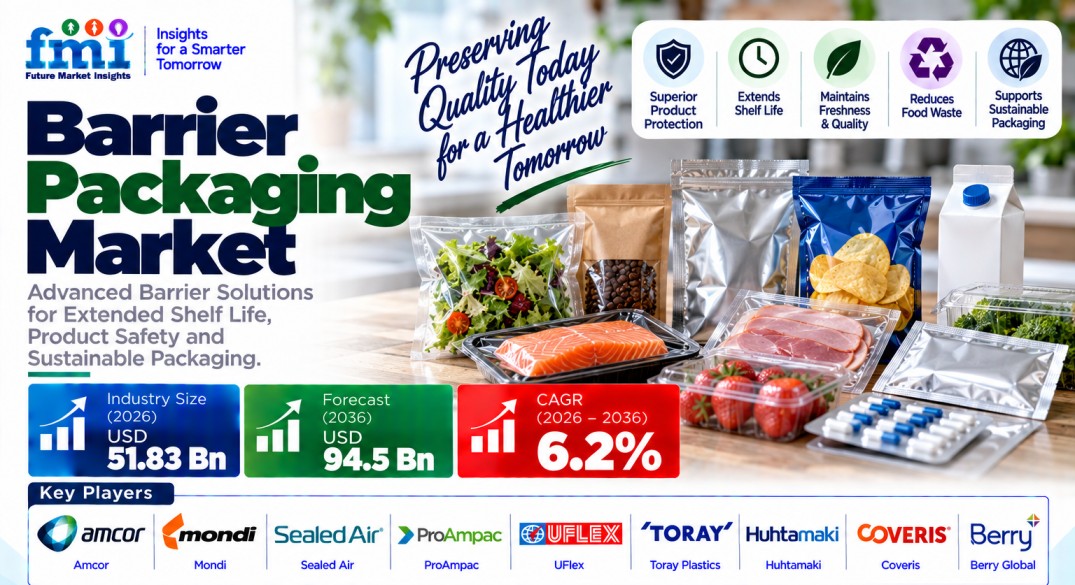
The global barrier packaging market is projected to grow from USD 51.83 billion in 2026 to USD 94.5 billion by 2036, registering a compound annual growth rate (CAGR) of 6.2%, according to Future Market Insights (FMI). The market was valued at USD 48.8 billion in 2025, with an incremental opportunity of USD 42.7 billion between 2026 and 2036.
The market is being shaped by two requirements that can be difficult to reconcile: protecting products from oxygen and moisture, and making packaging easier to recycle. Food and beverage applications are expected to account for 56.0% of demand in 2026, while plastic films are projected to hold a 47.0% share of the material segment. Converters are also developing mono-material films and coated paper formats to address recyclability requirements without compromising barrier performance.
Get Detailed Market Forecasts, Competitive Benchmarking, and Pricing Trends: https://www.futuremarketinsights.com/reports/sample/rep-gb-2146
Context: EU packaging rules raise the pressure to redesign
The European Union’s Packaging and Packaging Waste Regulation (EU) 2025/40 entered into force in February 2025 and generally applies from August 2026. The regulation sets a direction toward packaging that is recyclable in an economically viable way by 2030. For suppliers serving European food and pharmaceutical customers, that timetable makes packaging redesign an issue for current product development and future supply renewals.
The technical challenge is substantial. Multilayer films can provide reliable protection against oxygen, moisture and aroma loss, but combinations of bonded materials can be difficult to recover through conventional recycling systems. Mono-material films and coated paper structures offer alternatives, but must still meet product-specific barrier, sealing and processing requirements.
Food waste provides another reason to focus on packaging performance. The Food and Agriculture Organization of the United Nations (FAO) estimates that 13.2% of food is lost after harvest and before retail, while a further 19% is wasted at retail and household levels. These figures, cited in FMI’s report, underline the scale of the challenge; they do not mean packaging alone can prevent all such losses.
Where growth is fastest
China and India are projected to grow faster than the other countries listed in FMI’s country comparison. The published forecasts for 2026–2036 are:
China – 7.6% CAGR: Growth is linked to demand from processed-food manufacturers and pharmaceutical packaging operations, including moisture-resistant blister packs.India – 7.3% CAGR: Organized retail and processed-food distribution are expected to support demand. FMI also points to food-processing capacity and the movement of packaged products across long, warm distribution routes.United States – 6.9% CAGR: Food protection needs, waste-reduction priorities and state-level packaging rules are shaping material choices.Germany – 6.2% CAGR: Recyclability requirements are increasing pressure to redesign established mixed-material packaging structures.United Kingdom – 6.0% CAGR: Packaging tax treatment and demand for recyclable structures are influencing material selection and procurement costs.
What leads the market
FMI’s 2026 estimates show that flexible materials and food-related applications form the largest parts of the market.
Material type – Plastic films: 47.0%. Lightweight flexible structures provide moisture protection and can be designed for different barrier requirements.
Application – Food and beverage: 56.0%. Packaged food and chilled products need protection during storage, distribution and retail handling.
Packaging format – Pouches: 34.0%. Pouches support lower package weight and practical handling across high-volume retail applications.
Barrier type – High barrier: 41.0%. These structures are used where oxygen sensitivity and aroma loss require stronger protection during storage.
Sales channel – Direct supply: 58.0%. Large manufacturers often source directly to manage custom specifications, approvals and delivery requirements.
The hurdle: Protection, recyclability and cost must align
The main restraint is the cost and complexity of developing a film that meets both barrier and recovery requirements. Resin prices and coating costs put pressure on converters, particularly smaller manufacturers working with complex multilayer structures. Switching to another material may also require testing and approval before it can run reliably on existing packing lines.
EVOH and other high-performance barrier materials illustrate the trade-off: a structure may protect a product effectively but be harder to recycle when bonded to incompatible layers. Buyers need to consider the complete packaging construction, including the seal layer, coating, barrier material and intended recovery route. A recyclable claim alone does not establish that the pack will meet the required shelf-life or production specification.
Cost pressures also extend to materials such as aluminum foil. FMI’s report notes that changes in US aluminum tariffs have affected the economics of foil-based barrier packaging and can lead converters to revisit quotations or material designs.
Recent developments and industry investment
Developments in recyclable paper structures and high-speed film processing show how suppliers are approaching the performance-versus-recyclability challenge.
November 13, 2024 – Amcor: Amcor announced recognition for its recycle-ready coffee packaging in an innovation award programme. The development illustrates supplier work on packaging structures designed with recycling in mind.
February 18, 2026 – Mondi: Mondi published a case study on Prymat’s use of its recyclable ultra-high-barrier paper solution for spices. The paper-based format is designed to retain aroma protection while increasing the paper content of the pack.
Undated in the report summary – ProAmpac: FMI cites the RP-2000 High Barrier Series, tested on high-speed horizontal form-fill-seal (HFFS) lines running at up to 900 packs per minute. The example is relevant to food manufacturers assessing fiber-based barrier structures against existing production requirements.
FMI profiles Amcor, Mondi, Sealed Air, Huhtamaki, Berry Global, ProAmpac, UFlex, Toray Plastics and Coveris. These companies operate across barrier films, flexible packaging, coated materials and related packaging structures. Their inclusion reflects the competitive scope of the report and does not imply endorsement by FMI.
>> Access detailed market insights: https://www.futuremarketinsights.com/reports/brochure/rep-gb-2114
Analyst perspective
“Barrier packaging is becoming a specification decision for food and pharmaceutical manufacturers. Brand teams need shelf-life gains with credible recyclability. Resin movement and coating complexity raise conversion cost while validation records reduce approval risk for large accounts.”
— Nandini Roy Choudhury, Principal Consultant for Packaging at FMI
What this means for food and pharmaceutical packaging buyers
Define protection requirements before selecting a material. Specify the oxygen and moisture barrier needed for the product, its storage conditions and its distribution route. Use those requirements to compare multilayer films, mono-material structures and coated paper formats.
Validate recyclability and production performance together. Ask suppliers to document material composition and the intended recovery route. Then test sealing, line speed and package integrity on the equipment that will be used for production.
Build cost and approval time into supplier comparisons. Compare resin and coating costs, testing requirements, production compatibility and supply reliability. A lower-cost material may not be the better choice if it requires extensive line changes or cannot meet the product’s protection requirements.