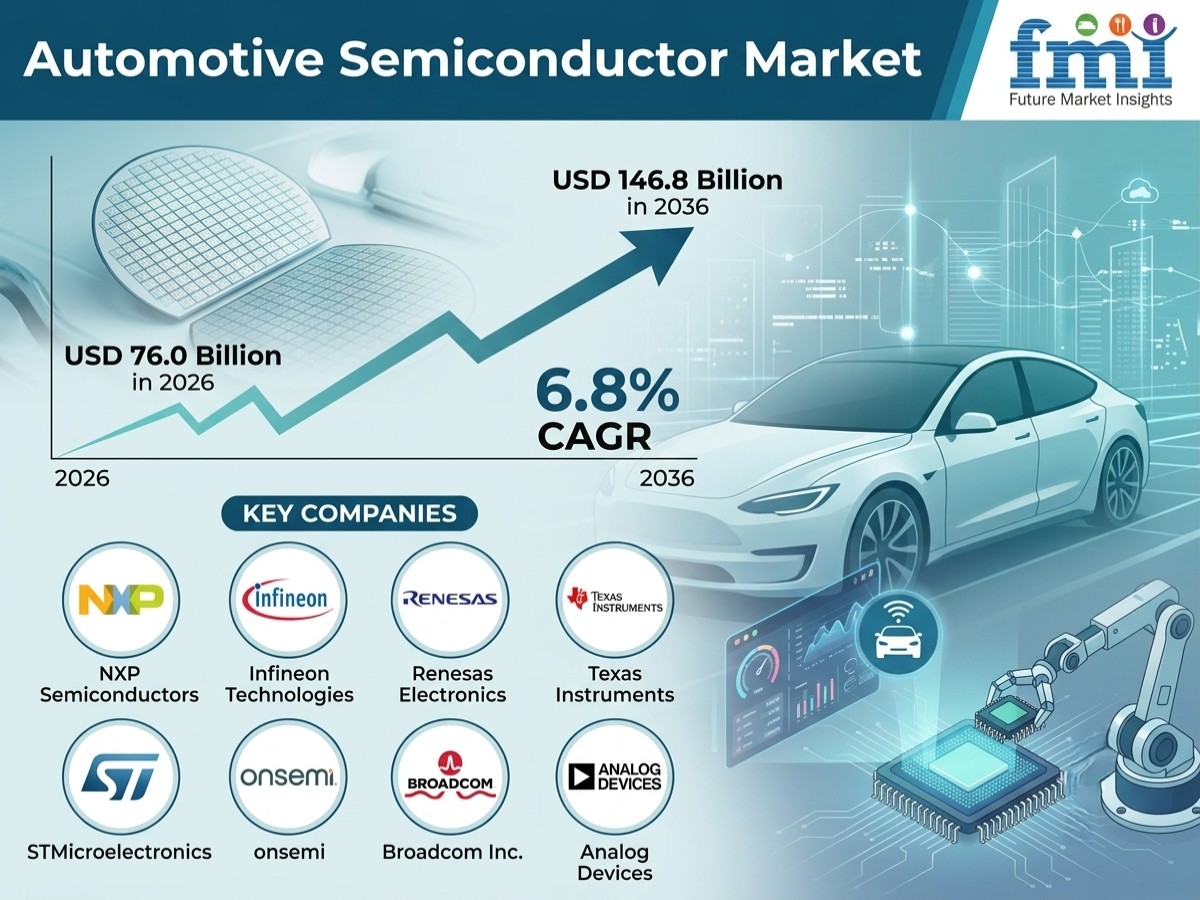
NEWARK, Del., October 12, 2026. The global automotive semiconductor market is projected to grow from USD 76.0 billion in 2026 to USD 146.8 billion by 2036, registering a compound annual growth rate (CAGR) of 6.8%, according to Future Market Insights (FMI). The market is expected to add USD 70.8 billion over the forecast period as vehicle manufacturers incorporate more processing, sensing, connectivity and power-management functions into their platforms.
Automotive semiconductor demand increasingly depends on the electronics content of each vehicle, rather than vehicle production volumes alone. Advanced driver assistance systems (ADAS), electric vehicle powertrains and software-defined architectures are increasing requirements for microcontrollers, processors, sensors and power semiconductors. For automakers and tier-one suppliers, securing qualified components and dependable supply has become an important part of platform planning.
Spectrum of chip requirements expands with vehicle electronics
Vehicle electrification and greater use of electronic control systems are changing how automotive manufacturers plan semiconductor procurement. Chips support engine management, motor control, battery management, infotainment and driver assistance. Each application has different performance, qualification and reliability requirements.
The Semiconductor Equipment and Materials International (SEMI) industry information cited by FMI indicates that automotive semiconductor capacity remained subject to allocation competition with consumer electronics and data-centre demand in 2025. This creates a procurement challenge for automotive buyers, whose product qualification cycles and vehicle launch schedules can make rapid supplier changes difficult.
FMI also cites Infineon’s 2025 reporting on automotive revenue growth associated with power semiconductors and ADAS processing demand. These industry signals support the case for closer coordination between chip suppliers and vehicle manufacturers, although they do not establish a direct causal relationship with the market forecast.
Request a Sample Report — Unlock Key Market Insights!
https://www.futuremarketinsights.com/reports/sample/rep-gb-1730
Where growth is fastest
India leads the five country forecasts shown in FMI’s report, followed by China and the United States. Differences in vehicle production, electrification, supplier localization and established manufacturing networks shape the outlook.
- India — 10.5% CAGR: Rising vehicle output, component localization and expanding aftermarket channels support demand. Suppliers need to balance local sourcing opportunities with distribution costs and varied customer requirements.
- China — 10.1% CAGR: A large vehicle production base and rapid electrification support demand across domestic automotive supply chains. Suppliers must account for local competition and pricing pressure.
- United States — 9.4% CAGR: A large vehicle base, replacement demand and growing electronic content support the market. National distribution and OEM relationships remain important for suppliers.
- Germany — 8.9% CAGR: Premium vehicle manufacturing, export-oriented production and established tier-one supplier networks support demand for automotive chips.
- United Kingdom — 5.7% CAGR: Replacement-led demand and established aftermarket channels support consumption, while import dependence makes availability and distribution important considerations.
These are forecast growth rates through 2036, not measures of current market share. The full report covers additional countries and regional markets.
What leads the market
FMI’s 2026 estimates identify processors, passenger vehicles, powertrain applications and original equipment manufacturers as important sources of demand.
- Micro Components (Processors) — 27.0% of component demand: Microcontrollers and system-on-chip devices support processing and control functions across vehicle electronic systems.
- Passenger Vehicles — 62.7% of vehicle-type demand: High production volumes and increasing ADAS and infotainment content contribute to semiconductor consumption per vehicle.
- Power Trains — 31.0% of application demand: Engine management, electric motor control and battery management systems require semiconductor components.
- Original Equipment Manufacturers (OEMs) — 73.0% of sales-channel demand: Factory-installed chips account for a substantial share of procurement across new vehicle platforms.
- Internal Combustion Engine Vehicles — 48.0% of propulsion-type demand: Existing production volumes continue to support semiconductor requirements across conventional vehicle platforms.
Battery electric vehicles are identified as the fastest-growing propulsion segment for semiconductor content, reflecting demand for power electronics, battery management systems and charging-related chips.
These figures describe separate market segments and should not be added together.
The hurdle: capacity constraints and lengthy qualification cycles
The main restraint is the difficulty of aligning semiconductor supply with automotive production schedules. Fabrication capacity is shared across multiple end markets, while automotive components must pass application-specific qualification and validation before they can be used in a vehicle platform.
Long qualification cycles can limit the ability of manufacturers to switch suppliers when shortages arise. A replacement chip may require engineering changes, software adjustments and additional testing before it can be approved for production.
FMI identifies silicon carbide (SiC) and gallium nitride (GaN) wide-bandgap semiconductors as an opportunity in electric powertrains. Their potential efficiency benefits in power conversion may support adoption where performance gains justify higher component costs. Buyers must still evaluate thermal requirements, operating conditions, qualification status and total system economics.
Industry investment and supplier activity
The report highlights three industry developments and signals from 2025 that relate to automotive semiconductor supply and technology.
- 2025 — SEMI industry information: FMI cites SEMI’s reporting on competition for automotive semiconductor capacity alongside demand from consumer electronics and data centres.
- 2025 — Infineon Technologies: The report cites the company’s automotive revenue growth in connection with demand for power semiconductors and ADAS processing.
- 2025 — STMicroelectronics: The report states that the company’s silicon carbide power-module portfolio expanded across electric vehicle OEM qualification programmes.
The published report summary does not provide the month or exact announcement date for these items. They are therefore presented as year-level industry signals rather than independently dated announcements.
FMI profiles eight principal companies: NXP Semiconductors, Infineon Technologies, Renesas Electronics, Texas Instruments, STMicroelectronics, onsemi, Broadcom Inc. and Analog Devices.
Their portfolios cover automotive processing, microcontrollers, power management, sensing, connectivity and battery-management applications. Competition depends on more than component pricing. Automotive qualification, engineering support, delivery performance and the ability to maintain supply over a vehicle programme’s life can influence supplier selection.
Analyst perspective
“Buyers are expected to judge micro components (processors) on performance and total cost of ownership rather than headline price. Automotive semiconductor adoption is expected to depend on ADAS mandate expansion and EV production scale across global vehicle platforms. Suppliers that combine automotive qualification with long-term wafer capacity commitment are likely to secure multi-year platform supply agreements. Market success is projected to depend on meeting accelerating chip content requirements while managing fab capacity constraints across automotive and industrial demand.”
— Sudip Saha, Principal Consultant, Future Market Insights
What this means for automotive OEMs and tier-one suppliers
Procurement teams can reduce supply and integration risks by evaluating semiconductor choices against complete vehicle programmes rather than individual component prices.
- Secure supply early in platform planning. Discuss capacity commitments, forecast volumes and delivery schedules with qualified suppliers before production ramps. Review exposure to shared fabrication capacity and identify alternatives early enough to complete the necessary qualification work.
- Compare components on lifecycle cost and performance. Evaluate processing capability, power efficiency, thermal requirements, software compatibility and qualification costs alongside unit price. For electric platforms, assess SiC and GaN options against the expected efficiency gains and additional system costs.
- Match sourcing strategy to regional growth. Suppliers evaluating India and China should consider local production relationships, pricing and distribution requirements. Buyers in Germany and the United States should also assess engineering support, long-term supply arrangements and compatibility with established OEM development programmes.
These actions give procurement and engineering teams a practical basis for balancing component performance, supply continuity and platform economics.
Report coverage
Future Market Insights’ Automotive Semiconductor Market report examines market size and forecasts through 2036, component and vehicle-type shares, application demand, propulsion categories, sales channels, country growth rates, competitive positioning, drivers, restraints and opportunities.
Read the full report:
https://www.futuremarketinsights.com/reports/automotive-semiconductor-market
Explore More Related Reports –
Mobile Computers Market – https://www.newstrail.com/mobile-computers-market-to-reach-usd-24-9-billion-by-2036-at-5-5-cagr-sweden-leads-at-5-8/
Food Supply Chain Traceability & Compliance Software Market – https://www.newstrail.com/food-supply-chain-traceability-compliance-software-market-to-reach-usd-21-3-billion-by-2036-at-13-9-cagr/
Low Smoke Zero Halogen (LSZH) Cables Market – https://www.newstrail.com/low-smoke-zero-halogen-lszh-cables-market-to-reach-usd-24-6-billion-by-2036-at-7-1-cagr-uae-leads-at-7-0/
Mobile Game Engine Market – https://www.futuremarketinsights.com/reports/mobile-game-engine-market
Data Bus Couplers Market – https://www.futuremarketinsights.com/reports/data-bus-couplers-market
Microswitch Assemblies Market – https://www.futuremarketinsights.com/reports/microswitch-assemblies-market
About Future Market Insights
Future Market Insights, Inc. (FMI) is an ESOMAR-certified market research and consulting firm headquartered in Delaware, USA, with offices in the United Kingdom, the United Arab Emirates and India. FMI delivers syndicated and custom research across food and beverage, healthcare, chemicals, technology, packaging, consumer goods and industrial sectors.
Media contact
Future Market Insights, Inc.
Email: sales@futuremarketinsights.com
Phone: +1-347-918-3531