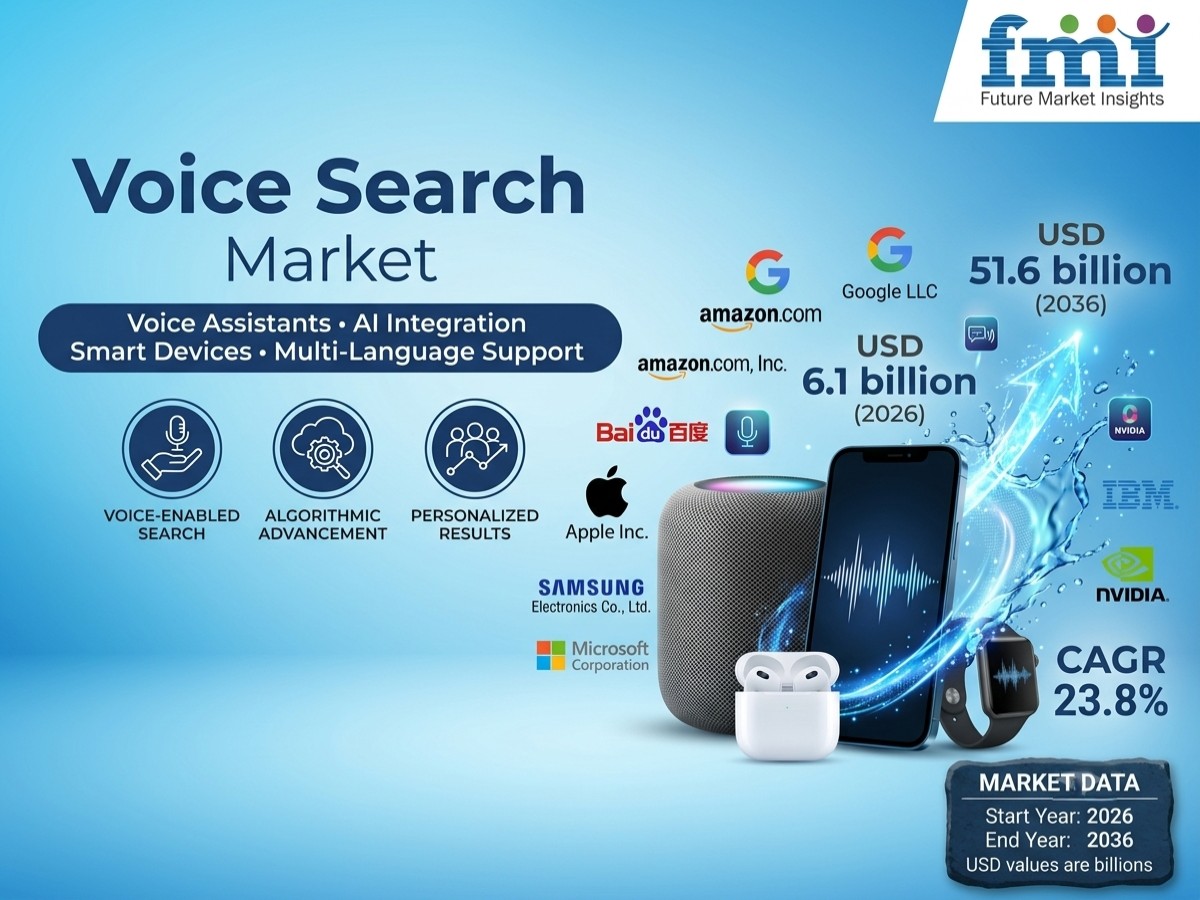
NEWARK, Del., October 12, 2026. The global voice search market is projected to grow from USD 6.1 billion in 2026 to USD 51.6 billion by 2036, expanding at a compound annual growth rate (CAGR) of 23.8%, according to Future Market Insights (FMI). Based on these published values, the market is expected to add USD 45.5 billion over the forecast period.
Voice search is becoming a more established way to access information through smartphones, smart speakers, connected vehicles and other consumer devices. Commercial adoption increasingly depends on whether systems can recognise spoken queries accurately, retain context across follow-up questions and provide results that users can inspect and verify.
Connected-device use creates new expectations for search
Existing smart-speaker use provides a foundation for wider voice-based information retrieval. In July 2025, Ofcom reported that 40% of UK households owned a smart speaker and that 43% of smart-speaker owners used the device to search for information online. The findings show how household devices can provide another route to online search beyond a phone or computer.
The next challenge is to make spoken search reliable across different users and environments. Accent variation, background noise and ambiguous requests can affect recognition accuracy. Systems must also preserve the meaning of follow-up questions and provide clear access to sources, particularly when users rely on results to make purchasing or service decisions.
Privacy requirements add another consideration. On June 11, 2026, the UK Information Commissioner’s Office (ICO) published expectations for the smart-device industry. The report also references a June 2026 joint paper from G7 data protection and privacy authorities on connected-home devices and children’s privacy. These developments underline the importance of clear privacy information, appropriate consent and controls over personal data.
Explore the Report Before You Buy — Download the Sample Now!
https://www.futuremarketinsights.com/reports/sample/rep-gb-34495
Where growth is fastest
FMI’s country forecasts point to strong growth across Asia, North America and Europe. South Korea leads the six profiled countries, while the United Kingdom and Germany provide European benchmarks.
- South Korea — 25.1% CAGR: High smart-device adoption and the integration of voice interfaces into connected-device applications support expansion. Language coverage and pronunciation differences remain important testing considerations.
- Japan — 23.1% CAGR: Established smartphone use and continued development of Japanese-language voice recognition support demand. Systems must account for regional pronunciation and shared-device privacy.
- United States — 22.9% CAGR: Broad smart-speaker adoption and integration across digital services provide established routes for voice search. Source visibility and performance in noisy environments remain relevant to commercial use.
- United Kingdom — 22.7% CAGR: Smart-speaker ownership and established voice-assistant use support adoption. Device compatibility and privacy controls influence the user experience.
- Germany — 22.4% CAGR: Voice-enabled consumer devices and automotive applications provide opportunities. German-language recognition, consent requirements and performance under road noise need to be addressed during deployment.
- Canada — 22.6% CAGR: High smartphone penetration and established digital-service use support adoption. Language coverage and consistent performance across devices remain relevant to deployment.
These figures represent forecast growth rates, not country market shares. Differences in language, device ecosystems, privacy requirements and the availability of voice-enabled services can influence how quickly suppliers gain adoption.
What leads the market
FMI’s 2026 estimates identify generic search as the leading type, smartphones and mobile devices as the largest application category, consumer electronics as the leading end-use category, and speech recognition as the leading technology.
- Generic search — 48.0% of the type segment: Routine information and navigation requests support demand for systems that can answer direct questions without requiring stored preferences or predictive permissions.
- Smartphones and mobile devices — 38.0% of application demand: Built-in microphones, personal accounts and existing search applications make mobile devices a direct route to recurring spoken queries.
- Consumer electronics — 34.0% of end-use demand: Smartphones and smart speakers provide repeated access to voice search across household and personal settings.
- Speech recognition and automatic speech recognition — 36.0% of technology demand: Converting spoken audio into usable text is the entry point for retrieval, making recognition accuracy and response time important to the overall experience.
These shares describe different market categories and should not be added together. They indicate where demand is concentrated, while the right technology and interface depend on the intended application and operating environment.
The hurdle: accuracy and privacy
Recognition errors remain a practical barrier to wider adoption. Accents, background noise, unfamiliar names and changes in context can cause systems to misunderstand queries. If users must repeatedly correct the assistant, the convenience of speaking rather than typing diminishes.
Privacy presents a second challenge. Smart speakers and connected devices may be used by several people, including children, within the same household. Providers need to make recording practices, data retention and consent controls understandable to users. Businesses must also assess whether voice data can be processed in accordance with their internal policies and applicable privacy requirements.
FMI identifies context-aware search and AI-assisted retrieval as opportunities for providers. Systems that combine accurate recognition with natural language processing can handle follow-up questions without requiring users to restart the search. Automotive and healthcare applications offer additional opportunities, but they require testing against the particular workflow, environment and data-access rules involved.
Recent developments and industry investment
Recent product and platform announcements show how voice interfaces are expanding across consumer devices and search applications.
- July 2026: Amazon expanded Alexa+ access through Alexa.com and the Alexa mobile app across supported markets.
- June 2026: Apple introduced Siri AI for developer testing, including web knowledge, personal context and conversation history across supported Apple devices.
- March 2026: Google expanded Search Live across more than 200 countries and territories, offering access through AI Mode.
These developments illustrate activity across assistant platforms and search interfaces. They should not be interpreted as evidence of market share or as a guarantee that the announced features are available on every device or in every country.
FMI profiles eight companies in the market: Google LLC, Amazon.com, Inc., Apple Inc., Baidu, Inc., Samsung Electronics Co., Ltd., Microsoft Corporation, International Business Machines Corporation and NVIDIA Corporation.
These companies serve different parts of the market. Consumer platforms combine search, assistant software and device distribution, while enterprise technology providers supply speech recognition, natural language processing and AI infrastructure for specific business workflows.
Analyst perspective
“A reliable voice-search system must preserve names and follow-up context throughout retrieval and any automated result. Platform teams should compare source visibility and permission handling across noisy devices so users can inspect or correct fluent answers during commercial use.”
— Sudip saha, Principal Consultant, Future Market Insights
What this means for technology buyers
For device manufacturers, digital platform teams and enterprise technology buyers, the market outlook points to three practical priorities.
- Test recognition under real operating conditions. Evaluate accents, background noise, unfamiliar names and multi-turn conversations using representative users and devices. Track recognition errors, correction rates and response times before choosing a platform.
- Make privacy and source visibility part of procurement. Check how providers explain recording, obtain consent, retain voice data and support deletion requests. Where search results inform commercial decisions, require clear source links and a way for users to correct misunderstood requests.
- Match the technology to the application. Mobile search, smart speakers, automotive systems and enterprise workflows have different performance and integration requirements. Assess compatibility with existing applications, language coverage, response latency and ongoing support before committing to a deployment.
These steps can help buyers compare platforms on measurable performance and establish clear acceptance criteria before expanding voice-enabled services.
Report coverage
Future Market Insights’ Voice Search Market report examines market size and forecasts through 2036, type, application, end use, technology, country growth rates, competitive activity, adoption drivers, restraints and emerging opportunities.
Read the full report:
https://www.futuremarketinsights.com/reports/voice-search-market
Explore More Related Reports –
Homomorphic Encryption Market – https://www.newstrail.com/homomorphic-encryption-market-to-reach-usd-3-9-billion-by-2036-japan-cagr-22-9-united-kingdom-cagr-22-5/
Direct Burial Cables Market – https://www.newstrail.com/direct-burial-cables-market-to-reach-usd-14-3-billion-by-2036-brazil-at-5-8-cagr-united-kingdom-at-5-5/
Noise Monitoring Devices Market – https://www.newstrail.com/noise-monitoring-devices-market-to-reach-usd-2-4-billion-by-2036-united-kingdom-cagr-6-2/
Hermetic Connectors Market – https://www.futuremarketinsights.com/reports/hermetic-connectors-market
Harsh-Environment Connectors Market – https://www.futuremarketinsights.com/reports/harsh-environment-connectors-market
Network Processing Unit Market – https://www.futuremarketinsights.com/reports/network-processing-unit-market
About Future Market Insights
Future Market Insights, Inc. (FMI) is an ESOMAR-certified market research and consulting firm headquartered in Delaware, USA, with offices in the United Kingdom, the United Arab Emirates and India. FMI delivers syndicated and custom research across food and beverage, healthcare, chemicals, technology, packaging, consumer goods and industrial sectors.
Media contact
Future Market Insights, Inc.
Email: sales@futuremarketinsights.com
Phone: +1-347-918-3531