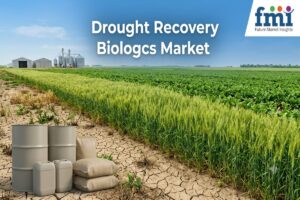
The global drought recovery biologics market was valued at USD 120.6 million in 2025 and is estimated to reach USD 135.6 million in 2026. The market is projected to reach USD 436.3 million by 2036, expanding at a CAGR of 12.4% from 2026 to 2036. Repeated drought conditions across major agricultural regions are increasing demand for biological products that help crops withstand water stress and recover after dry periods. In March 2026, the U.S. Department of Agriculture reported that 55% of winter wheat acreage and 46% of corn acreage faced moderate or worse drought conditions. This exposure is encouraging growers to include crop stress management products in seasonal input budgets. Clearer product registration pathways, expanding field trials, and integrated crop nutrition programs are also creating opportunities for drought recovery biologics suppliers.
Global Segment Leaders
- Product Type: Osmoprotectant blends are projected to account for 46.8% of market sales in 2026, as glycine betaine and proline formulations can be applied before anticipated heat and water stress.
- Crop Type: Cereals and grains are expected to hold a 45.3% share in 2026, supported by extensive wheat and maize acreage and the need to manage drought exposure across large cultivated areas.
- Application Method: Soil application is projected to account for 42.2% of sales in 2026, as root-zone treatments fit established drenching, in-furrow, and band application practices.
- Farm Type: Large commercial farms are expected to represent 47.3% of sales in 2026, supported by dedicated agronomy teams and planned seasonal crop protection programs.
- Sales Channel: Agri-input distributors are projected to account for 37.7% of sales in 2026, as growers rely on local product availability, application guidance, and advice on treatment timing.
Country-Level Performance
South Korea is projected to lead the five profiled countries with an 11.9% CAGR from 2026 to 2036, followed by the United States at 11.6%, Germany at 11.3%, the United Kingdom at 11.0%, and Japan at 10.3%.
South Korea’s growth outlook reflects recurring drought conditions and government-supported agricultural response measures. Gangwon Yeongdong received only 34.2% of normal summer rainfall in 2025, contributing to increased attention to crop stress management.
In the United States, the USDA reported in March 2026 that 55% of winter wheat acreage, 46% of corn acreage, and 47% of soybean acreage faced drought conditions. This exposure supports demand for seed treatments and biological formulations targeting drought stress in major row crops.
Germany’s market outlook is influenced by dry spring conditions and pressure on grain production. In August 2026, the German Farmers’ Association expected a grain harvest of 41.9 million tonnes, 7% below 2025 levels. These conditions are encouraging growers to consider stress management programs before critical crop development stages.
The United Kingdom is projected to register an 11.0% CAGR through 2036. In September 2026, the Environment Agency reported drought conditions in ten areas of England and 467 abstraction licence restrictions. Limited irrigation availability supports interest in products designed to improve crop stress tolerance without requiring additional water.
Japan is expected to record the lowest CAGR among the five profiled countries, at 10.3%. Its market development depends partly on local field validation and product labelling requirements. Japan’s Ministry of Agriculture, Forestry and Fisheries issued biostimulant labelling guidelines in May 2025, outlining conditions for claims related to drought and other abiotic stresses.
Regional Context
South Korea and the United States represent the fastest-growing markets in the country-level analysis, with projected CAGRs of 11.9% and 11.6%, respectively. Recurring drought exposure, demand for pre-stress treatments, and opportunities to integrate biological products into established crop input programs support their growth outlook.
Germany and the United Kingdom are also expected to expand at double-digit rates, driven by dry growing seasons, concerns about crop yields, and interest in products that help manage water stress. Product registration, local field evidence, and application timing will influence adoption across European markets. Japan’s comparatively slower projected growth reflects the importance of replicated field trials, crop-specific evidence, and established water management practices.
The full report covers North America, Latin America, Western Europe, Eastern Europe, East Asia, South Asia and the Pacific, and the Middle East and Africa, with detailed country-level analysis for South Korea, the United States, Germany, the United Kingdom, and Japan.
Competitive Landscape
The drought recovery biologics market includes integrated agricultural biosolutions providers, seaweed-based product specialists, and manufacturers of plant-based stress management formulations. Key companies profiled include UPL Limited (NPP), Rovensa Next (Tradecorp), Acadian Plant Health, BioAtlantis Ltd., Hello Nature (formerly Italpollina), Atlantica Agricola S.A., Seipasa S.A., and Kimitec Group.
Companies are expanding their product portfolios, manufacturing capacity, and application-specific solutions to reach growers managing drought and other abiotic stresses. In February 2025, Acadian Plant Health launched its Abiotic Stress Management portfolio for crops exposed to drought, flooding, and severe weather. In May 2025, Rovensa Next introduced its Biostimulation 360º program, combining Phylgreen for stress preparation with Delfan Plus for use during and after stress. In June 2025, Hello Nature began an expansion at its Novara, Italy, facility intended to double production capacity.
Competitive positioning depends on formulation quality, local field trial results, product registration, distribution reach, and the ability to provide clear application guidance. Suppliers that demonstrate consistent performance across crops and growing conditions may be better placed to convert initial product trials into repeat seasonal orders.
Related Report:
https://www.openpr.com/news/4655991/rhizosphere-nutrient-boosters-market-to-reach-usd-247-7-million
https://www.openpr.com/news/4655995/soil-pathogen-inhibitors-market-to-reach-usd-595-6-million
https://www.openpr.com/news/4655998/root-disease-suppressors-market-to-reach-usd-287-4-million