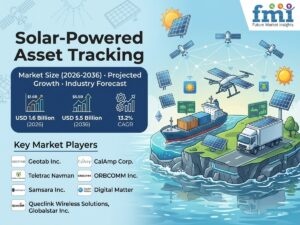


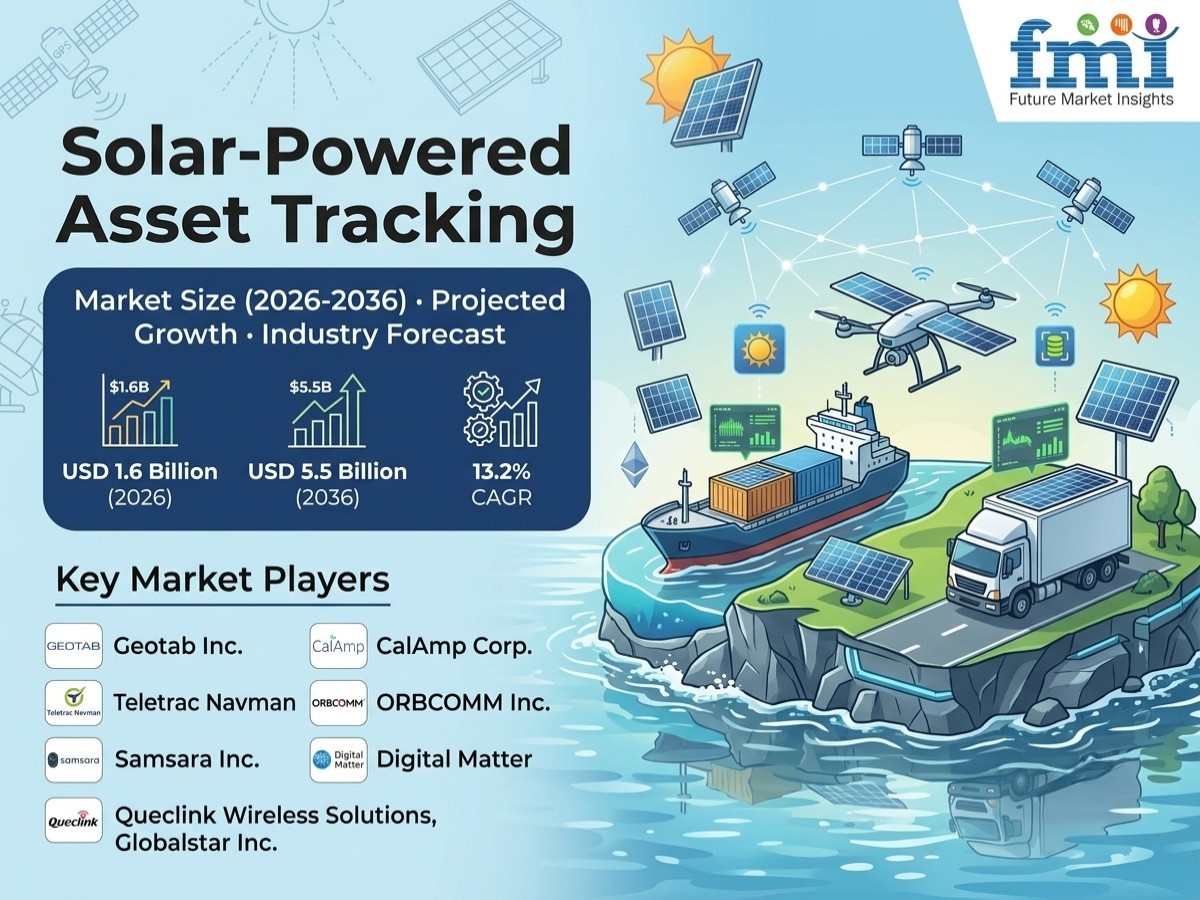
NEWARK, Del., October 9, 2026. The global solar-powered asset tracking market is projected to grow from USD 1.6 billion in 2026 to USD 5.5 billion by 2036, registering a compound annual growth rate (CAGR) of 13.2%, according to Future Market Insights (FMI). The market is expected to add USD 3.9 billion in value over the forecast period as fleet operators, logistics providers and industrial businesses seek reliable location data for trailers, containers and equipment that lack continuous vehicle power.
Solar-powered trackers offer an alternative to frequent battery replacement and routine servicing across dispersed fleets. However, their commercial value depends on how assets are parked, how often devices report their locations and whether the available network can maintain coverage. These operating conditions are becoming central to purchasing decisions as tracking deployments extend across transport corridors, industrial facilities and remote locations.
Why connectivity and device autonomy matter now
Asset tracking providers are addressing two practical requirements: extending operating life between service visits and maintaining visibility when cellular networks are unavailable. In February 2025, Globalstar reported that its SmartOne Solar device could operate for ten years under a validated power budget. The development highlights the importance of evaluating device longevity against expected field conditions rather than relying on battery-life claims alone.
Network availability also affects technology selection. In October 2025, the Canadian Radio-television and Telecommunications Commission (CRTC) reported that mobile networks served 87% of major Canadian roads and highways during 2023. This coverage context supports the use of cellular tracking on covered freight routes, while remote operations may require satellite connectivity or a hybrid approach.
For fleet managers, the choice is not simply between solar and battery power. It also involves balancing reporting frequency, network reach, installation requirements and the cost of servicing assets in the field.
Download Your Sample Report — See the Market Analysis!
https://www.futuremarketinsights.com/reports/sample/rep-gb-34582
Where growth is fastest
FMI identifies five countries with strong growth prospects for solar-powered asset tracking through 2036. Their outlooks reflect differences in freight activity, network readiness and the operating environments in which assets are deployed.
- South Korea – CAGR 14.2%: Smart-logistics investment is increasing the value of integrated location data across automated facilities. Indoor coverage and platform qualification remain considerations for multi-site deployments.
- United States – CAGR 13.5%: Extensive freight circulation across trailers and equipment serving regional distribution networks supports demand. Network gaps and differences between fleet operating conditions require validation.
- Canada – CAGR 13.3%: Cellular coverage across populated freight corridors supports deployment, although remote routes can increase satellite costs and service requirements.
- United Kingdom – CAGR 13.1%: Replacement of legacy tracking devices following the retirement of 3G networks supports demand. Remaining 2G timelines and roaming arrangements can affect implementation.
- Australia – CAGR 13.0%: Mining and agricultural operations create demand for rugged trackers across remote areas. Long service distances and satellite connectivity costs remain important considerations.
These forecasts indicate that adoption conditions vary by country. Buyers should evaluate network coverage and asset use before extending a tracking solution across multiple markets.
What leads the market
Three segments account for the leading projected shares in the 2026 market outlook, according to FMI.
- Portable solar-powered trackers – 60.0%: Flexible mounting makes these devices suitable for assets that are reassigned or moved between locations.
- 4G-LTE connectivity – 44.0%: Familiar provisioning and lower-power cellular variants support adoption across fleet tracking applications.
- Vehicle and fleet tracking – 34.0%: Operators use tracking systems to monitor vehicle utilization and unauthorized movement.
These shares show where demand is concentrated, but they do not remove the need to match equipment to operating conditions. A portable tracker intended for frequently reassigned trailers may require a different configuration from a fixed device monitoring industrial equipment.
The hurdle: maintaining reliable operation in the field
Solar-powered tracking performance depends on the relationship between energy generation, stored power and device activity. Shading can reduce solar charging, while frequent location reports increase power consumption. If a device uses stored energy faster than it can replenish it, dependable field operation may be affected.
This challenge is particularly relevant to equipment that remains parked for long periods, operates in shaded locations or travels through areas with inconsistent connectivity. Satellite fallback can extend coverage but may add cost, while a cellular-only configuration may not suit every remote route.
FMI’s market analysis therefore points to a practical purchasing priority: validate the complete device and connectivity configuration under expected field conditions before scaling deployment.
Recent developments and companies to watch
Product launches and platform integrations are addressing the need to connect asset location with broader fleet-management workflows.
- February 2026 – Geotab Inc.: The company launched GO Anywhere trackers with MyGeotab integration and optional Starlink Direct to Cell connectivity for trailers and equipment. North American availability was scheduled to begin in the second quarter of 2026.
- February 2025 – ORBCOMM Inc.: The company joined Geotab Marketplace Order Now, making its CT 1000 and solar-powered GT 1220 and GT 1230 devices directly available through the marketplace. The offering combines purchasing with MyGeotab integration for trailer visibility and sensor support.
- January 2025 – Teletrac Navman: The company introduced indoor and outdoor asset trackers featuring a stated ten-year battery life, 4G connectivity and 2G fallback. Integration with TN360 connects location information with maintenance and utilization records.
The developments illustrate different approaches to tracking unpowered assets, from integrated fleet platforms to satellite-enabled devices and configurable hardware.
FMI profiles the following companies in the solar-powered asset tracking market: Geotab Inc., CalAmp Corp., Teletrac Navman, ORBCOMM Inc., Samsara Inc., Digital Matter, Queclink Wireless Solutions and Globalstar Inc. Their offerings span fleet-management software, tracking hardware, cellular connectivity and satellite-based services.
Analyst perspective
“Solar tracking should be qualified against the asset’s parking pattern and reporting duty cycle conditions. Fleet operators protect deployment economics by testing reserve capacity and network fallback under the same conditions expected across the commercial fleet.”
— Sudip Saha, Principal Consultant for Industrial Automation, Future Market Insights
The analysis underscores a distinction between a device’s stated technical capabilities and its performance across a working fleet. Deployment decisions should account for charging conditions, reporting requirements, network availability and the cost of maintaining equipment at remote sites.
What this means for fleet operators and logistics decision-makers
The projected market expansion creates opportunities for buyers, but investment decisions should begin with operational requirements rather than headline growth figures.
- Test trackers under real operating conditions. Evaluate solar exposure, parking patterns, reporting frequency and reserve battery capacity before selecting devices for large fleets. Include periods of limited sunlight and inconsistent network coverage in the assessment.
- Match connectivity to route requirements. Compare cellular coverage across regular routes with the cost and availability of satellite fallback. A hybrid configuration may be appropriate for remote operations, while cellular connectivity may be sufficient for assets that remain within covered corridors.
- Calculate total deployment and service costs. Consider installation, device replacement, connectivity charges, platform integration and field-service visits together. Confirm that tracking data can support the intended fleet-management, maintenance and utilization workflows before committing to a large-scale rollout.
These measures can help organizations assess whether solar-powered tracking will meet their specific visibility and maintenance requirements while limiting avoidable deployment costs.
Report coverage
Future Market Insights’ Solar-Powered Asset Tracking Market report examines market size and forecasts from 2026 to 2036, segment performance, country-level growth, regional demand, competitive positioning and opportunities across product type, connectivity, application, end user and distribution channel.
Read the full report and request a sample:
https://www.futuremarketinsights.com/reports/solar-powered-asset-tracking-market
Explore More Related Reports –
Voice Cloning Market – https://www.futuremarketinsights.com/reports/voice-cloning-market
Voice Search Market – https://www.futuremarketinsights.com/reports/voice-search-market
Model-Based Manufacturing Technologies Market – https://www.futuremarketinsights.com/reports/model-based-manufacturing-technologies-market
About Future Market Insights
Future Market Insights, Inc. (FMI) is an ESOMAR-certified market research and consulting firm headquartered in Delaware, USA, with offices in the United Kingdom, the United Arab Emirates and India. FMI delivers syndicated and custom research across food and beverage, healthcare, chemicals, technology, packaging, consumer goods and industrial sectors.
Media contact:
Future Market Insights, Inc.
Email: sales@futuremarketinsights.com
Phone: +1-347-918-3531