

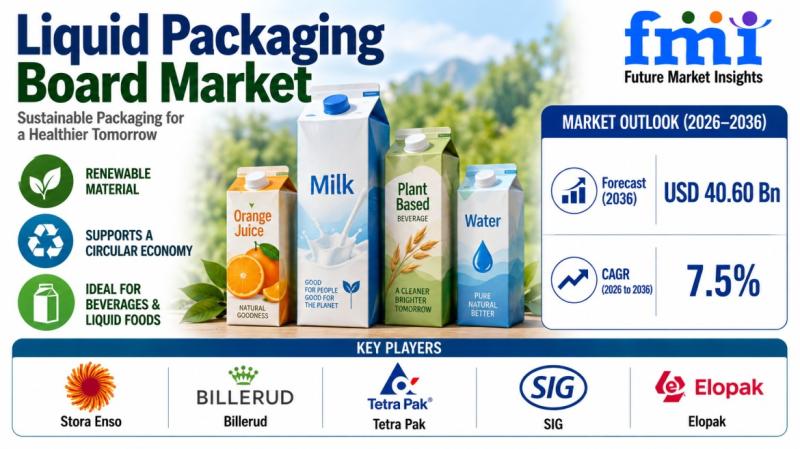
The global liquid packaging board market is projected to grow from USD 19.70 billion in 2026 to USD 40.60 billion by 2036, expanding at a 7.5% CAGR, as dairy, juice, and plant-based beverage producers increase their use of fibre-based carton formats.
The market is being shaped by two parallel requirements: liquid packaging must maintain barrier performance and filling-line reliability, while brand owners face growing pressure to reduce reliance on conventional plastic packaging. Aseptic carton board is expected to account for 58.0% of product category demand in 2026, while dairy products represent 46.0% of end-use demand.
👉 Get Detailed Market Forecasts, Competitive Benchmarking, and Pricing Trends: https://www.futuremarketinsights.com/reports/sample/rep-gb-4420
Why is liquid packaging board gaining ground in dairy and beverages?
Aseptic cartons remain central to the market because they allow processors to distribute shelf-stable liquids with less dependence on refrigerated logistics. This is particularly relevant in emerging markets where retail networks are expanding beyond major cities and cold-chain infrastructure remains uneven.
Dairy provides the largest demand base. Milk and drinking-dairy products generate recurring carton volumes, while plant-based beverages are adding faster-growing applications as oat, nut, and other alternatives expand their presence in ambient retail.
The shift is also changing material specifications. Polyethylene-coated board is projected to hold 52.8% of coating structure demand in 2026, reflecting the importance of established moisture resistance and heat-sealing performance. At the same time, suppliers are being pushed toward lighter board structures and improved recyclability without compromising carton stiffness or filling-line speed.
What developments are changing the competitive landscape?
Recent capacity investments show that competition is increasingly linked to qualified supply rather than board availability alone.
In July 2025, Tetra Pak launched its second aseptic carton packaging material production line at its Binh Duong facility in Vietnam, more than doubling local plant capacity and adding 15 packaging formats. The expansion strengthens access to qualified carton material for beverage processors in Vietnam and neighboring Southeast Asian markets.
In August 2025, Stora Enso inaugurated its new consumer packaging board production line at Oulu, Finland, following a reported EUR 1.1 billion investment. Billerud also reported that liquid packaging board price increases took effect from the beginning of the first quarter of 2025.
Together, these developments point to a market where scale, mill qualification, converter relationships, and regional production capacity increasingly influence supplier selection.
The market is becoming a balance between fibre efficiency and barrier performance
The competitive structure extends across both board producers and carton-system specialists. Stora Enso and Billerud compete through board capacity and material performance, while Tetra Pak and SIG influence demand through aseptic carton and filling-system specifications. Elopak, Nippon Paper Industries, and Metsä Board add regional and adjacent fibre-based packaging capabilities.
This creates an important purchasing dynamic: a new board grade must not only meet food-contact and barrier requirements but also run consistently on qualified converting and filling equipment. As a result, lightweighting and recyclability improvements are most commercially valuable when they can be introduced without disrupting existing production systems.
Analyst perspective
Ismail Sutaria, Principal Consultant at Future Market Insights, says:
“Liquid packaging board demand is moving toward higher barrier performance and better fibre efficiency as dairy and beverage brands balance shelf life with packaging waste rules. Aseptic formats will keep leading because they reduce cold-chain dependence for milk and plant-based drinks across emerging markets.”
Liquid Packaging Board Market Snapshot
- 2026 Market Size: USD 19.70 billion
- 2036 Forecast: USD 40.60 billion
- CAGR, 2026–2036: 7.5%
- Incremental Opportunity: USD 20.90 billion
- Leading Product Category: Aseptic carton board, 58.0%
- Leading End Use: Dairy products, 46.0%
- Leading Coating Structure: Polyethylene coated, 52.8%
- Leading Supply Format: Roll stock, 63.0%
- Fastest-Growing Country: India, 9.2% CAGR
Which countries offer the strongest growth opportunities?
India is forecast to lead country growth at 9.2% CAGR through 2036, supported by expanding packaged dairy penetration and a large fluid-milk consumption base. China follows at 8.5%, while Indonesia and Vietnam are projected to grow at 8.2% and 8.0%, respectively.
The country pattern highlights a broader regional opportunity. Southeast Asian markets benefit from ambient beverage formats because cartons can support distribution across geographically dispersed retail networks. By contrast, the United States, Germany, and Japan are more mature carton markets, making lightweighting, premium beverage applications, and recycling performance more important sources of incremental demand.
Access detailed market insights: https://www.futuremarketinsights.com/reports/brochure/rep-gb-4420
What is driving demand for liquid packaging board?
Four factors are shaping the forecast:
- Aseptic shelf-life requirements: Shelf-stable dairy and beverages create recurring demand for high-performance carton board.
- Fibre-based packaging adoption: Packaging strategies focused on reducing conventional plastic use are supporting interest in paperboard-based liquid formats.
- Retail expansion: Ambient cartons help beverage and dairy brands reach markets where refrigerated logistics are less developed.
- Lightweighting: Converters are seeking lower material consumption while maintaining stiffness, sealing performance, and line speed.
Recycling remains a constraint. Liquid cartons can combine paperboard with polyethylene and, in some structures, aluminium barriers, creating recovery challenges where collection and processing infrastructure is limited. Suppliers therefore face pressure to improve fibre recovery and PolyAl separation while keeping total packaging costs commercially viable.
About the Liquid Packaging Board Market Report
Future Market Insights’ study examines liquid packaging board across product category, end-use application, coating structure, board grade, supply format, and region. The forecast covers 2026 to 2036, with 2025 as the historical reference year.
The study covers aseptic and fresh carton board, coated and uncoated structures, dairy, beverages, plant-based drinks, liquid foods, pharmaceutical liquids, roll stock, sheets, blanks, and printed board.
FMI’s research process combines primary interviews, secondary research, supply- and demand-side validation, bottom-up modelling, top-down reconciliation, and multi-source triangulation.