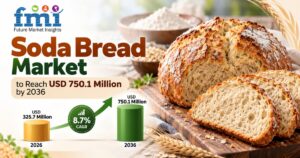


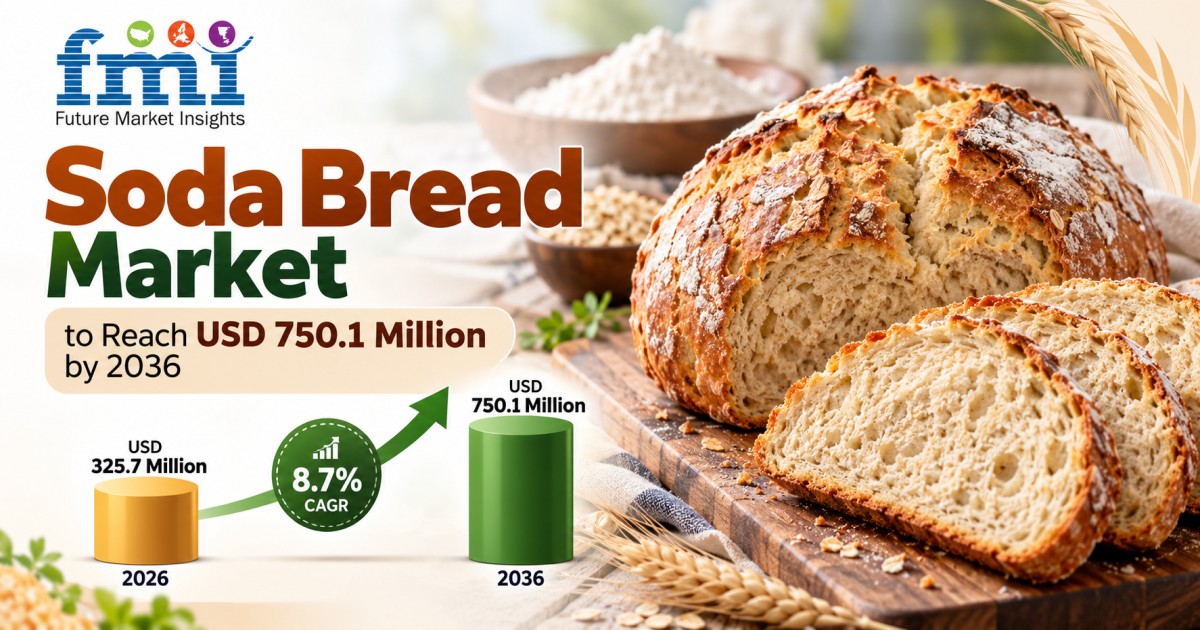
The global soda bread market is forecast to increase from USD 325.7 million in 2026 to USD 750.1 million by 2036, expanding at an 8.7% CAGR during the 2026–2036 forecast period, according to Future Market Insights. The market stood at USD 299.6 million in 2025. Growth is being supported by continued demand for traditional buttermilk-based bread, alongside whole-grain, seeded, mini, and specialty formats that give retailers additional merchandising opportunities. Repeat purchases depend on consistent crumb quality, freshness, and shelf life that can accommodate increasingly complex delivery networks.
Get detailed market forecasts, competitive benchmarking, and pricing trends:
https://www.futuremarketinsights.com/reports/sample/rep-gb-35633
Regional Segment Leaders
As this is a global soda bread market report, the segment analysis reflects demand across major product, claim, format, packaging, and retail channels.
- Classic / original — 33.0% of Product Type demand in 2026: Traditional buttermilk flavor, dense crumb, yeast-free preparation, and strong consumer familiarity support its leading position.
- Conventional — 54.0% of Claim / Nature demand in 2026: Conventional soda bread fits established bakery production lines and mainstream pricing without requiring specialized sourcing or claim controls.
- Fresh — 37.0% of Format demand in 2026: Fresh soda bread provides the texture and bakery cues associated with traditional loaves, particularly where frequent delivery routes can protect quality.
- Multipack — 34.0% of Packaging Format demand in 2026: Multipacks support breakfast, snacking, and portion-based consumption while making smaller formats easier to merchandise.
- Supermarkets & hypermarkets — 38.0% of Sales Channel sales in 2026: Modern grocery provides broad household reach and allows soda bread to be positioned alongside mainstream, whole-grain, and specialty bakery products.
Country-Level Performance
The report profiles eight countries, with a 2.2 percentage-point spread between the highest and lowest forecast CAGR.
- Germany | CAGR 10.0% (2026–2036) | Key drivers: Whole-grain dietary guidance supports seeded and brown soda bread, creating a nutrition-led route into a market where local bread traditions remain strong.
- Australia | CAGR 9.7% (2026–2036) | Key drivers: Wholegrain dietary guidance and bread-flour fortification requirements create opportunities for brown and seeded products, provided formulation and labeling meet local requirements.
- New Zealand | CAGR 9.4% (2026–2036) | Key drivers: Mandatory folic-acid fortification for non-organic wheat flour used in bread-making establishes a clear compliance baseline, while longer delivery routes can support frozen and packaged formats.
- Ireland | CAGR 9.0% (2026–2036) | Key drivers: Strong cultural familiarity with soda bread supports authenticity-led demand, although established fresh-bread competition raises expectations for freshness and product consistency.
- UK | CAGR 8.7% (2026–2036) | Key drivers: Mature bakery networks and broad retail access support distribution, while higher energy, wheat, and delivery costs increase pressure on fresh products.
- Canada | CAGR 8.4% (2026–2036) | Key drivers: Whole-grain guidance supports brown and seeded varieties, while gluten-free products require strict cross-contamination controls and credible labeling.
- USA | CAGR 8.1% (2026–2036) | Key drivers: Irish-style bakery occasions and specialty grocery channels provide entry points, while gluten-free products must satisfy federal labeling requirements.
- France | CAGR 7.8% (2026–2036) | Key drivers: Whole-grain and cereal-food guidance creates a nutrition-led opportunity, with specialty bakeries and premium grocers providing suitable routes for market testing.
Regional Context
Soda bread benefits from a combination of heritage appeal and evolving nutrition-led purchasing. Traditional buttermilk recipes provide strong recognition, while whole-grain, seeded, mini, and gluten-free variants allow producers to target additional consumer needs.
However, freshness remains a critical execution challenge. Short shelf life and rising energy, wheat, and distribution costs can restrict the profitable delivery radius for fresh products. Producers expanding beyond established regional markets may therefore need frozen, ambient packaged, chilled, or par-baked formats to protect product quality.
Nutrition and claim requirements also influence product development. Whole-grain guidance across several European and Pacific markets supports brown and seeded soda bread, while gluten-free products require tighter production controls and credible cross-contamination management.
Smaller formats provide another route for expansion. Mini breads and multipacks allow producers to target breakfast and snacking occasions without requiring consumers to purchase a full family loaf, while specialty formats can support premiumization and dietary positioning.
Competitive Landscape
The competitive landscape includes established Irish soda bread producers alongside large bakery companies with extensive production and distribution networks.
- Broad Soda Bread Assortment Specialists: Irwin’s Bakery and McCambridge of Galway use multiple formats and specialty variants to serve different consumer occasions.
- Irish Fresh-Bread Producers with Soda Lines: Brennans Bread and Pat The Baker integrate soda bread into established Irish bakery portfolios supported by domestic distribution networks.
- Scaled UK Bakery Network Participants: Warburtons and Hovis Bakeries bring broad manufacturing, depot, and retail-distribution capabilities that can support wider bakery-format expansion.
Notable strategic developments include Associated British Foods’ July 2026 completion of its acquisition of Hovis Group, bringing the business together with Allied Bakeries under Hovis Bakeries. In April 2026, Warburtons announced an investment program exceeding £100 million, including a new bakery site, distribution center, production lines, and redevelopment of its gluten-free bakery.
Get the Complete Story — Read More About Our Latest Report
https://www.futuremarketinsights.com/reports/soda-bread-market
Analyst Perspective
“Freshness and price will decide whether soda bread reaches more households. A familiar buttermilk loaf can win the first sale, but repeat buyers need the same texture each time.” — Nandini Roy Choudhury, Principal Analyst, Future Market Insights
About Future Market Insights (FMI)
Future Market Insights, Inc. (FMI) is an ESOMAR-certified, ISO 9001:2015 market research and consulting organization, trusted by Fortune 500 clients and global enterprises. With operations in the U.S., UK, India, and Dubai, FMI provides data-backed insights and strategic intelligence across 30+ industries and 1200 markets worldwide.