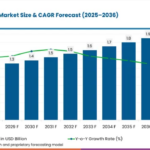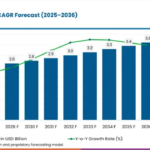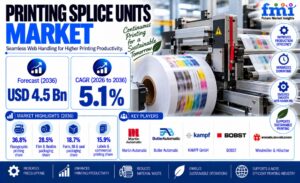


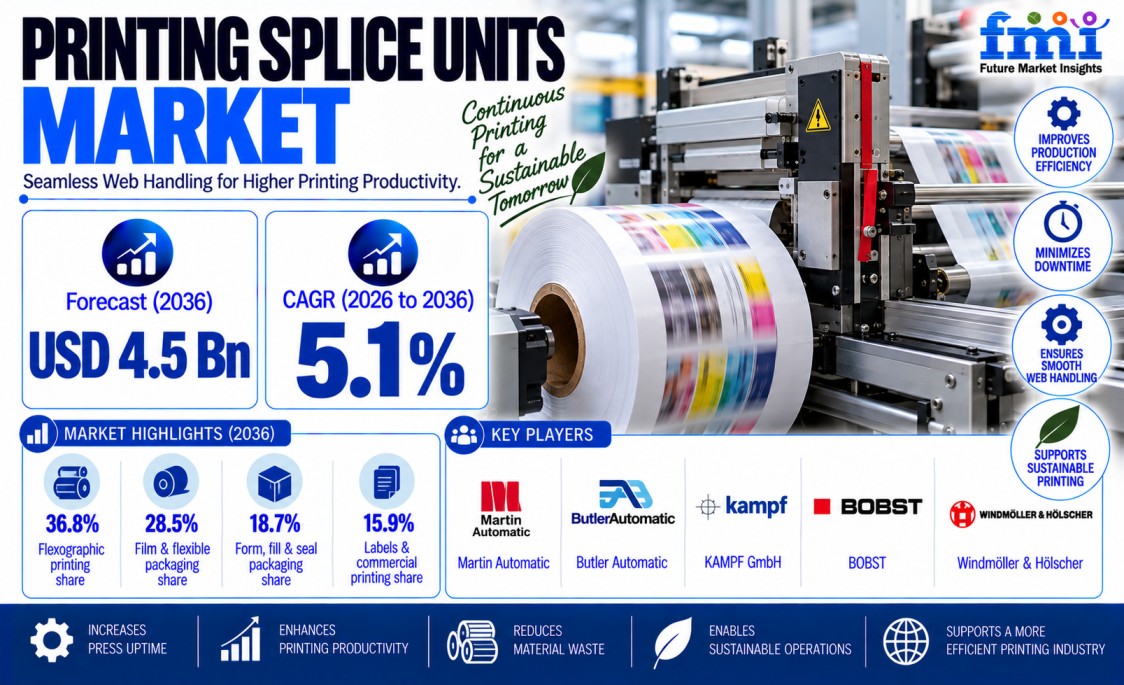
The global printing splice units market is projected to reach USD 4.5 billion by 2036, up from USD 2.7 billion in 2026, expanding at a 5.1% CAGR during the forecast period, according to Future Market Insights.
Demand is being supported by printing and converting plants looking to reduce production time lost during repeated reel changes. Automatic splice units allow incoming rolls to be transferred without planned press stops, helping web-fed operations improve utilization without replacing an entire press.
Martin Automatic’s February 2026 case study illustrates the potential production impact. Zumbiel makes six to eight reel changes during an eight-hour shift, while its automatic splicer recovers an estimated 25 to 30 productive minutes per shift compared with manual changes.
Automatic Splicing Gains Importance in Web-Fed Production
Automatic splice units are projected to account for 31.0% of the market by unit type in 2026. Their ability to support non-stop reel transfer makes them relevant to printing environments where frequent reel changes can remove saleable production time.
Flexographic printing is expected to lead the printing process segment with a 31.0% share in 2026. Packaging lines using roll-fed webs depend on continuous production, making reel-change interruptions particularly important to production economics.
Paper is projected to lead the web material segment with a 30.0% share in 2026. Repeated reel changes across carton and commercial printing operations support demand for equipment capable of handling paper webs while maintaining stable downstream production.
The 500-1,000 mm web-width segment is expected to hold a 35.0% share in 2026, reflecting demand across common mid-web label and packaging formats. Meanwhile, press OEMs are projected to lead the sales channel with a 41.0% share, as web-handling requirements and splice controls are often specified during press installation and line planning.
Retrofit Requirements Remain a Key Consideration
While automatic splicing can recover press time, installation can become more complicated in older facilities.
Many printing plants operate older presses and have limited capital budgets. Existing walls, floor levels and fixed web paths can require customized engineering before a splice unit can be installed and tested.
Smaller printing companies face an additional consideration. Intergraf’s June 2025 activity report counted approximately 110,000 European printing companies and found that 95% employed fewer than 20 people. For these smaller operations, the business case depends not only on recovered production time but also on installation planning and accessible technical support.
Control integration is another consideration as modern presses automate more functions. Splice systems increasingly need to exchange status signals with the press and operate reliably alongside automated register setup and other web-handling functions.
Country Markets Show Different Growth Patterns
Among the countries profiled, Poland is forecast to record a 5.9% CAGR through 2036, followed by Mexico at 5.6% and Brazil at 5.3%. Italy is projected to grow at 5.0%, while the USA, Germany and Japan are expected to record CAGRs of 4.6%, 4.3% and 3.9%, respectively.
Country-level demand reflects different equipment bases, investment cycles and retrofit requirements. Poland’s printing equipment investment activity supports opportunities for automated reel handling. Mexico’s export-oriented manufacturing base creates demand during capacity upgrades. In the USA, mature installed equipment makes replacement and efficiency improvements important considerations.
Germany’s machinery base supports detailed integration work, while Japanese plants place emphasis on proven interfaces, acceptance testing and local technical support.
Analyst Perspective
“Printing splice units justify capital when recovered press time exceeds integration and operator-preparation costs. Strong offers hold web tension at production speed without turning installation into a longer source of downtime.”
— Nandini Roy Choudhury, Principal Consultant, Future Market Insights
Competitive Landscape
The market includes automatic splicing specialists, press OEMs and converting-equipment companies serving different parts of the web-handling process.
Notable companies include Martin Automatic, Butler Automatic, KAMPF GmbH, BOBST, Windmöller & Hölscher, Koenig & Bauer, BW Papersystems, Rotoflex, a Mark Andy brand, MPS Printing, and Grafotronic.
Recent developments include KAMPF GmbH merging its two North American operations in April 2025, BW Papersystems relocating its Brazil operations in June 2026, and Koenig & Bauer reporting contract signings at Expográfica in June 2026 as Latin American customers invested in automation.
Printing Splice Units Market Scope
The report covers the market by unit type, web material, printing process, web width, sales channel and region. Unit types include automatic splice units, manual splice tables, flying splice units, tape splice units and web accumulator splice units.
The study covers paper, film, labelstock, foil laminates and nonwoven webs across flexographic, gravure, offset web, digital web printing and converting lines. Web-width categories range from below 500 mm to above 1,800 mm.
The analysis covers North America, Latin America, Western Europe, Eastern Europe, East Asia, South Asia and Pacific, and the Middle East and Africa.