

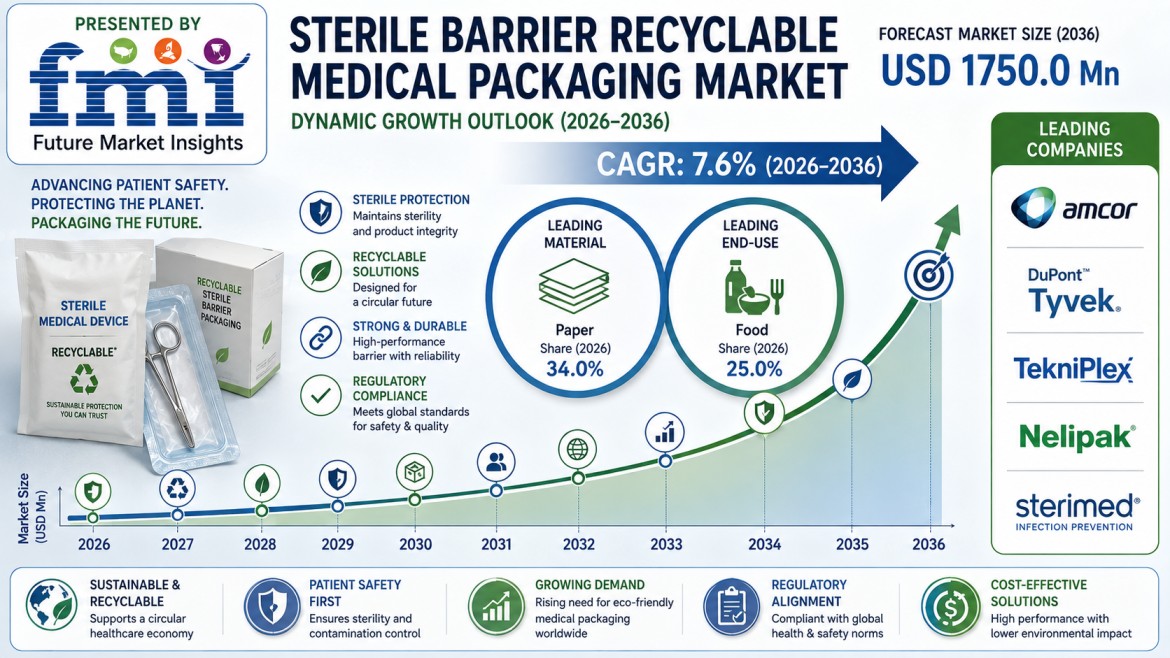
The global Sterile Barrier Recyclable Medical Packaging Market is expected to witness robust growth over the next decade as healthcare manufacturers increasingly adopt sustainable packaging solutions without compromising sterility, safety, or regulatory compliance. According to Future Market Insights (FMI), the market is projected to grow from USD 839.3 million in 2026 to USD 1,750.0 million by 2036, registering a CAGR of 7.6% during the forecast period.
The market is benefiting from rising demand for environmentally responsible medical packaging that maintains sterile integrity throughout sterilization, transportation, storage, and clinical use. Medical device manufacturers are increasingly seeking recyclable materials that comply with stringent regulatory requirements while supporting corporate sustainability goals.
International standards such as ISO 11607-1, recognized by regulatory authorities including the U.S. FDA, continue to shape packaging development. These standards require sterile barrier systems to maintain sterility until the point of use while enabling safe and controlled aseptic opening. As a result, packaging manufacturers are focusing on lightweight recyclable materials and optimized package structures instead of redesigning complete sterile systems.
The implementation of Regulation (EU) 2025/40, which came into force in 2025 and generally applies from August 2026, has also influenced market development across Europe. Although certain medical packaging formats remain exempt from specific recyclability requirements, the regulation encourages manufacturers to improve secondary and transport packaging while preserving validated primary sterile barriers.
Growing Focus on Sustainable Healthcare Packaging
Sustainability has become one of the strongest drivers for innovation in sterile medical packaging. Healthcare companies are under increasing pressure to reduce packaging waste, minimize material usage, and improve recyclability without affecting product safety.
Manufacturers are investing in recyclable paper structures, mono-material polyethylene films, recycled PET, molded fiber, and bio-based polymers that provide both environmental benefits and regulatory compliance. Instead of replacing existing packaging systems entirely, many organizations are adopting gradual material optimization strategies that preserve sealing performance while reducing environmental impact.
The growing availability of regional testing laboratories and coating facilities is also shortening package qualification timelines, allowing medical device manufacturers to commercialize recyclable packaging more efficiently.
Paper Continues to Lead Material Demand
Among material types, paper is projected to account for 34.0% of global demand in 2026, making it the largest material segment.
Breathable medical-grade paper remains widely preferred because it supports ethylene oxide sterilization while offering excellent sealing performance and compatibility with existing medical packaging equipment. Lower basis-weight coated papers are also helping manufacturers reduce material consumption without affecting package performance.
Recent investments in regional healthcare coating facilities have further strengthened paper adoption by reducing qualification lead times and improving local supply capabilities.
However, paper-based packaging still faces limitations in applications involving moisture-sensitive products, sharp medical instruments, and high-barrier packaging requirements where multilayer structures remain necessary.
Pouches Dominate Packaging Format
Pouches are expected to represent 15.0% of the market in 2026, making them the leading packaging format.
Medical pouches offer several operational advantages, including efficient material utilization, consistent sealing performance, excellent sterile protection, and controlled aseptic presentation during clinical procedures.
Their compatibility with automated packaging lines also reduces manufacturing costs while supporting high-volume medical device production. Innovations in mono-material polyethylene pouches further improve recyclability without sacrificing seal strength or peel performance.
Healthcare manufacturers continue to use sterile pouches extensively for wound care products, surgical instruments, diagnostic devices, dressings, and disposable medical components.
Food for Special Medical Purposes Emerges as Major End-use
Within end-use industries, Food for Special Medical Purposes (FSMP) is expected to capture 25.0% of market demand in 2026.
Unlike conventional food packaging, these products require strict contamination protection, documented shelf life, and reliable sterile barriers throughout the distribution chain.
Medical nutrition manufacturers are increasingly adopting recyclable secondary packaging while maintaining validated primary contact materials. This approach enables measurable reductions in packaging waste without compromising food safety or regulatory compliance.
Market Drivers
Several long-term factors are supporting the expansion of the sterile barrier recyclable medical packaging market. Growing demand for sustainable medical packaging remains the primary growth catalyst as healthcare organizations work toward reducing environmental impact while maintaining product quality. Continuous innovation in recyclable medical papers, mono-material flexible packaging, and bio-based polymers is improving packaging performance while supporting circular economy initiatives.
Regional investments in sterile packaging manufacturing facilities, coating operations, and technical development centers are accelerating commercialization by reducing package validation timelines. The expansion of global medical device manufacturing, pharmaceutical production, and healthcare infrastructure is also creating sustained demand for advanced sterile barrier packaging solutions.
Market Challenges
Despite strong growth prospects, the industry continues to face several challenges. Multilayer packaging structures remain difficult to recycle because different materials are often permanently bonded together. Even when individual components are recyclable, healthcare collection systems frequently lack the infrastructure to process complex medical packaging waste.
Regulatory qualification remains another significant barrier. Every packaging modification must undergo extensive testing for sterilization compatibility, seal integrity, microbial protection, shelf-life performance, and transportation durability before commercialization. These lengthy validation processes increase both development costs and time-to-market for new recyclable packaging solutions.
Regional Outlook
India is expected to remain the fastest-growing country, recording a CAGR of 10.3% through 2036. Expansion of medical device parks, increased healthcare manufacturing investments, and improved testing infrastructure continue to support market growth.
The United States is forecast to grow at 9.5% CAGR, driven by strong medical device production, established sterilization networks, and increasing investments in sustainable healthcare packaging.
The United Kingdom is projected to expand at 8.7% CAGR, supported by stricter healthcare waste reduction initiatives and updated medical device regulations.
France is expected to register 8.0% CAGR, while Japan and Germany are forecast to grow at 7.2% and 6.5%, respectively, as manufacturers continue investing in recyclable sterile packaging technologies and quality-focused production systems.
Competitive Landscape
Competition in the sterile barrier recyclable medical packaging market is centered on material innovation, sterile barrier validation, technical support, and regional manufacturing capabilities.
Leading companies are expanding healthcare coating facilities, developing recyclable sterile barrier materials, and strengthening package qualification services to support faster commercialization.
Major market participants include Amcor, DuPont Tyvek, TekniPlex, Nelipak, Sterimed, Billerud, Oliver Healthcare Packaging, and Coveris. These companies continue investing in recyclable packaging technologies, validation services, and regional production facilities to address the growing demand for sustainable sterile medical packaging.
Future Outlook
The sterile barrier recyclable medical packaging market is expected to experience sustained growth through 2036 as healthcare manufacturers increasingly prioritize sustainability alongside regulatory compliance and patient safety. Advances in recyclable materials, regional testing capabilities, and sterile packaging technologies will continue driving market expansion. Companies capable of delivering validated recyclable packaging solutions that maintain sterilization compatibility, seal integrity, and clinical performance are expected to strengthen their competitive position in the global healthcare packaging industry.
Related Research Reports:
Mono-PE Medical Device Pouches Market: The mono-PE medical device pouches market is expected to reach USD 0.61 billion in 2026 at a CAGR of 5.28% during the forecast period.
Medical Specialty Bag Market: Medical specialty bags is valued at USD 3.8 billion in 2025 and is projected to reach USD 4.1 billion in 2026.
Bio-medical Packaging Market: The bio-medical packaging market grow at a CAGR of 6.4% between 2026-2036 to reach USD 876.8 million by 2036.
About Future Market Insights (FMI)
Future Market Insights is a leading provider of market intelligence, consulting services, and syndicated research reports. FMI delivers actionable insights across packaging, logistics, industrial manufacturing, food and beverage, healthcare, chemicals, and emerging technologies, helping organizations identify growth opportunities and make informed strategic decisions in rapidly evolving markets.
Contact
Future Market Insights Inc.
Christiana Corporate
200 Continental Drive, Suite 401
Newark, Delaware 19713, USA
Email: sales@futuremarketinsights.com