

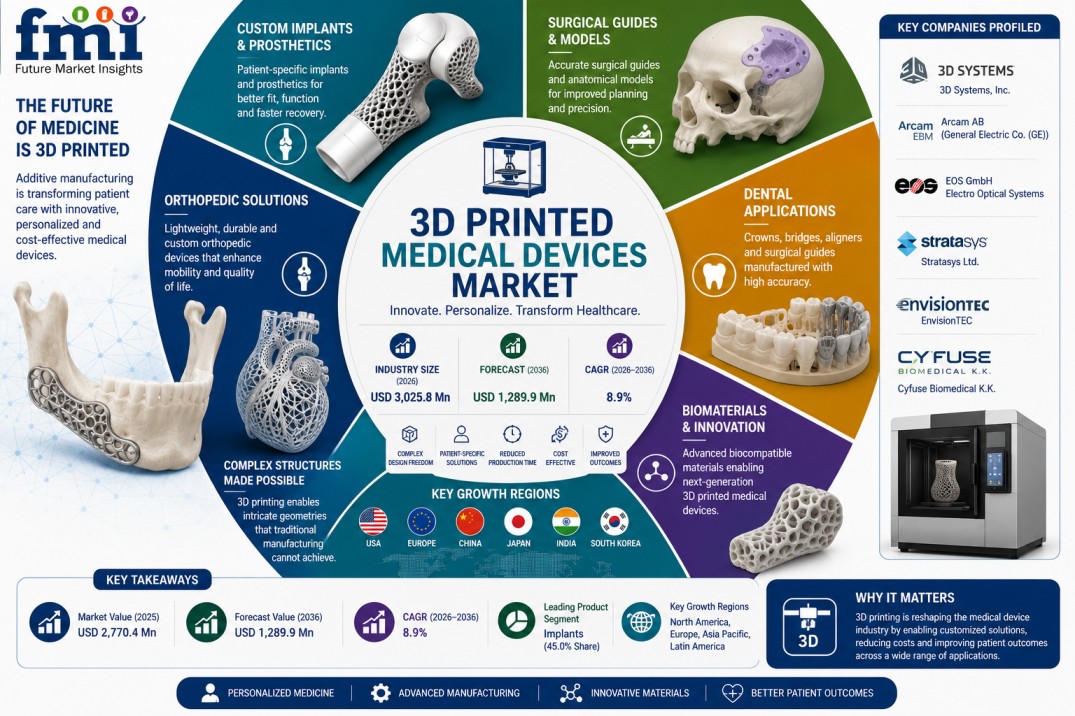
NEWARK, DE, July 17, 2026 –– The global 3D Printed Medical Devices Market is witnessing robust expansion as healthcare providers and medical device manufacturers increasingly adopt additive manufacturing technologies to produce customized implants, surgical instruments, prosthetics, and anatomical models. According to the latest market analysis, the market is projected to grow from USD 1,289.9 million in 2026 to USD 3,025.8 million by 2036, registering a CAGR of 8.9% during the forecast period.
The growing shift toward patient-specific healthcare, advances in biomaterials, rapid prototyping capabilities, and increasing adoption of personalized implants are reshaping the global medical device landscape. Innovations in metal 3D printing, bioprinting, artificial intelligence-assisted design, and robotic surgery are enabling healthcare providers to deliver more precise treatments while reducing production time, surgical complexity, and overall healthcare costs. As regulatory frameworks mature and healthcare investments continue to rise, 3D printing is expected to become an integral part of next-generation medical device manufacturing.
Key Market Highlights at a Glance
- Market Size (2026): USD 1,289.9 Million
- Forecast Market Size (2036): USD 3,025.8 Million
- Forecast CAGR (2026–2036): 8.9%
- Incremental Opportunity (2026–2036): USD 1,735.9 Million
- Leading Material Type: Metals & Alloys (54.8% market share)
- Fastest-Growing Markets: India (10.8% CAGR) and France (7.6% CAGR)
- Major Applications: Orthopedic Implants, Dental Implants, Surgical Instruments, Pre-surgical Models, Prosthetics
- Forecast Period: 2026–2036
- Countries Covered: United States, Canada, United Kingdom, Germany, France, China, Japan, South Korea, Brazil, Australia, India, and 40+ countries
- Report Length: 322 Pages
- Reviewed By: Anurag Sharma
Why Is the 3D Printed Medical Devices Market Growing?
The rapid adoption of additive manufacturing is transforming medical device production by enabling highly customized, patient-specific solutions with improved precision and shorter manufacturing timelines. Compared with traditional manufacturing techniques, 3D printing reduces material waste, supports complex geometries, and accelerates product development.
Growing demand for personalized implants, increasing orthopedic procedures, technological advancements in biomaterials, and rising investments in digital healthcare are creating strong long-term growth opportunities across hospitals, research institutes, and medical device manufacturers.
Primary Growth Drivers
- Increasing demand for customized implants, prosthetics, and patient-specific surgical solutions.
- Technological advances in metal 3D printing, biomaterials, and bioprinting technologies.
- Rising adoption of minimally invasive surgery supported by personalized surgical guides and anatomical models.
Analyst Quote
“Additive manufacturing is fundamentally changing how medical devices are designed, manufactured, and delivered. As healthcare increasingly embraces personalized treatment approaches, 3D printing will play a pivotal role in improving clinical outcomes, accelerating innovation, and reducing production costs across the global medical device industry.”
— Anurag Sharma, Healthcare Industry Analyst, Future Market Insights (FMI)
Which Material Type Leads the 3D Printed Medical Devices Market?
Metals and alloys dominate the market with 54.8% of the material segment due to their exceptional mechanical strength, biocompatibility, and widespread use in orthopedic, spinal, cranio-maxillofacial, and dental implants.
Titanium-based alloys continue to gain significant traction because they offer excellent osseointegration, corrosion resistance, and long-term durability for implantable medical devices.
Material Type Highlights
- Metals & Alloys – 54.8% market share
- Biomaterials
- Plastics
Which Applications Generate the Highest Demand?
Orthopedic and dental implants remain among the largest application segments as hospitals increasingly adopt patient-specific implants designed from CT and MRI imaging. Customized surgical guides, anatomical models, and prosthetic devices are also expanding rapidly due to improvements in precision medicine and surgical planning.
Major Applications
- Orthopedic Implants
- Dental Implants
- Pre-Surgical Models
- Surgical Guides
- Surgical Instruments
- Wearable Biosensors
- Cranio-Maxillofacial Implants
- Internal & External Prostheses
- Patient-Specific Organ Models
- Other Medical Applications
Which Technology Segment Supports Industry Innovation?
Several advanced additive manufacturing technologies are driving innovation by enabling the production of complex, highly customized medical devices with improved mechanical performance and biological compatibility.
Technology Segments
- Laser Beam Melting
- Stereolithography
- Selective Laser Sintering
- Digital Light Processing
- Fused Deposition Modeling
- Electron Beam Melting
- PolyJet/Inkjet 3D Printing
- Other Technologies
Which End User Segment Drives Market Growth?
Hospitals continue to represent the largest end-user segment due to increasing orthopedic and reconstructive procedures, while dental and orthopedic clinics are expanding rapidly as patient-specific implants become more accessible.
Academic research institutes and clinical research organizations are also investing heavily in bioprinting, tissue engineering, and regenerative medicine research.
End Users
- Hospitals
- Dental & Orthopedic Clinics
- Academic Research Institutes
- Clinical Research Organizations
Market Dynamics
Market Drivers
Increasing prevalence of orthopedic disorders, rising demand for customized implants, technological advancements in additive manufacturing, and expanding healthcare investments are driving market growth.
Growing adoption of digital imaging technologies, including CT and MRI-based 3D modeling, is enabling precise implant customization and improving surgical outcomes.
Market Restraints
High equipment costs, complex regulatory approval processes, quality assurance challenges, limited reimbursement, and shortages of skilled additive manufacturing professionals remain key barriers to broader market adoption.
Validation of patient-specific devices and ensuring manufacturing consistency continue to present technical challenges for manufacturers.
Emerging Market Trends
Key industry trends include:
- Expansion of patient-specific implants
- Growth of metal 3D printing technologies
- Increased use of titanium biomaterials
- Rapid advancement of bioprinting and tissue engineering
- AI-assisted implant design and surgical planning
- Integration of machine learning into additive manufacturing workflows
- Growing adoption of just-in-time medical device manufacturing
Regional and Country Outlook
Fastest-Growing Markets
- India – 10.8% CAGR
- France – 7.6% CAGR
Regional Growth Story
United States
The United States remains a global innovation hub, supported by advanced healthcare infrastructure, significant R&D investments, and widespread adoption of personalized medical technologies.
India
India is projected to be one of the fastest-growing markets as expanding healthcare infrastructure, increasing orthopedic procedures, medical tourism, and rising investments in digital healthcare drive adoption.
France
France continues to strengthen its market position through investments in advanced manufacturing technologies, supportive healthcare policies, and increasing use of personalized implants.
Germany
Germany benefits from a strong medical device manufacturing ecosystem, technological innovation, and extensive adoption of additive manufacturing across healthcare applications.
China
China is experiencing robust growth through increasing healthcare investments, government support for advanced manufacturing, and expanding medical device production capabilities.
Competitive Landscape
The global 3D Printed Medical Devices Market is characterized by continuous innovation, strategic collaborations, acquisitions, and investments in next-generation additive manufacturing technologies. Market participants are focusing on expanding biomaterial portfolios, improving printing precision, and accelerating commercialization of patient-specific devices.
Key Companies
- 3D Systems, Inc. – Medical additive manufacturing solutions
- Arcam AB (General Electric Co.) – Electron beam melting technologies
- EOS GmbH Electro Optical Systems – Industrial metal additive manufacturing
- Stratasys Ltd. – Multi-material 3D printing platforms
- EnvisionTEC – High-precision dental and medical printing solutions
- Cyfuse Biomedical K.K. – Bioprinting and regenerative medicine technologies
- Formlabs, Inc. – Desktop medical-grade 3D printing systems
- FabRx Ltd. – Pharmaceutical and personalized medicine 3D printing
Competitive differentiation increasingly depends on biomaterial innovation, software integration, AI-assisted design, regulatory approvals, and partnerships with healthcare providers and research institutions.
Frequently Asked Questions (FAQ)
- What is the projected size of the 3D Printed Medical Devices Market by 2036?
The global 3D Printed Medical Devices Market is projected to reach USD 3,025.8 million by 2036.
- What is the expected CAGR of the 3D Printed Medical Devices Market?
The market is expected to grow at a CAGR of 8.9% from 2026 to 2036.
- Which material segment dominates the market?
Metals and alloys lead the market, accounting for 54.8% of the material type segment in 2026.
- Which applications are driving demand for 3D printed medical devices?
Orthopedic implants, dental implants, surgical guides, prosthetics, and patient-specific anatomical models are among the primary applications driving market growth.
- Which countries are expected to experience the fastest growth?
India, with a projected 10.8% CAGR, and France, with a 7.6% CAGR, are among the fastest-growing markets during the forecast period.
- Who are the leading companies in the 3D Printed Medical Devices Market?
Major industry participants include 3D Systems, Inc., Arcam AB (General Electric Co.), EOS GmbH Electro Optical Systems, Stratasys Ltd., EnvisionTEC, Cyfuse Biomedical K.K., Formlabs, Inc., and FabRx Ltd.
Related Reports:
- The 3D printed surgical models market is projected to reach USD 0.75 billion in 2026 and USD 2.90 billion by 2036 at 15.6% CAGR.
- The 3D Printed Prosthetics Market was valued at USD 1.90 billion in 2025. Sales are expected to reach USD 2.05 billion in 2026 and USD 4.43 billion by 2036.
- The 3D Printed Brain Model Market was valued at USD 53.90 billion in 2025. Sales are expected to reach USD 63.87 billion in 2026 and USD 348.73 billion by 2036.
About Future Market Insights (FMI)
Future Market Insights, Inc. (ESOMAR certified, recipient of the Stevie® Award, and a member of the Greater New York Chamber of Commerce) provides deep insights into governing factors elevating demand in global markets.
FMI delivers market intelligence, consulting services, and syndicated research reports across chemicals, materials, food ingredients, pharmaceuticals, industrial manufacturing, sustainability, advanced materials, and infrastructure sectors.
Economics
With global expertise and industry-focused research capabilities, FMI provides actionable insights that help organizations understand market dynamics and identify emerging opportunities.
Contact
Future Market Insights Inc.
Christiana Corporate, 200 Continental Drive, Suite 401, Newark, Delaware 19713, USA
Rahul Singh
AVP – Marketing and Growth Strategy
Future Market Insights, Inc.
Phone: +91 8600020075
For Media: Rahul.Singh@futuremarketinsights.com
Email: sales@futuremarketinsights.com
Website: www.futuremarketinsights.com