

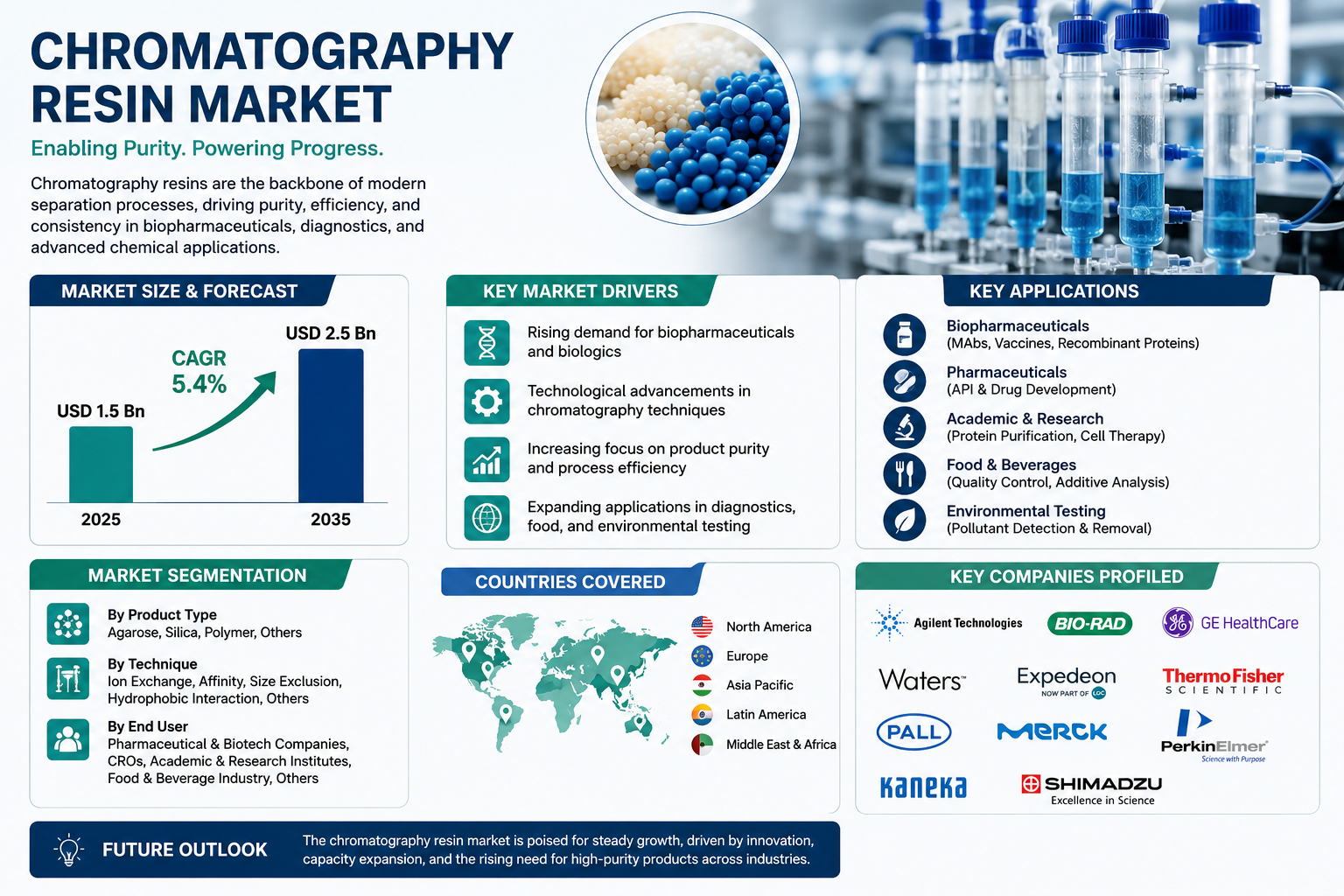
NEWARK, Del., July 14, 2026 — The global Healthcare industry continues to witness rapid growth in biologics manufacturing, making the Chromatography Resin Market an essential component of modern downstream bioprocessing. According to Future Market Insights (FMI), the global Chromatography Resin Market is projected to grow from USD 1.5 billion in 2025 to USD 2.5 billion by 2035, registering a 5.4% CAGR during the forecast period. Rising production of monoclonal antibodies, vaccines, recombinant proteins, and gene therapies, coupled with increasing demand for high-purity biomolecule separation and continuous bioprocessing technologies, is expected to drive sustained market expansion worldwide.
The market continues to benefit from growing investments in biopharmaceutical manufacturing, increasing adoption of affinity chromatography technologies, and continuous innovations in resin chemistry that improve purification efficiency, resin longevity, and manufacturing economics. As biologics production scales globally, chromatography resins remain a critical contributor to downstream process optimization and cost reduction.
Get Detailed Market Forecasts, Competitive Benchmarking, and Pricing Trends
Key Chromatography Resin Market Highlights at a Glance
- Market Size (2025): USD 1.5 Billion
- Forecast Market Size (2035): USD 2.5 Billion
- Forecast Period: 2025–2035
- CAGR (2025–2035):4%
- Leading Resin Type: Synthetic (73.3% Market Share in 2025)
- Leading Technology: Affinity Chromatography (36.3% Market Share in 2025)
- Key Growth Regions: North America, Asia-Pacific, Europe
- Key Segments Covered: Resin Type, Technology, Application, End User, Region
- Report Pages: 342
- Last Updated: October 23, 2025
- Reviewed by: Anurag Sharma
Why Is the Chromatography Resin Market Growing?
The market is expanding steadily as biopharmaceutical manufacturers increasingly focus on improving purification efficiency, maximizing resin utilization, and reducing downstream manufacturing costs.
Key Growth Drivers
- Rising production of monoclonal antibodies and biologics.
- Growing demand for high-purity protein purification.
- Increasing adoption of affinity chromatography technologies.
- Expansion of vaccine and cell & gene therapy manufacturing.
- Continuous innovations in resin chemistry and binding capacity.
- Growing implementation of continuous bioprocessing systems.
- Increasing investments in biopharmaceutical R&D.
- Rising emphasis on reducing downstream manufacturing costs.
As downstream purification remains one of the most expensive stages of biologics manufacturing, advanced chromatography resins are becoming increasingly important for improving production efficiency and commercial scalability.
According to Anurag Sharma, Principal Consultant for Healthcare at Future Market Insights, “Chromatography resin has evolved from a routine purification material into a strategic economic lever in biologics manufacturing. Resin lifetime, dynamic binding capacity, alkaline stability, and compatibility with continuous downstream processing increasingly determine overall manufacturing efficiency and long-term production economics.”
Which Resin Type Leads the Chromatography Resin Market?
Synthetic chromatography resins remain the dominant segment, accounting for 73.3% of the global market in 2025.
Their superior chemical stability, high binding capacity, longer operational lifetime, and compatibility with modern purification processes continue supporting widespread adoption across commercial biopharmaceutical manufacturing.
Resin Segment Highlights
- Synthetic resins dominate global market demand.
- High durability supports extended operational cycles.
- Superior chemical stability improves purification performance.
- Greater compatibility with large-scale biologics manufacturing.
Why Does Affinity Chromatography Dominate the Market?
Affinity chromatography accounts for 36.3% of total market demand in 2025 due to its exceptional selectivity, high purification efficiency, and extensive use in monoclonal antibody and recombinant protein manufacturing.
Protein A affinity resins remain the preferred choice for antibody purification despite their relatively higher cost because they deliver superior product recovery and process consistency.
Technology Segment Highlights
- Affinity chromatography remains the leading purification technology.
- Protein A resins enable high-yield antibody purification.
- Improved selectivity enhances manufacturing efficiency.
- Continuous process integration strengthens commercial adoption.
How Are Biologics Manufacturing Trends Supporting Market Expansion?
Growing demand for biologics, biosimilars, vaccines, and advanced therapies is increasing the need for highly efficient downstream purification technologies capable of improving product quality while reducing production costs.
Manufacturing Highlights
- Continuous chromatography improves resin utilization.
- Higher dynamic binding capacity reduces operating costs.
- Longer resin lifetime lowers total cost per gram of biologic product.
- Advanced purification technologies improve commercial scalability.
- Buffer optimization and process intensification enhance manufacturing efficiency.
Market Dynamics
Market Drivers
Increasing biologics production, rising demand for monoclonal antibodies, expansion of cell and gene therapies, continuous improvements in downstream processing technologies, and growing investments in biopharmaceutical manufacturing continue driving market growth.
Market Restraints
High costs associated with premium affinity resins, stringent regulatory requirements, complex downstream validation processes, and supply chain challenges for specialized purification materials continue posing challenges for manufacturers.
Market Trends
Innovation continues reshaping downstream bioprocessing.
Major trends include:
- Expansion of continuous chromatography systems.
- Development of high-capacity Protein A resins.
- Increasing adoption of reusable chromatography media.
- Growth in automated purification platforms.
- Advanced resin chemistries for intensified processing.
- Greater focus on reducing biologics manufacturing costs.
Regional and Country Outlook
North America continues to dominate the global Chromatography Resin Market owing to strong biopharmaceutical manufacturing capabilities, extensive biologics research, and significant investments in downstream processing technologies.
Europe remains a major market supported by advanced pharmaceutical manufacturing infrastructure and stringent quality standards.
Asia-Pacific is expected to witness substantial growth driven by expanding biopharmaceutical production, increasing contract manufacturing activities, and growing investments in biotechnology infrastructure across emerging economies.
Competitive Landscape
Competition remains highly dynamic, with leading manufacturers focusing on advanced resin chemistries, continuous processing compatibility, higher binding capacities, strategic acquisitions, and manufacturing expansion to strengthen their global market presence.
Key Companies
- GE Healthcare
- Thermo Fisher Scientific Inc.
- Waters Corporation
- Merck KGaA
- Agilent Technologies
- Bio-Rad Laboratories
- Pall Corporation
- PerkinElmer Inc.
- Shimadzu Corporation
- Avantor Performance Materials Inc.
- Mitsubishi Chemical Corporation
- R. Grace & Co.
- Kaneka Corporation
- Tosoh Bioscience
- Expedeon Ltd.
- Life Technology Corporation
- JSR Micro Inc.
- Knauer GmbH
Frequently Asked Questions
- What is the projected size of the Chromatography Resin Market by 2035?
The global Chromatography Resin Market is projected to reach USD 2.5 billion by 2035, growing from USD 1.5 billion in 2025.
- What is the expected CAGR of the Chromatography Resin Market?
The market is forecast to expand at a 5.4% CAGR between 2025 and 2035.
- Which resin type dominates the market?
Synthetic chromatography resins lead the market, accounting for 73.3% of total demand in 2025.
- Which technology segment holds the largest market share?
Affinity chromatography remains the leading technology, capturing 36.3% of the market in 2025.
- What factors are driving market growth?
Growing biologics production, increasing demand for monoclonal antibody purification, rising adoption of continuous downstream processing, advancements in resin chemistry, expanding vaccine and gene therapy manufacturing, and increasing investments in biopharmaceutical production continue driving global market growth.
Related Reports
- The chromatography instrumentation market is projected to grow from USD 10.9 billion in 2025 to USD 18.3 billion by 2035, at a CAGR of 5.3%.
- The DNA chromatography chips market is projected to grow from USD 1.3 billion in 2025 to USD 3.5 billion by 2035, at a CAGR of 10.2%.
- The plant genome extraction kit market is projected to grow from USD 804.9 million in 2025 to USD 1,336.3 million by 2035, at a CAGR of 5.2%.
About Future Market Insights (FMI)
Future Market Insights, Inc. (ESOMAR certified, recipient of the Stevie® Award, and a member of the Greater New York Chamber of Commerce) provides deep insights into governing factors elevating demand in global markets.
FMI delivers market intelligence, consulting services, and syndicated research reports across healthcare, pharmaceuticals, chemicals, materials, food ingredients, industrial manufacturing, sustainability, and advanced materials sectors.
With global expertise and industry-focused research capabilities, FMI provides actionable insights that help organizations understand market dynamics and identify emerging opportunities.
Contact
Future Market Insights Inc.
Christiana Corporate, 200 Continental Drive, Suite 401, Newark, Delaware 19713, USA
Rahul Singh
AVP – Marketing and Growth Strategy
Future Market Insights, Inc.
Phone: +91 8600020075
For Sales – sales@futuremarketinsights.com
For Media – Rahul.singh@futuremarketinsights.com
Website: www.futuremarketinsights.com