

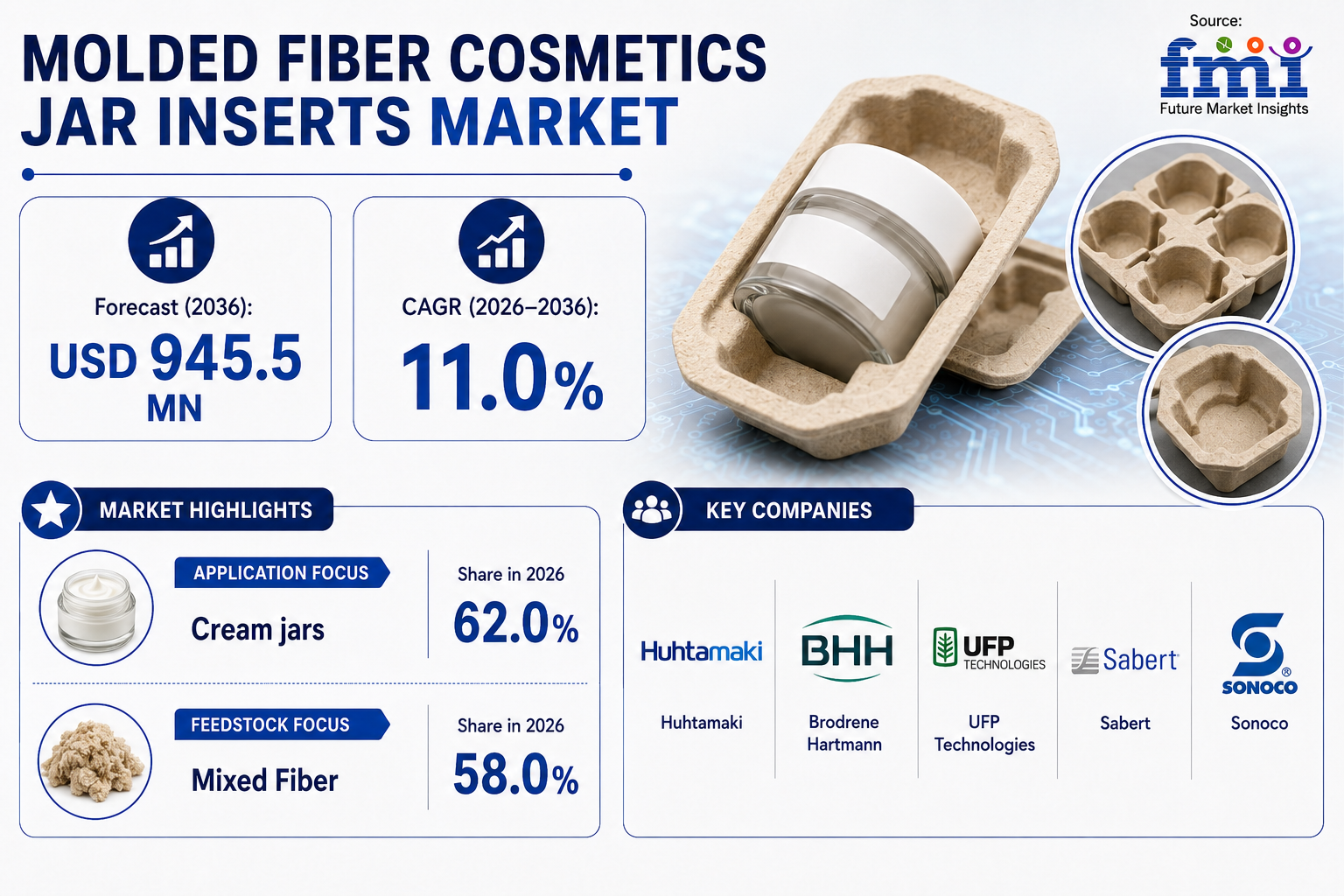
The Molded Fiber Cosmetics Jar Inserts Market is projected to experience strong growth over the coming decade as cosmetic brands increasingly adopt sustainable packaging solutions to replace conventional plastic and foam inserts. According to Future Market Insights (FMI), the global market is expected to grow from USD 333.0 million in 2026 to USD 945.5 million by 2036, expanding at a CAGR of 11.0% during the forecast period. Rising environmental regulations, growing consumer demand for eco-friendly cosmetic packaging, and increased adoption of recyclable protective materials are driving the transition toward molded fiber packaging solutions across the beauty and personal care industry.
Sustainability Trends Accelerate Adoption of Molded Fiber Packaging
The cosmetics industry is undergoing a significant transformation as manufacturers seek environmentally responsible packaging alternatives that reduce plastic waste without compromising product protection. Molded fiber cosmetics jar inserts have emerged as an attractive solution because they provide excellent cushioning, minimize transportation damage, and are manufactured using renewable or recycled fiber materials.
Governments worldwide are strengthening packaging regulations to encourage recyclable and compostable materials. Regulations such as the European Union Packaging and Packaging Waste Regulation (PPWR), together with increasing corporate sustainability commitments, are encouraging cosmetic brands to replace traditional foam inserts with molded fiber alternatives. At the same time, international standards related to packaging quality, recyclability, and material certification are influencing procurement decisions across global markets.
Rising Demand from Premium Cosmetic Brands
Premium skincare and beauty products require protective packaging that maintains product integrity during transportation while enhancing the customer unboxing experience. Molded fiber inserts provide secure positioning for cosmetic jars, reducing movement inside cartons and minimizing the risk of breakage during shipping.
The rapid growth of e-commerce has further accelerated demand for protective packaging solutions. Online cosmetic retailers require packaging materials capable of withstanding multiple handling stages while maintaining attractive product presentation. As a result, packaging engineers are increasingly incorporating molded fiber inserts into premium skincare packaging for creams, balms, facial masks, refill systems, and gift sets. Brand owners are also prioritizing packaging materials that align with their sustainability messaging. The ability to offer recyclable and biodegradable packaging helps companies strengthen their environmental credentials while meeting changing consumer preferences.
Inserts Continue to Lead Product Demand
Among product categories, inserts are expected to dominate the market with a 34.3% share in 2026. Their popularity stems from their ability to provide customized cushioning, excellent fit, and reliable protection for fragile cosmetic jars during storage and transportation.
Unlike conventional plastic inserts, molded fiber inserts offer superior environmental performance while maintaining structural strength and product stability. Their compatibility with automated packaging lines and growing availability across multiple cosmetic formats further supports widespread adoption. Other product forms, including jar cradles, unit trays, clamshells, and dividers, are also witnessing increasing demand across premium cosmetic packaging applications where enhanced product protection is essential.
Mixed Fiber Becomes the Preferred Feedstock
By feedstock, mixed fiber is anticipated to account for 31.1% of the market in 2026, making it the leading raw material segment. Mixed fiber combines recycled paper with renewable fiber sources to deliver an effective balance between mechanical strength, cushioning performance, and sustainability.
Manufacturers continue investing in advanced molded fiber technologies that improve surface finish, dimensional accuracy, and moisture resistance while maintaining recyclability. Other materials such as recycled paper, virgin wood pulp, bamboo, and bagasse are also gaining popularity as cosmetic companies diversify sustainable material sourcing strategies.
Standard Finish Dominates Commercial Applications
Based on finish, the Standard category is expected to capture 35.2% of the global market in 2026. Standard molded fiber inserts provide adequate protection for most cosmetic packaging applications while offering cost-effective manufacturing and simplified production processes.
Premium cosmetic brands are also exploring fine-molded, embossed, dyed, and coated finishes to enhance product presentation and brand differentiation. These advanced finishing techniques improve aesthetics without compromising the environmental benefits associated with molded fiber packaging.
Cream Jars Drive Application Growth
Among applications, Cream Jars are projected to hold the largest market share at 40.0% in 2026. Facial creams, moisturizers, anti-aging products, and premium skincare formulations often use glass or heavy plastic containers that require effective cushioning during distribution.
Protective molded fiber inserts help prevent breakage, maintain product positioning, and reduce shipping damage, making them an ideal solution for premium cosmetic packaging. Growing consumer demand for luxury skincare products and subscription beauty boxes continues to increase the adoption of sustainable protective packaging. Applications involving balms, masks, refill systems, and cosmetic gift sets are also expected to contribute significantly to future market expansion.
India Emerges as the Fastest-Growing Market
From a regional perspective, India is forecast to record the fastest growth with a CAGR of 10.0% through 2036. Rapid expansion of domestic cosmetic manufacturing, increasing online beauty retail, and growing awareness of sustainable packaging are creating substantial opportunities for molded fiber packaging suppliers.
China also remains an important growth market, supported by its large-scale cosmetics manufacturing industry and expanding export activities. Meanwhile, North America and Europe continue to generate steady demand due to stringent environmental regulations, established premium beauty brands, and strong consumer preference for sustainable packaging solutions. Countries including Germany, the United Kingdom, Japan, and South Korea are expected to witness consistent growth as cosmetic manufacturers adopt recyclable packaging materials to comply with evolving regulatory requirements and corporate sustainability goals.
Competitive Landscape
Competition within the Molded Fiber Cosmetics Jar Inserts Market is focused on product performance, material innovation, manufacturing capabilities, and sustainability credentials. Leading companies are investing in advanced molded fiber technologies that deliver improved cushioning, superior aesthetics, and enhanced production efficiency.
Major companies operating in the market include Huhtamaki, Brodrene Hartmann, UFP Technologies, Sabert, Sonoco, Henry Molded Products, EnviroPAK, and Mondi. These companies continue expanding production capacity, strengthening regional supply chains, and developing customized molded fiber packaging solutions for cosmetic manufacturers. Strategic collaborations with beauty brands, investments in recyclable packaging innovation, and expansion of molded fiber production facilities remain important competitive strategies across the industry.
Future Outlook
The Molded Fiber Cosmetics Jar Inserts Market is expected to witness sustained growth as cosmetic companies accelerate the transition toward environmentally responsible packaging solutions. With the market projected to reach USD 945.5 million by 2036, manufacturers are increasingly focusing on product innovation, improved protective performance, and sustainable material development.
Growing demand from skincare, premium cosmetics, e-commerce fulfillment, and luxury beauty packaging will continue to support market expansion over the forecast period. As sustainability becomes a core purchasing criterion across the cosmetics industry, molded fiber cosmetics jar inserts are expected to play a vital role in the future of protective packaging worldwide.
Related Research Reports
Compostable Beauty Product Mailers Market: USD 407.5 million in 2026 and USD 1,408.0 million by 2036 at a 13.2% CAGR.
Compostable Small Parcel Mailers Market: USD 632.2 million in 2026 and USD 2,127.3 million by 2036 at a 12.9% CAGR.
Molded Fiber Beauty Packaging Inserts Market: The molded fiber beauty packaging inserts market is projected to reach USD 1,705.1 million by 2036, growing at an 11.4% CAGR.
About Future Market Insights (FMI)
Future Market Insights is a leading provider of market intelligence, consulting services, and syndicated research reports. FMI delivers actionable insights across packaging, logistics, industrial manufacturing, food and beverage, healthcare, chemicals, and emerging technologies, helping organizations identify growth opportunities and make informed strategic decisions in rapidly evolving markets.
Economics
Contact
Future Market Insights Inc.
Christiana Corporate
200 Continental Drive, Suite 401
Newark, Delaware 19713, USA
Email: sales@futuremarketinsights.com
Website: www.futuremarketinsights.com