

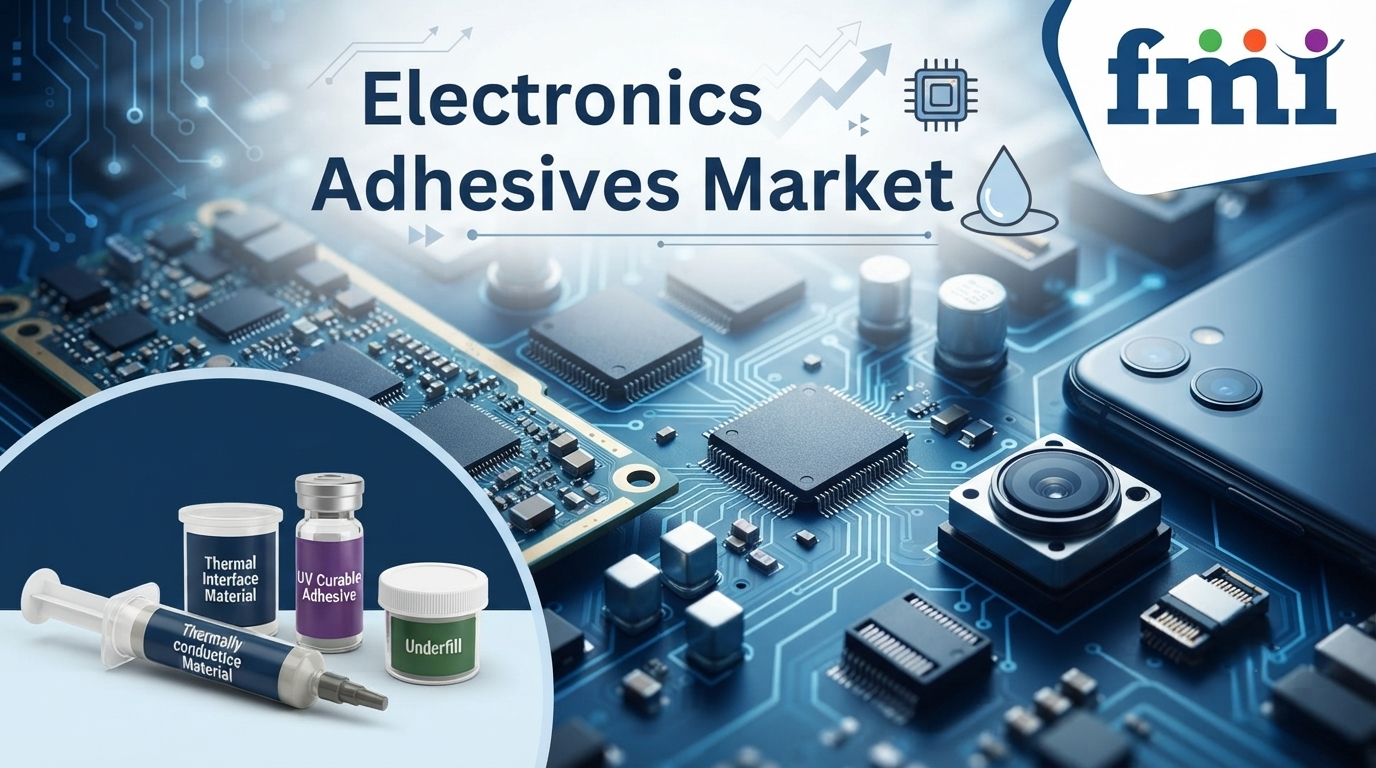
The global Electronics Adhesives Market is undergoing a structural transformation as manufacturers shift from competing primarily on manufacturing efficiency to differentiating through thermal performance, technical support, and application-specific engineering. Industry analysis indicates that pricing across the market is increasingly influenced by raw material volatility, specialty filler costs, and qualification requirements rather than conventional production complexity.
Epoxy resins and silicone precursors remain the dominant cost contributors, exposing manufacturers to fluctuations in petrochemical markets. At the same time, demand for advanced thermal interface materials, conductive adhesives, and semiconductor packaging solutions is increasing the use of premium fillers such as silver, aluminum nitride, and boron nitride. These materials significantly improve electrical and thermal conductivity while creating substantial pricing differences across product categories.
Market Overview
The Electronics Adhesives Market has evolved beyond traditional bonding materials into a technology-intensive industry supporting modern electronics manufacturing. Adhesives now perform multiple functions, including structural bonding, electrical insulation, thermal management, vibration resistance, and environmental protection across increasingly compact electronic devices.
Unlike conventional industrial adhesives, electronics adhesives rely heavily on specialty raw materials that determine both product performance and overall production economics. Epoxy systems derived from epichlorohydrin and bisphenol-A remain widely used because of their excellent mechanical strength and chemical resistance. Silicone-based formulations continue expanding due to superior flexibility and thermal stability required in automotive electronics, semiconductor packaging, and high-temperature applications.
Key Growth Drivers
- Rising demand for thermal management materials in electric vehicles, power electronics, and semiconductor packaging.
- Increasing adoption of conductive adhesives using silver, aluminum nitride, and boron nitride fillers.
- Growing electronics miniaturization requiring advanced bonding and heat dissipation solutions.
- Expansion of automotive electronics requiring long-term reliability and qualification standards.
- Increasing investment in application engineering and customized adhesive formulations.
- Strong demand for supply chain resilience through regional manufacturing and diversified sourcing strategies.
Technology & Innovation Trends
Innovation within the Electronics Adhesives Market is increasingly centered on improving thermal conductivity without compromising mechanical integrity or manufacturing efficiency.
Academic research demonstrates that unfilled epoxy adhesives possess relatively low thermal conductivity. By incorporating engineered fillers such as aluminum nitride, boron nitride, ceramic particles, or silver flakes, manufacturers can dramatically improve heat transfer performance while enabling higher device reliability.
The industry is simultaneously investing in advanced mixing technologies capable of achieving uniform filler dispersion. Maintaining consistent thermal conductivity across production batches has become essential for semiconductor packaging, automotive electronics, telecommunications infrastructure, and industrial automation systems.
Market Challenges & Restraints
Despite favorable long-term demand, the Electronics Adhesives Market faces several structural challenges.
Raw material volatility remains one of the industry’s largest risks. Epoxy resin prices closely follow fluctuations in global crude oil markets, while silicone intermediates are similarly exposed to energy costs, geopolitical uncertainty, and environmental regulations. These fluctuations directly affect production costs and profitability throughout the supply chain.
Specialty filler materials further increase pricing uncertainty. Silver flakes, ceramic fillers, aluminum nitride, and boron nitride represent significant portions of total manufacturing costs for premium conductive formulations. As demand grows across multiple industries, securing reliable supplies of these materials becomes increasingly important.
Smaller manufacturers also face considerable challenges in maintaining long-term customer contracts during periods of raw material inflation. Without vertically integrated supply chains or diversified procurement strategies, they often struggle to absorb sudden cost increases while remaining price competitive.
Segment Analysis
The Electronics Adhesives Market can be broadly categorized into three major pricing and performance segments.
The first consists of commodity-grade acrylic and standard epoxy adhesives, which primarily serve general electronics assembly applications where cost efficiency remains the principal purchasing criterion. These products compete largely on price and production scale.
The second segment includes functional adhesive systems incorporating ceramic fillers designed for enhanced thermal performance and substrate compatibility. These products address growing demand from industrial electronics, telecommunications equipment, and advanced consumer electronics requiring improved heat management.
The premium segment comprises electrically conductive and thermally conductive adhesives utilizing silver, aluminum nitride, or boron nitride fillers. These solutions support semiconductor packaging, electric vehicle power electronics, aerospace electronics, and battery thermal management applications. In this category, filler materials frequently account for the largest share of production costs, creating substantial price premiums compared with conventional adhesive systems.
Industry analysts observe that profitability increasingly concentrates within these specialized applications, where qualification requirements, engineering support, and long-term reliability justify premium pricing.
Regional Analysis
Asia-Pacific continues to dominate global electronics adhesives manufacturing due to its proximity to major electronics assembly operations and semiconductor production facilities. The concentration of electronics manufacturing throughout the region creates significant logistics efficiencies while supporting close collaboration between adhesive suppliers and original equipment manufacturers.
Chinese producers have established strong positions within commodity-grade adhesive manufacturing through cost optimization and integrated regional supply chains. However, competition in high-performance applications increasingly favors manufacturers capable of delivering advanced technical support and long-term reliability validation.
European and North American manufacturers remain highly competitive in specialized markets including automotive electronics, aerospace systems, and advanced semiconductor packaging. Their strengths lie in regulatory compliance, engineering expertise, and customer qualification support rather than low-cost manufacturing.
Meanwhile, nearshoring trends and growing geopolitical uncertainty are encouraging regional production diversification, enabling manufacturers to strengthen supply chain resilience while reducing logistics risks for critical electronics applications.
Competitive Landscape
Competition within the Electronics Adhesives Market has shifted from commodity manufacturing toward application expertise and integrated customer support.
Leading suppliers increasingly compete by offering comprehensive engineering services, qualification assistance, customized formulations, and manufacturing optimization rather than focusing solely on adhesive chemistry. Supply continuity has also emerged as a strategic differentiator as manufacturers seek reliable partners capable of maintaining production during raw material disruptions.
Companies with vertically integrated supply chains and diversified sourcing strategies are better positioned to withstand raw material volatility while preserving long-term customer relationships.
Leading Companies Analysis
Industry leaders including Henkel Loctite, 3M, and Shin-Etsu continue strengthening their market positions through extensive research investments and global technical service infrastructure.
Henkel emphasizes process integration by combining adhesive products with dispensing equipment, curing technologies, and production optimization services. This approach allows customers to reduce total manufacturing costs while improving process consistency.
3M leverages its broad materials science portfolio to deliver integrated solutions incorporating adhesives alongside thermal interface materials, electromagnetic shielding technologies, and optical films. This systems-based strategy creates higher switching costs while expanding long-term customer relationships.
Shin-Etsu remains a significant supplier of advanced silicone-based materials supporting high-temperature electronics, semiconductor manufacturing, and demanding thermal management applications.
Investment & Strategic Developments
Investment across the Electronics Adhesives Market increasingly targets thermal management innovation, advanced filler technologies, semiconductor packaging materials, and regional manufacturing capabilities.
Manufacturers continue expanding technical centers that provide application testing, rapid prototyping, qualification support, and custom formulation development. Simultaneously, companies are investing in supply chain diversification and regional production facilities to reduce exposure to geopolitical disruptions while improving customer responsiveness.
These strategic investments position suppliers to capture growing demand from electric vehicles, industrial automation, advanced consumer electronics, renewable energy systems, and next-generation semiconductor manufacturing.
Future Outlook
The future of the Electronics Adhesives Market will be shaped by increasing electronics complexity, higher power densities, and continued demand for efficient thermal management solutions.
As semiconductor packaging becomes more sophisticated and electric vehicle production accelerates, demand for conductive and thermally enhanced adhesive systems is expected to grow significantly. At the same time, customers will increasingly prioritize suppliers capable of providing engineering expertise, qualification support, and resilient global supply chains.
Manufacturers that successfully integrate advanced material science with technical service capabilities will likely capture greater value than competitors focused solely on production efficiency.
FMI Custom Research: Strategic Intelligence for Confident Decision-Making
In today’s rapidly evolving business environment, leadership teams need more than market data—they need clear, actionable intelligence tailored to their strategic objectives. FMI’s Custom Research solutions are designed around the specific business questions organizations need answered, enabling executives to evaluate growth opportunities, validate investments, assess competitive dynamics, and reduce uncertainty before making critical decisions. By combining deep industry expertise, primary research, and proprietary market intelligence, FMI delivers insights that help organizations move from assumptions to evidence-based strategies with greater speed and confidence.
Key Executive Benefits
- Decision-Ready Insights: Research tailored to your specific business challenges, growth plans, and investment priorities.
- Reduced Strategic Risk: Validate market opportunities, customer demand, and competitive positioning before committing resources.
- Market Entry Confidence: Assess opportunity size, regulatory barriers, channel dynamics, and competitive landscapes with precision.
- Competitive Advantage: Gain proprietary intelligence unavailable through syndicated reports or internal datasets.
- Faster Growth Decisions: Accelerate expansion, product development, portfolio optimization, and investment planning.
- Primary Market Validation: Access real-world customer, buyer, and stakeholder insights that support high-confidence decision-making.
- Global Industry Expertise: Powered by 100+ analysts, 20,000+ published reports, and 1.6 million+ hours of research experience.
- Proven Track Record: Over 7,000 market-entry engagements completed across six regions and 14 industry sectors with strong client retention.
Business Impact
FMI helps organizations transform market complexity into strategic clarity, enabling leadership teams to identify growth opportunities faster, optimize resource allocation, strengthen competitive positioning, and make high-stakes business decisions with confidence.
Related Report:
About Future Market Insights (FMI)
Future Market Insights (FMI) is a global market intelligence and consulting firm providing comprehensive market research, competitive intelligence, and strategic business insights across industries. The firm delivers detailed forecasts, technology analysis, and data-driven recommendations that support informed decision-making for manufacturers, investors, distributors, and policymakers worldwide.
For Press & Corporate Inquiries
Rahul Singh
AVP – Marketing and Growth Strategy
Future Market Insights, Inc.
+91 8600020075
For Sales – sales@futuremarketinsights.com
For Media – Rahul.singh@futuremarketinsights.com
For web – https://www.futuremarketinsights.com/