

The global fermented ingredients market is evolving from an innovation-driven sector into a production-efficiency business where commercial success depends less on biotechnology headlines and more on industrial economics. While fermentation continues to unlock new opportunities across amino acids, proteins, enzymes, probiotics, organic acids, and specialty metabolites, widespread adoption is increasingly determined by fermentation yield, feedstock utilization, downstream processing efficiency, and application-specific cost competitiveness.
Fermented ingredients are no longer evaluated simply by their natural origin or sustainability credentials. Food manufacturers, nutrition companies, and ingredient buyers are focusing on cost-in-use, supply reliability, production scalability, and formulation performance. An ingredient that performs exceptionally in laboratory-scale fermentation may still struggle commercially if production costs, purification requirements, or feedstock volatility prevent it from competing with conventional alternatives.
Featured Snippet: Key Market Answer
Q: Why is fermentation yield becoming more important than ingredient novelty in the fermented ingredients market?
A: Fermentation yield determines how efficiently microorganisms convert feedstocks into commercially valuable ingredients. High-yield processes reduce raw material consumption, production time, energy use, and downstream purification costs, making ingredients more competitive against conventional alternatives. While innovative fermented compounds generate market interest, long-term commercial success depends on scalable manufacturing, cost-in-use, and consistent production economics rather than technological novelty alone.
Quick Stats of the Fermented Ingredients Market
- Core Growth Theme: Yield Optimization and Commercial Bioprocess Efficiency
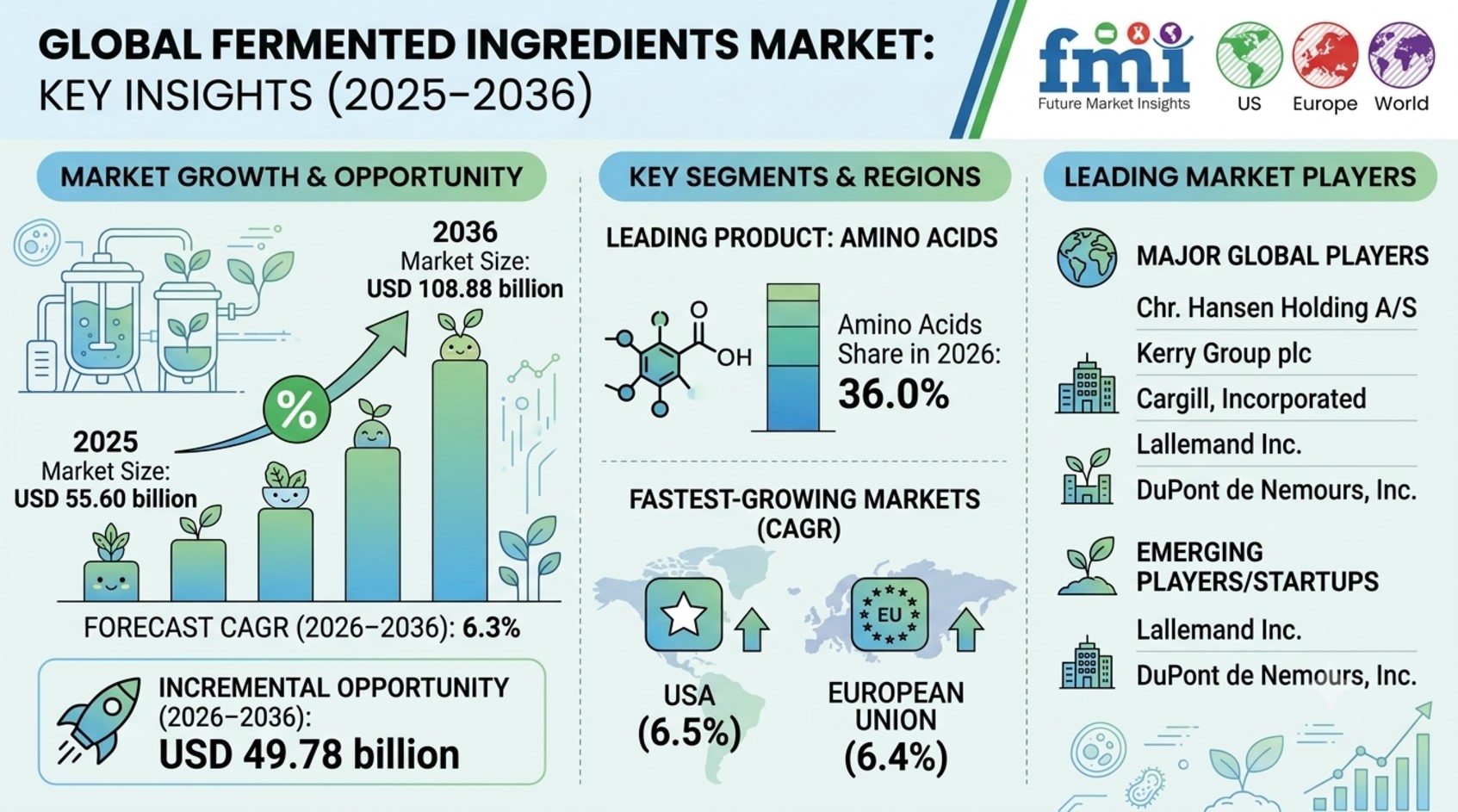
- Leading Product Category: Amino Acids
- Primary Commercial Driver: Feedstock-to-Product Conversion Efficiency
- Fastest Innovation Area: Precision Fermentation and Specialty Functional Ingredients
- Critical Economic Variable: Cost-in-use across industrial food, beverage, nutrition, and biotechnology applications
Market Overview: Production Economics Define Commercial Viability
The fermented ingredients industry has entered an era where manufacturing efficiency determines competitive advantage more than scientific innovation alone. Every commercial fermentation process must balance biological productivity with industrial-scale economics.
Ingredient manufacturers increasingly evaluate fermentation through measurable operational indicators including microbial productivity, substrate conversion efficiency, fermentation duration, recovery yield, purification complexity, energy consumption, and transportation stability. These variables collectively determine whether a fermented ingredient can compete with synthetic, extracted, or conventionally produced alternatives.
As food manufacturers seek functional ingredients that improve nutrition, preservation, flavor, texture, and sustainability, procurement decisions increasingly prioritize predictable production economics over emerging biotechnology narratives.
Key Growth Drivers Across Fermented Ingredients
Industrial Yield Optimization Drives Profitability
Advances in microbial strain engineering, fermentation control, and process optimization are enabling manufacturers to produce higher ingredient volumes using fewer raw materials. Improved yield directly lowers production costs while increasing manufacturing efficiency and asset utilization.
Functional Food Innovation Expands Demand
Consumer demand for clean-label, functional, and naturally derived ingredients continues creating opportunities for fermentation-derived solutions across nutrition, food preservation, flavor enhancement, and specialty food applications.
Precision Manufacturing Improves Ingredient Consistency
Modern fermentation facilities increasingly employ digital process monitoring, automated fermentation control, and advanced analytical systems that improve batch consistency, reduce contamination risk, and enhance production reliability.
Sustainability Must Deliver Economic Benefits
Although fermentation supports sustainability goals by utilizing renewable biological systems, customers increasingly expect environmental improvements to coincide with competitive pricing, reliable supply chains, and measurable formulation advantages.
Technical & Production Economics Behind Fermented Ingredients
Commercial fermentation requires balancing biological performance with manufacturing efficiency throughout the production cycle.
- Feedstock Utilization Economics: Sugars, starch hydrolysates, molasses, vegetable oils, glycerol, nitrogen sources, and agricultural by-products represent significant operating costs. Ingredient manufacturers increasingly focus on maximizing conversion efficiency while reducing dependence on volatile raw material markets.
- Energy and Utility Management: Industrial fermentation relies on sterilization, aeration, agitation, cooling, heating, clean-in-place systems, wastewater treatment, drying, and purification. Energy efficiency has therefore become a major contributor to production profitability.
- Downstream Processing Complexity: Producing target compounds inside fermentation vessels represents only part of the manufacturing process. Filtration, centrifugation, concentration, extraction, chromatography, crystallization, encapsulation, spray drying, and freeze drying frequently account for a substantial portion of overall production costs.
- Application-Specific Cost Modeling: Ingredient economics increasingly depend on finished-product applications. Premium nutritional products may justify higher ingredient costs through superior functionality, whereas mainstream food products require much stricter cost-per-serving thresholds.
Segment Deep Dive: Every Fermented Ingredient Follows Different Economic Rules
Amino Acids: Industrial Fermentation at Scale
Amino acids demonstrate how fermentation achieves commercial competitiveness through decades of strain optimization, production efficiency, and manufacturing scale.
Modern amino acid production relies on highly productive microbial systems capable of delivering consistent product quality while minimizing feedstock consumption and purification costs. Success depends on continuous process optimization rather than product novelty.
Precision Fermentation: High Potential with Capital Intensity
Precision fermentation represents one of the industry’s most promising technological developments, enabling targeted production of proteins, enzymes, fats, vitamins, and specialty biomolecules.
However, commercial success depends on reducing production costs sufficiently to compete with conventional ingredient sources. Scaling from laboratory demonstration to industrial food-grade manufacturing requires substantial investment in strain development, bioprocess engineering, purification infrastructure, and regulatory compliance.
Fermented Proteins: Competing Against Established Alternatives
Fermented proteins offer opportunities across dairy alternatives, sports nutrition, medical nutrition, and functional foods.
Despite their technological advantages, these ingredients compete directly against dairy proteins, soy, pea, wheat, egg proteins, and other established raw materials. Commercial adoption therefore depends on delivering measurable improvements in functionality, nutrition, sustainability, allergen management, or sensory performance that justify higher production costs.
Probiotics and Specialty Microbial Ingredients
Unlike commodity fermentation products, probiotic ingredients derive value from strain identity, clinical evidence, documented health benefits, stability, and survivability rather than production volume alone.
Customers increasingly evaluate probiotic ingredients according to scientific validation, regulatory documentation, and application performance instead of microbial biomass alone.
Natural Preservation Systems
Fermentation-derived preservation ingredients continue expanding within clean-label food formulations.
Commercial success depends not only on antimicrobial performance but also on dosage efficiency, sensory neutrality, regulatory acceptance, and overall formulation economics. Preservation systems requiring excessive inclusion levels or negatively affecting flavor may struggle despite favorable natural positioning.
Regional Market Dynamics
North America
North America maintains leadership in commercial fermentation through advanced biotechnology infrastructure, strong food innovation ecosystems, established industrial manufacturing capacity, and increasing investment in precision fermentation technologies.
Europe
European markets emphasize sustainable manufacturing, clean-label ingredient development, regulatory compliance, and environmentally responsible bioprocessing. Manufacturers increasingly differentiate through resource efficiency, traceability, and low-carbon production systems.
Asia-Pacific
Asia-Pacific continues emerging as the fastest-growing fermentation manufacturing hub due to expanding food processing industries, competitive production costs, increasing biotechnology investments, and growing regional demand for functional ingredients across food, nutrition, and industrial applications.
Competitive Differentiation Strategies
Leading fermented ingredient manufacturers increasingly compete through manufacturing excellence rather than biotechnology claims alone.
- High-Yield Microbial Strain Development: Advanced strain engineering improves substrate conversion efficiency, productivity, and manufacturing economics.
- Process Optimization & Scale-Up Expertise: Commercial success increasingly depends on translating laboratory performance into reliable industrial production with consistent quality and predictable costs.
- Integrated Downstream Processing: Efficient purification, drying, stabilization, and ingredient recovery systems reduce manufacturing costs while improving finished-product consistency.
- Application-Specific Technical Support: Suppliers increasingly provide formulation guidance, process recommendations, stability data, and application expertise that simplify customer product development.
- Supply Chain Resilience: Feedstock diversification, regional manufacturing capacity, and operational flexibility enable manufacturers to reduce exposure to raw material volatility and logistics disruptions.
Industry FAQs
Why are fermentation yield and production efficiency becoming critical competitive factors?
Higher fermentation yields reduce raw material requirements, energy consumption, production time, and downstream processing costs, allowing fermented ingredients to compete more effectively against conventional manufacturing methods.
Why do amino acids remain the leading fermented ingredient category?
Amino acid production benefits from decades of microbial strain optimization, mature industrial fermentation technology, efficient downstream processing, and large-scale manufacturing infrastructure that collectively deliver competitive production economics.
Why is precision fermentation commercially challenging despite its innovation potential?
Precision fermentation requires significant investment in strain engineering, industrial bioreactors, purification systems, regulatory approval, and manufacturing scale-up. Commercial success depends on reducing production costs while maintaining product functionality and supply reliability.
How does downstream processing influence ingredient economics?
Recovery, purification, concentration, drying, encapsulation, and stabilization frequently represent major manufacturing expenses. Efficient downstream processing can significantly improve profitability even when fermentation productivity remains unchanged.
Why is cost-in-use more important than ingredient price?
An ingredient with a higher purchase price may lower overall formulation costs if it performs at lower inclusion levels, improves shelf life, reduces reformulation requirements, or enhances finished-product value. Manufacturers therefore increasingly evaluate total formulation economics rather than price per kilogram.
Conclusion
The future development of the fermented ingredients market will depend less on biotechnology excitement and more on manufacturing discipline. Commercial success increasingly belongs to suppliers capable of maximizing fermentation yield, optimizing feedstock utilization, reducing downstream processing costs, and delivering application-specific value that justifies ingredient adoption.
Amino acids will continue demonstrating the economic advantages of mature fermentation systems, while precision fermentation, fermented proteins, probiotics, enzymes, natural preservatives, and specialty metabolites will expand as manufacturing efficiencies improve and production costs decline.
Ultimately, fermentation itself is not the competitive advantage. Sustainable commercial growth will belong to manufacturers capable of transforming biological innovation into scalable, reliable, and economically competitive ingredient production.
Related Research Reports
- Food Amino Acids Market – Strategic evaluation of amino acid applications across food, beverage, and nutritional products.
- Precision Fermentation Ingredients Market – Market intelligence covering precision fermentation technologies, scale-up strategies, and commercial production economics.
- Fermented Protein Market – Analysis of fermentation-derived proteins, alternative protein development, and cost competitiveness.
FMI Custom Research: Strategic Intelligence for Confident Decision-Making
In today’s rapidly evolving business environment, leadership teams need more than market data they need clear, actionable intelligence tailored to their strategic objectives. FMI’s Custom Research solutions are designed around the specific business questions organizations need answered, enabling executives to evaluate growth opportunities, validate investments, assess competitive dynamics, and reduce uncertainty before making critical decisions. By combining deep industry expertise, primary research, and proprietary market intelligence, FMI delivers insights that help organizations move from assumptions to evidence-based strategies with greater speed and confidence.
Key Executive Benefits
- Decision-Ready Insights: Research tailored to your specific business challenges, growth plans, and investment priorities.
- Reduced Strategic Risk: Validate market opportunities, customer demand, and competitive positioning before committing resources.
- Market Entry Confidence: Assess opportunity size, regulatory barriers, channel dynamics, and competitive landscapes with precision.
- Competitive Advantage: Gain proprietary intelligence unavailable through syndicated reports or internal datasets.
- Faster Growth Decisions: Accelerate expansion, product development, portfolio optimization, and investment planning.
- Primary Market Validation: Access real-world customer, buyer, and stakeholder insights that support high-confidence decision-making.
- Global Industry Expertise: Powered by 100+ analysts, 20,000+ published reports, and 1.6 million+ hours of research experience.
- Proven Track Record: Over 7,000 market-entry engagements completed across six regions and 14 industry sectors with strong client retention.
Business Impact
FMI helps organizations transform market complexity into strategic clarity, enabling leadership teams to identify growth opportunities faster, optimize resource allocation, strengthen competitive positioning, and make high-stakes business decisions with confidence.
To explore how FMI Custom Research can support your strategic priorities, please connect with our team at – sales@futuremarketinsights.com
About Future Market Insights (FMI)
Future Market Insights is a leading provider of market intelligence, consulting services, and syndicated research reports. FMI delivers actionable insights across food and beverage, healthcare, consumer goods, biotechnology, chemicals, industrial products, and emerging technologies, helping organizations identify growth opportunities and make informed strategic decisions in evolving global markets.
Contact Us:
Future Market Insights Inc.
Christiana Corporate, 200 Continental Drive,
Suite 401, Newark, Delaware – 19713, USA
T: +1-347-918-3531
Why FMI: https://www.futuremarketinsights.com/why-fmi
For Sales Enquiries: sales@futuremarketinsights.com
Website: https://www.futuremarketinsights.com