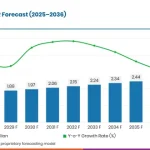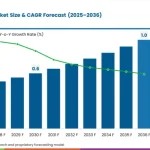


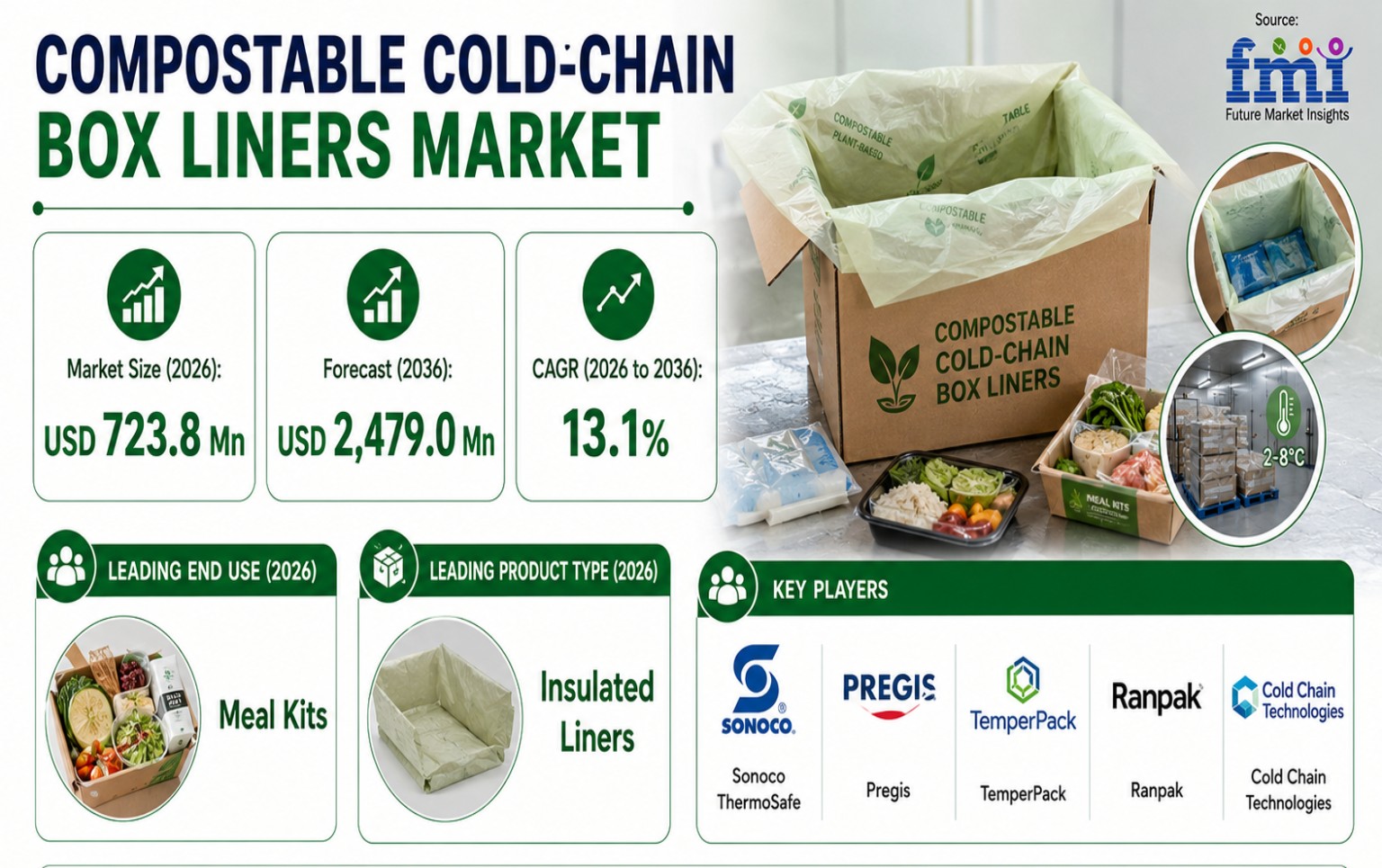
The Compostable Cold-Chain Box Liners Market is projected to witness remarkable growth over the next decade as sustainability becomes a central focus across food delivery, pharmaceutical logistics, and temperature-sensitive e-commerce supply chains. According to Future Market Insights (FMI), the market is expected to grow from USD 723.8 million in 2026 to USD 2,479.0 million by 2036, registering a robust CAGR of 13.1% during the forecast period. Rising environmental regulations, increasing demand for eco-friendly packaging solutions, and the rapid expansion of cold-chain logistics are creating strong growth opportunities for manufacturers worldwide.
Compostable Cold-Chain Box Liners Market Driven by Sustainable Cold-Chain Packaging Demand
Cold-chain packaging has become essential for preserving the quality and safety of temperature-sensitive products such as meal kits, pharmaceuticals, seafood, groceries, and specialty foods. Traditional insulation materials made from expanded polystyrene (EPS) and plastic foams are increasingly being replaced by compostable alternatives as governments and businesses prioritize sustainability.
Compostable cold-chain box liners are designed to provide reliable thermal insulation while minimizing environmental impact. These liners are manufactured using renewable and biodegradable materials such as cellulose wadding, molded pulp, recycled paper, and compostable coated fibers, allowing companies to reduce plastic waste without compromising packaging performance. The growing emphasis on circular economy principles and sustainable packaging regulations is expected to significantly accelerate adoption across developed as well as emerging economies.
Growing E-commerce and Meal Kit Deliveries Fuel Market Expansion
The rapid expansion of online grocery platforms and meal kit delivery services has transformed the cold-chain packaging industry. Consumers increasingly expect fresh food products to arrive safely while businesses seek environmentally responsible packaging alternatives.
Meal kit providers, food retailers, and direct-to-consumer brands are investing in compostable cold-chain liners to improve customer satisfaction and meet corporate sustainability goals. Since temperature-sensitive shipments often travel long distances, packaging must maintain consistent thermal protection throughout transit while remaining easy to dispose of after delivery. The pharmaceutical industry is also contributing to market growth as vaccines, biologics, specialty medicines, and laboratory samples require reliable temperature-controlled transportation. Healthcare organizations are increasingly choosing compostable packaging materials to align with sustainability commitments while ensuring regulatory compliance.
Insulated Liners Lead Product Adoption
Among product categories, Insulated Liners are expected to account for 35.7% of the global market in 2026, making them the largest product segment. Their popularity stems from excellent thermal performance, lightweight construction, ease of handling, and compatibility with existing packaging systems.
These liners provide effective protection during shipping while reducing dependence on petroleum-based insulation materials. Manufacturers continue to improve insulation efficiency through innovative fiber engineering, multilayer designs, and compostable barrier technologies. Wrap liners, pouch liners, panel liners, and multi-layer liners are also gaining traction across specialized cold-chain applications, particularly where customized packaging configurations are required.
Cellulose Wadding Emerges as the Preferred Material
Material selection plays a critical role in determining thermal efficiency and environmental performance. Cellulose wadding is projected to hold 31.3% market share in 2026, making it the leading material segment.
Cellulose-based insulation offers several advantages, including high thermal resistance, renewable sourcing, biodegradability, and excellent cushioning properties. Growing investments in fiber-based packaging innovation are expected to further strengthen demand for cellulose materials over the coming years. Recycled paper, molded pulp, corrugated structures, and compostable coated materials are also witnessing increased adoption as companies diversify sustainable packaging portfolios.
Chilled Applications Continue to Dominate Demand
By thermal performance, Chilled (2–8°C) applications are anticipated to account for 26.5% of the global market in 2026. This temperature range is widely used for fresh foods, dairy products, pharmaceuticals, biologics, and laboratory samples.
Maintaining stable temperatures throughout transportation remains one of the biggest challenges in modern cold-chain logistics. Compostable liners designed for chilled applications help businesses minimize spoilage while reducing reliance on conventional plastic insulation. Advancements in insulation materials are improving thermal retention capabilities, allowing compostable solutions to compete more effectively with traditional cold-chain packaging technologies.
India Leads Global Growth Opportunities
Geographically, India is expected to emerge as the fastest-growing market with a projected CAGR of 12.1% through 2036. Rapid growth in organized retail, food delivery platforms, pharmaceutical manufacturing, and e-commerce logistics is driving demand for sustainable temperature-controlled packaging across the country.
China also represents a significant growth opportunity as manufacturers continue expanding production capacity to serve domestic and export markets. Meanwhile, North America and Europe remain mature markets supported by strict environmental regulations, sustainability commitments, and growing consumer preference for recyclable and compostable packaging solutions. Countries including Germany, the United Kingdom, Japan, and South Korea continue investing heavily in environmentally responsible packaging innovations while strengthening cold-chain infrastructure.
Competitive Landscape
Competition within the Compostable Cold-Chain Box Liners Market is centered on thermal performance, sustainability credentials, product innovation, and supply chain capabilities. Leading companies continue investing in advanced fiber technologies, improved insulation performance, and scalable manufacturing capacity to strengthen their competitive positions.
Major companies operating in the market include Sonoco ThermoSafe, Pregis, TemperPack, Ranpak, Cold Chain Technologies, Smurfit Westrock, DS Smith, and Stora Enso. These companies are expanding product portfolios while developing innovative compostable insulation solutions that meet increasingly stringent regulatory and customer requirements. Strategic partnerships, product innovation, mergers, and manufacturing expansion remain key competitive strategies as demand for sustainable cold-chain packaging accelerates worldwide.
Future Outlook
The Compostable Cold-Chain Box Liners Market is entering a period of sustained expansion as sustainability becomes a defining factor in packaging procurement decisions. With the market forecast to reach USD 2,479.0 million by 2036, manufacturers are expected to focus on improving insulation efficiency, reducing environmental impact, and meeting evolving regulatory standards. Growing adoption across meal kits, pharmaceuticals, grocery delivery, seafood transportation, and specialty food logistics will continue creating long-term opportunities for industry participants. As governments strengthen packaging regulations and businesses pursue carbon reduction goals, compostable cold-chain box liners are expected to become an increasingly important component of the global cold-chain packaging industry.
Related Research Reports
Cold Chain Packaging Market: The cold chain packaging market is expected to USD 39.1 billion by 2036. The market is forecast to register a 6.9% CAGR during the forecast period.
Compostable Foodservice Packaging Market: The compostable foodservice packaging market is expected to USD 9.8 billion by 2035. The market is anticipated to register an 8.8% CAGR during the forecast period.
Cold-Chain Sensor Encapsulators Market: The cold-chain sensor encapsulators market will expand from USD 1.3 billion in 2025 to USD 2.5 billion by 2035, advancing at a CAGR of 6.6%.
About Future Market Insights (FMI)
Future Market Insights is a leading provider of market intelligence, consulting services, and syndicated research reports. FMI delivers actionable insights across packaging, logistics, industrial manufacturing, food and beverage, healthcare, chemicals, and emerging technologies, helping organizations identify growth opportunities and make informed strategic decisions in rapidly evolving markets.
Contact
Future Market Insights Inc.
Christiana Corporate
200 Continental Drive, Suite 401
Newark, Delaware 19713, USA
Email: sales@futuremarketinsights.com
Website: www.futuremarketinsights.com