

The global probiotic ingredients market is entering a new phase of commercial maturity where strain selection is no longer determined by brand familiarity or colony-forming unit (CFU) claims alone. Instead, manufacturers are adopting an application-first formulation strategy in which probiotic performance is evaluated according to processing conditions, product matrix, shelf-life expectations, delivery format, and clinically supported health positioning.
While dietary supplements continue to represent the largest commercial application for probiotic ingredients, dairy products, functional beverages, gummies, nutritional powders, baked foods, and animal nutrition products each expose probiotic cultures to fundamentally different environmental stresses. As a result, probiotic ingredients are increasingly being selected based on survival architecture the ability of a strain to remain viable throughout manufacturing, storage, distribution, and consumer use rather than simply demonstrating high laboratory potency.
Featured Snippet: Key Market Answer
Q: Why is probiotic ingredient selection becoming application-specific instead of strain-specific?
A: Modern probiotic formulation depends on whether a strain can survive the processing, storage, and delivery conditions of a particular product. Capsules, yogurts, acidic beverages, gummies, baked foods, and animal feed expose probiotics to different levels of heat, moisture, oxygen, acidity, and mechanical stress. Successful manufacturers therefore prioritize application compatibility over generic CFU counts, selecting strains that remain stable within the intended product matrix while delivering scientifically validated health benefits throughout shelf life.
Quick Stats of the Probiotic Ingredients Market
- Core Growth Theme: Application-Specific Survival Architecture and Functional Delivery Optimization
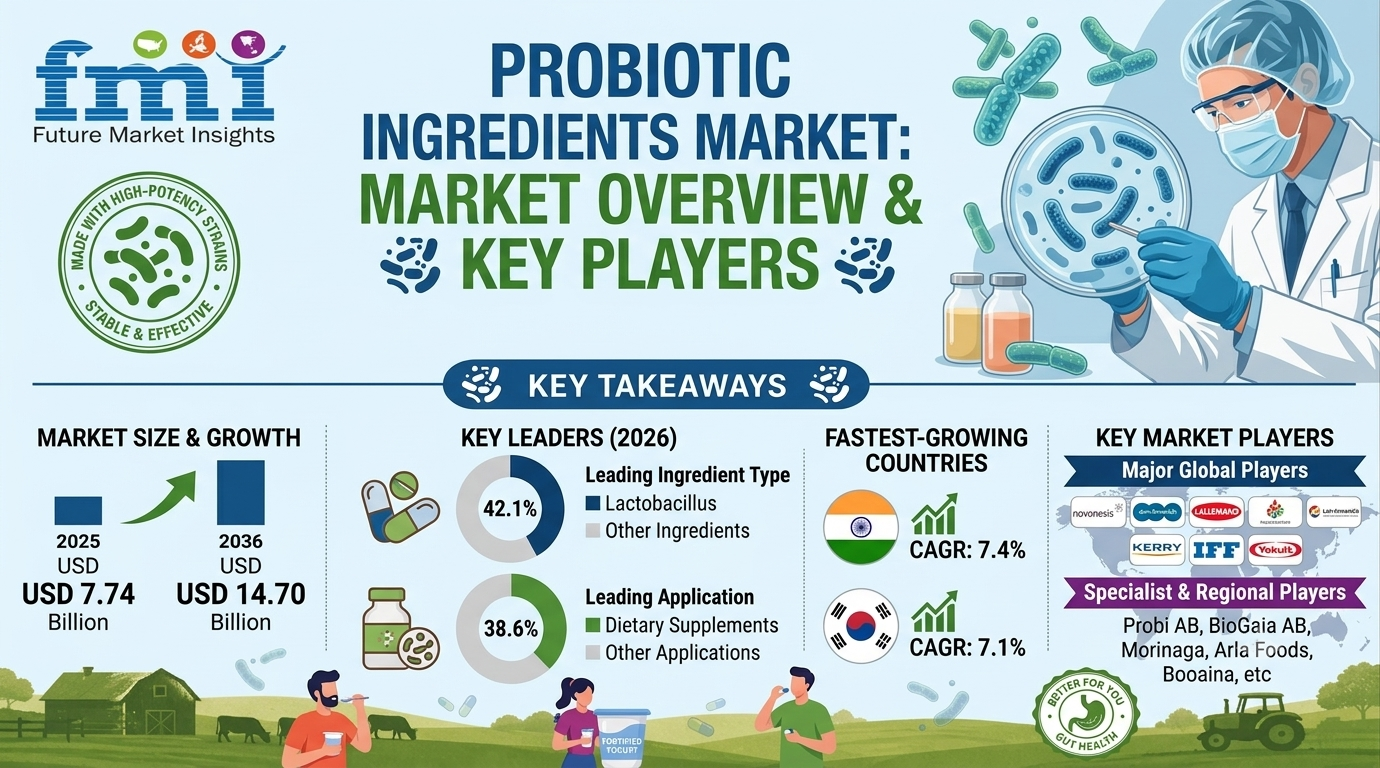
- Leading Application: Dietary Supplements
- Dominant Microbial Category: Lactobacillus strains across multiple wellness applications
- Fastest Innovation Area: Heat-stable and matrix-specific probiotic formulations
- Critical Technical Variable: Strain viability across processing, packaging, storage, and consumption
Market Overview: Application Environment Determines Commercial Success
The probiotic ingredients industry has evolved from selling microbial cultures into delivering complete formulation systems engineered for specific commercial applications. Manufacturers no longer evaluate probiotic ingredients solely by strain identity or potency. Instead, they assess how effectively each culture performs inside a defined food, beverage, supplement, or animal nutrition environment.
Each application introduces its own combination of formulation challenges. Moisture activity, oxygen exposure, acidity, fermentation dynamics, thermal processing, packaging materials, transportation conditions, and expected shelf life collectively determine whether a probiotic remains viable until consumption.
Consequently, ingredient suppliers are increasingly investing in application laboratories capable of validating strain performance across diverse commercial matrices rather than promoting universal strain solutions.
Key Growth Drivers Across Applications
Application-Specific Formulation Becomes Industry Standard
Product developers increasingly recognize that probiotic success depends on compatibility with the finished formulation rather than laboratory performance alone. This transition has encouraged brands to evaluate ingredient systems according to processing conditions, product architecture, and intended consumer benefit before selecting probiotic strains.
Expansion Beyond Traditional Supplements
While capsules and sachets remain foundational delivery systems, probiotics are rapidly expanding into gummies, protein powders, fermented beverages, nutritional snacks, bakery products, and plant-based foods. Each new format creates additional formulation complexity, increasing demand for specialized ingredient expertise.
Consumer Demand for Convenient Wellness Formats
Consumers increasingly expect digestive and immune health solutions in everyday foods rather than only pharmaceutical-style supplements. This shift encourages manufacturers to integrate probiotics into products consumed throughout daily routines, creating new opportunities for application-specific strain development.
Stability Becomes a Competitive Differentiator
Commercial success increasingly depends on maintaining labeled probiotic counts throughout the entire product shelf life. Ingredient suppliers capable of demonstrating long-term stability under realistic storage conditions gain stronger competitive positioning than suppliers relying solely on initial CFU specifications.
Technical & Formulation Economics Behind Application Selection
Selecting probiotic ingredients has become an exercise in balancing biological performance with manufacturing economics.
- Benefit-Driven Strain Selection: Digestive health, immune support, infant nutrition, women’s wellness, metabolic health, oral care, and animal performance each require clinically supported strains rather than generic microbial categories. Commercial differentiation increasingly depends on matching strain evidence with intended health outcomes.
- Matrix Compatibility Economics: Product matrices significantly influence microbial survival. Capsules provide relatively controlled environments, whereas acidic beverages, confectionery systems, fermented dairy, and baked products expose cultures to varying degrees of biological stress. Ingredient suppliers increasingly evaluate strain performance within the finished formulation instead of isolated laboratory conditions.
- Heat-Stable Processing Advantage: Conventional probiotic cultures often struggle during baking, extrusion, hot filling, or pellet manufacturing. Heat-resistant and spore-forming probiotic systems have therefore emerged as valuable alternatives for applications requiring thermal processing. However, heat tolerance alone does not guarantee suitability unless aligned with the desired health claim and product positioning.
- Delivery Technology as Value Creation: Microencapsulation, protective carrier systems, oxygen barriers, controlled moisture environments, and specialized packaging technologies have become integral components of probiotic ingredient architecture. These technologies frequently determine finished-product viability as much as strain genetics.
Segment Deep Dive: One Strain Does Not Fit Every Format
Dietary Supplements: The Controlled Delivery Benchmark
Capsules, tablets, sachets, powders, and stick packs remain the industry’s largest application because manufacturers can tightly manage moisture exposure, oxygen levels, packaging protection, and serving consistency.
However, supplement categories themselves have diversified considerably. Products targeting infant health, women’s wellness, sports nutrition, digestive balance, and immune support each require unique strain combinations supported by application-specific clinical evidence.
Dairy Applications: Balancing Fermentation and Functionality
Fermented milk products, cultured yogurt, drinking yogurt, and probiotic dairy beverages present a highly specialized biological environment. Probiotic cultures must coexist with fermentation organisms while preserving desirable taste, texture, acidity, and refrigeration stability.
Commercial success therefore depends on selecting strains that support both manufacturing performance and consumer sensory expectations without compromising health functionality.
Functional Beverages: The Acidity Challenge
Ready-to-drink probiotic beverages represent one of the industry’s most technically demanding applications. Low pH, dissolved oxygen, preservatives, extended shelf-life requirements, and transportation conditions continuously challenge microbial viability.
Rather than increasing probiotic dosage to compensate for losses, manufacturers increasingly prioritize acid-tolerant strains, protective encapsulation technologies, and optimized packaging systems that improve long-term survival.
Gummies and Chewables: Convenience with Formulation Complexity
Consumer demand for enjoyable supplement formats has accelerated growth in probiotic gummies and chewables. Yet these products expose cultures to elevated processing temperatures, moisture, sugars, organic acids, and extended storage periods.
Successful commercialization requires careful coordination between strain selection, processing sequence, encapsulation technology, packaging barriers, and viability modeling throughout shelf life.
Functional Foods and Heat-Stable Products
Protein bars, breakfast cereals, meal replacements, baked snacks, and fortified foods continue expanding probiotic applications beyond conventional supplements.
These products introduce interactions among proteins, fibers, sweeteners, minerals, emulsifiers, and processing temperatures that can significantly influence microbial stability. Suppliers capable of validating strain performance within complex food systems increasingly command higher commercial value.
Animal Nutrition: A Distinct Technical Environment
Livestock and companion animal nutrition represent a separate application ecosystem with unique processing requirements.
Probiotic ingredients used in feed must tolerate premix manufacturing, storage, pelleting pressure, transportation, and species-specific digestive conditions. Purchasing decisions are therefore driven by measurable improvements in gut health, feed conversion efficiency, survivability, and production economics rather than consumer wellness marketing.
Regional Market Dynamics
North America
North America continues to lead probiotic ingredient commercialization through strong dietary supplement consumption, advanced functional food innovation, established clinical research infrastructure, and premium consumer demand for evidence-based health solutions.
Europe
European markets emphasize scientific substantiation, regulatory compliance, clean-label formulation, and transparent health claims. Manufacturers increasingly differentiate products through documented strain evidence, sustainability initiatives, and rigorous quality assurance systems.
Asia-Pacific
Asia-Pacific represents the fastest-growing opportunity for probiotic ingredients as expanding middle-class populations adopt preventive healthcare, functional foods, digestive wellness products, and premium nutritional supplements. Rapid innovation across dairy alternatives, beverages, and personalized nutrition continues accelerating regional demand.
Competitive Differentiation Strategies
Leading probiotic ingredient manufacturers increasingly compete through technical capabilities rather than strain catalogs alone.
- Application Validation Laboratories: Advanced suppliers conduct real-world stability studies across beverages, supplements, dairy, baked foods, gummies, and animal nutrition products to demonstrate commercial viability.
- Shelf-Life Modeling & Stability Testing: Long-term viability data under realistic storage conditions has become essential for customer confidence and regulatory compliance.
- Advanced Encapsulation Technologies: Protective delivery systems improve resistance to moisture, oxygen, acidity, heat, and gastrointestinal transit while extending commercial shelf life.
- Regulatory and Clinical Support: Manufacturers increasingly provide formulation guidance, technical documentation, application recommendations, and claim substantiation to simplify product development for brand owners.
- Customized Strain Systems: Rather than promoting universal probiotic cultures, suppliers increasingly design application-specific multistrain solutions optimized for individual product categories and health outcomes.
Industry FAQs
What is driving application-specific probiotic ingredient selection?
Manufacturers increasingly recognize that probiotic effectiveness depends on survival within the intended product system. Processing conditions, packaging, storage, and consumption environments all influence strain viability, making application compatibility more important than generic CFU counts.
Why do dietary supplements remain the largest probiotic application?
Supplements provide highly controlled delivery environments through capsules, sachets, powders, and tablets. These formats simplify moisture management, oxygen protection, serving consistency, and shelf-life optimization while supporting targeted health positioning.
Why are heat-stable probiotic strains gaining commercial importance?
Heat-stable probiotic systems enable manufacturers to incorporate probiotics into baked goods, cereals, functional snacks, animal feed, and other thermally processed products where conventional probiotic cultures often lose viability during manufacturing.
Why are probiotic beverages technically challenging?
Acidic pH, oxygen exposure, preservatives, long distribution cycles, and refrigeration requirements continuously reduce probiotic survival. Successful beverage formulations therefore require specialized strain selection, encapsulation technologies, and protective packaging systems.
How are suppliers differentiating themselves in the probiotic ingredients market?
Leading suppliers increasingly compete through application expertise, formulation support, stability validation, regulatory guidance, customized strain development, and complete technical solutions that improve finished-product performance across diverse commercial applications.
Conclusion
The future direction of the probiotic ingredients market will be shaped less by individual strain popularity and more by application survival architecture. Commercial success increasingly depends on selecting probiotic systems capable of surviving specific manufacturing environments while consistently delivering clinically supported health benefits throughout product shelf life.
Dietary supplements will remain the industry’s primary application because of their controlled formulation environment, yet expanding opportunities across dairy, beverages, gummies, functional foods, heat-stable products, and animal nutrition will continue driving innovation in matrix-specific strain development.
Manufacturers that integrate formulation science, processing knowledge, packaging technology, stability validation, and application expertise into complete probiotic delivery systems will be better positioned than competitors relying on one-size-fits-all microbial solutions.
Related Research Reports
- Probiotic Strains Market – Analysis of clinically validated probiotic strains, formulation science, and commercial differentiation.
- Multistrain Probiotics Market – Evaluation of strain compatibility, formulation strategies, and multistrain product innovation.
- Heat-Stable Probiotics Market – Technical assessment of thermally resilient probiotic systems for food, beverage, and feed applications.
FMI Custom Research: Strategic Intelligence for Confident Decision-Making
In today’s rapidly evolving business environment, leadership teams need more than market data they need clear, actionable intelligence tailored to their strategic objectives. FMI’s Custom Research solutions are designed around the specific business questions organizations need answered, enabling executives to evaluate growth opportunities, validate investments, assess competitive dynamics, and reduce uncertainty before making critical decisions. By combining deep industry expertise, primary research, and proprietary market intelligence, FMI delivers insights that help organizations move from assumptions to evidence-based strategies with greater speed and confidence.
Key Executive Benefits
- Decision-Ready Insights: Research tailored to your specific business challenges, growth plans, and investment priorities.
- Reduced Strategic Risk: Validate market opportunities, customer demand, and competitive positioning before committing resources.
- Market Entry Confidence: Assess opportunity size, regulatory barriers, channel dynamics, and competitive landscapes with precision.
- Competitive Advantage: Gain proprietary intelligence unavailable through syndicated reports or internal datasets.
- Faster Growth Decisions: Accelerate expansion, product development, portfolio optimization, and investment planning.
- Primary Market Validation: Access real-world customer, buyer, and stakeholder insights that support high-confidence decision-making.
- Global Industry Expertise: Powered by 100+ analysts, 20,000+ published reports, and 1.6 million+ hours of research experience.
- Proven Track Record: Over 7,000 market-entry engagements completed across six regions and 14 industry sectors with strong client retention.
Business Impact
FMI helps organizations transform market complexity into strategic clarity, enabling leadership teams to identify growth opportunities faster, optimize resource allocation, strengthen competitive positioning, and make high-stakes business decisions with confidence.
To explore how FMI Custom Research can support your strategic priorities, please connect with our team at – sales@futuremarketinsights.com
About Future Market Insights (FMI)
Future Market Insights is a leading provider of market intelligence, consulting services, and syndicated research reports. FMI delivers actionable insights across food and beverage, healthcare, consumer goods, biotechnology, chemicals, industrial products, and emerging technologies, helping organizations identify growth opportunities and make informed strategic decisions in evolving global markets.
Contact Us:
Future Market Insights Inc.
Christiana Corporate, 200 Continental Drive,
Suite 401, Newark, Delaware – 19713, USA
T: +1-347-918-3531
Why FMI: https://www.futuremarketinsights.com/why-fmi
For Sales Enquiries: sales@futuremarketinsights.com
Website: https://www.futuremarketinsights.com