

Application-Led Probiotic Formulation Is Reshaping the Ingredient Landscape
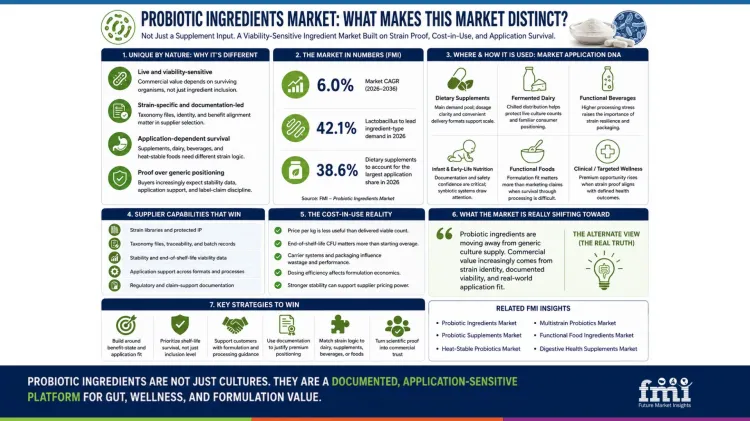
According to the latest insights by Future Market Insights, the global Probiotic Ingredients Market is entering a new phase as manufacturers increasingly adopt application-specific strain selection strategies instead of relying on generic probiotic popularity or high CFU counts. While dietary supplements remain the largest application, dairy products, functional beverages, gummies, heat-stable foods, and animal nutrition each require different probiotic survival architectures to ensure efficacy throughout processing and shelf life.
Manufacturers are increasingly developing application-specific probiotic solutions to achieve:
- Improved strain survivability
- Matrix-specific formulation performance
- Extended shelf-life stability
- Targeted health positioning
- Better regulatory compliance
- Enhanced consumer confidence
Industry analysts emphasize that successful probiotic formulation is no longer determined by selecting the most popular strain. Instead, manufacturers are choosing probiotic systems based on processing conditions, delivery format, storage environment, and intended health benefits.
Application Determines the Right Probiotic Strategy
The probiotic industry has traditionally focused on strain recognition and CFU counts because of:
- Strong consumer awareness
- Established clinical evidence
- Broad commercial availability
- Simplified product positioning
- Standard supplement formulations
However, as functional nutrition categories become increasingly specialized, manufacturers are evaluating probiotic ingredients according to application performance rather than strain popularity alone.
Application-specific probiotic design supports:
- Matrix compatibility
- Processing resilience
- Shelf-life stability
- Targeted clinical benefits
- Premium formulation quality
- Product differentiation
The strongest market opportunities are expected to come from probiotic systems that survive real-world manufacturing conditions rather than simply delivering high initial potency.
Dietary Supplements Continue to Lead the Market
Dietary supplements remain the foundation of the global probiotic ingredients industry because they provide controlled delivery environments and flexible dosage formats.
Growth continues to be supported by increasing demand for:
- Digestive health supplements
- Immune support products
- Women’s health formulations
- Children’s nutrition
- Sports nutrition
Supplement applications benefit from:
- Moisture-controlled packaging
- Defined serving sizes
- Flexible dosage forms
- Better viability management
- Established consumer trust
These advantages ensure dietary supplements remain the preferred delivery format across many probiotic applications.
Dairy and Beverage Applications Require Specialized Survival Logic
Despite the dominance of supplements, dairy and beverage manufacturers face much more complex formulation challenges.
Manufacturers must evaluate:
- Fermentation compatibility
- Product acidity
- Oxygen exposure
- Refrigerated storage
- Sensory performance
Successful probiotic ingredients for dairy and beverages provide:
- Stable fermentation performance
- Refrigeration tolerance
- Improved sensory acceptance
- Acid resistance
- Reliable shelf-life
These capabilities make application-specific strains essential for yogurt, cultured dairy, fermented drinks, and probiotic beverages.
Heat-Stable Foods Create New Commercial Opportunities
Growing demand for functional foods is creating significant opportunities for heat-stable probiotic ingredients.
Emerging food applications increasingly require:
- Heat tolerance
- Shelf stability
- Processing resilience
- Functional health benefits
Heat-stable probiotic systems are increasingly incorporated into:
- Baked foods
- Cereals
- Nutrition bars
- Meal replacements
- Shelf-stable functional foods
Selected spore-forming strains enable manufacturers to expand probiotic applications beyond traditional refrigerated products while maintaining product performance.
Gummies and Functional Foods Demand Advanced Formulation Technologies
Consumer demand for convenient wellness products continues to expand probiotic use into technically challenging formats.
Manufacturers now evaluate probiotic systems based on:
- Water activity
- Heat exposure
- Sugar content
- Packaging protection
Advanced formulation technologies support:
- Encapsulation systems
- Moisture protection
- Oxygen barriers
- Processing optimization
- Improved shelf stability
These solutions enable probiotic ingredients to maintain viability throughout manufacturing and distribution.
Plant-Based Nutrition Expands Probiotic Innovation
The rapid growth of plant-based nutrition is creating new opportunities for application-specific probiotic ingredients.
Manufacturers increasingly formulate products requiring:
- Plant-based compatibility
- Diverse protein systems
- Fiber-rich matrices
- Stable fermentation
Probiotic ingredients are increasingly incorporated into:
- Plant-based yogurts
- Dairy alternatives
- Functional nutrition shakes
- Fermented plant beverages
- Wellness foods
Matrix-specific testing allows manufacturers to deliver consistent probiotic performance across evolving plant-based product categories.
Manufacturers Shift Toward Application-Led Probiotic Portfolios
The future of probiotic ingredient development is increasingly centered on application optimization rather than single-strain positioning.
Manufacturers are combining specialized probiotic technologies to achieve:
- Greater formulation flexibility
- Better product performance
- Improved shelf-life
- Enhanced processing tolerance
- Stronger market differentiation
Modern probiotic portfolios increasingly include:
- Lactobacillus strains
- Bifidobacterium strains
- Bacillus probiotics
- Yeast-based probiotics
- Multistrain systems
- Heat-stable probiotic technologies
These diversified application strategies allow manufacturers to deliver optimized solutions for individual product categories.
Stability Technologies Accelerate Premium Product Development
Growing demand for premium nutrition products continues to reshape probiotic formulation strategies.
Today’s manufacturers increasingly prioritize:
- Long-term viability
- Packaging optimization
- Processing stability
- Reliable efficacy
Advanced probiotic technologies support these goals across:
- Dietary supplements
- Functional foods
- Dairy products
- Gummies
- Clinical nutrition
Strong stability performance has become a key competitive advantage for premium probiotic brands.
Application Expertise Becomes a Strategic Competitive Advantage
Global ingredient suppliers are moving beyond supplying probiotic cultures alone toward providing complete formulation support.
Key priorities now include:
- Application-specific strain selection
- Stability testing
- Processing guidance
- Packaging recommendations
- Regulatory documentation
Application-focused suppliers help manufacturers overcome challenges related to:
- Heat exposure
- Oxygen sensitivity
- Moisture control
- Shelf-life performance
- Product claims
Companies offering comprehensive application expertise are expected to gain long-term competitive advantages.
The Future of Probiotic Ingredient Competition
The future of the Probiotic Ingredients Market will depend on balancing:
- Clinical effectiveness
- Application survivability
- Shelf-life stability
- Processing compatibility
- Consumer expectations
Dietary supplements will continue to represent the largest application because of their formulation flexibility and established market presence.
However, dairy, beverages, gummies, heat-stable foods, plant-based nutrition, and functional foods are creating significant opportunities for specialized probiotic systems that deliver superior stability, targeted benefits, and application-specific performance.
The next phase of probiotic ingredient market evolution will not be defined by a single dominant strain—it will be driven by intelligent application survival architecture that combines scientific validation, formulation performance, and consumer trust.
FMI Custom Research: Strategic Intelligence for Confident Decision-Making
In today’s rapidly evolving business environment, leadership teams need more than market data—they need clear, actionable intelligence tailored to their strategic objectives.
FMI’s Custom Research solutions are designed around the specific business questions organizations need answered, enabling executives to evaluate growth opportunities, validate investments, assess competitive dynamics, and reduce uncertainty before making critical decisions.
By combining deep industry expertise, primary research, and proprietary market intelligence, FMI delivers insights that help organizations move from assumptions to evidence-based strategies with greater speed and confidence.
Key Executive Benefits
- Decision-Ready Insights
- Reduced Strategic Risk
- Market Entry Confidence
- Competitive Advantage
- Faster Growth Decisions
- Primary Market Validation
- Global Industry Expertise
- Proven Track Record
Business Impact
FMI helps organizations transform market complexity into strategic clarity, enabling leadership teams to identify opportunities faster, strengthen competitive positioning, optimize investments, and make confident business decisions.
To explore how FMI Custom Research can support your strategic priorities, connect with our team at: sales@futuremarketinsights.com
Explore More Related Studies Published by FMI Research
Probiotic Strains Market is segmented by Product (Lactobacillus Strains, Bifidobacterium Strains, Streptococcus Strains, Bacillus Strains), Application (Dietary Supplements, Functional Food And Beverages, Pharmaceuticals, Animal Nutrition), End Use (Nutraceutical Companies, Pharmaceutical Companies, Animal Feed Manufacturers), and Region. Forecast for 2026 to 2036.
Multistrain Probiotics Market is segmented by Strain Type (Lactobacillus, Bacteria, Bifidobacterium, Bacillus licheniformis, Lactococcus lactis, Streptococcus, Pediococcus acidilactici, Enterococcus faecium, Yeast including Saccharomyces cerevisiae and Saccharomyces boulardii), End Use (Dietary Supplements, Food & Beverages, Personal Care & Cosmetics, Animal Feed, Pet Food, Agriculture, Aquaculture), and Region. Forecast for 2026 to 2036.
Heat-Stable Probiotics Market is segmented by Strain Type (Bacillus coagulans, Bacillus subtilis, Bacillus clausii, Other Spore-Forming), Application (Baked Goods, Hot Beverages, Shelf-Stable Supplements, Ready-to-Drink Beverages, Functional Foods), End Use (Food & Beverage Manufacturing, Dietary Supplements, Clinical Nutrition, Animal Feed), Distribution Channel (Pharmacies, Supermarkets, E-commerce, Food Service Distributors) and Region. Forecast for 2026 to 2036.
About Future Market Insights (FMI)
Future Market Insights, Inc. (FMI) is an ESOMAR-certified, ISO 9001:2015 market research and consulting organization, trusted by Fortune 500 clients and global enterprises.
With operations in the U.S., UK, India, and Dubai, FMI provides data-backed insights and strategic intelligence across 30+ industries and 1,200 markets worldwide.
Contact Us
Future Market Insights Inc.
Christiana Corporate, 200 Continental Drive,
Suite 401, Newark, Delaware – 19713, USA
T: +1-347-918-3531
Why FMI: https://www.futuremarketinsights.com/why-fmi
Website: https://www.futuremarketinsights.com
LinkedIn| Twitter| Blogs | YouTube