

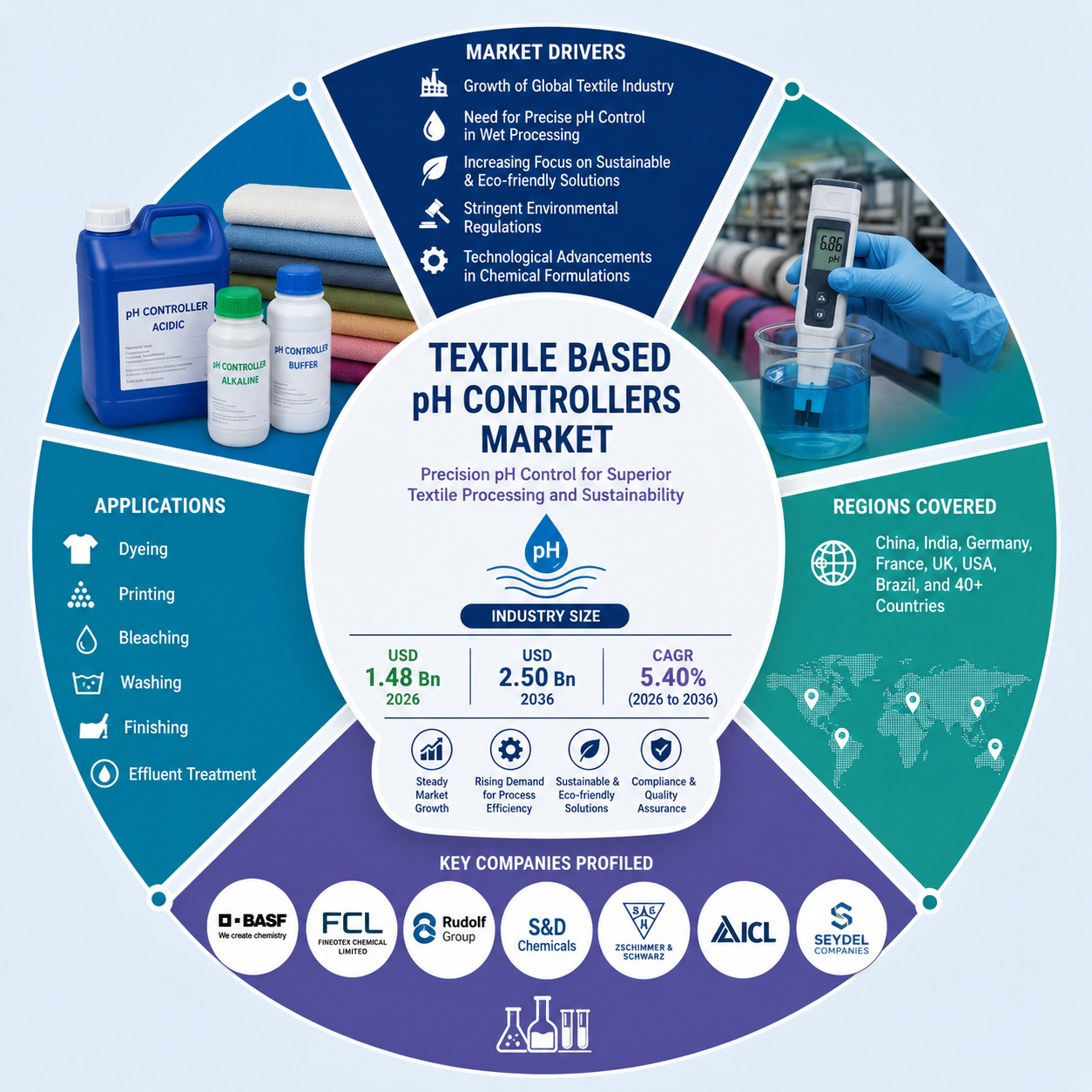
The global Textile Based pH Controllers Market, according to Future Market Insights, is entering a strategic growth phase driven by tightening wastewater regulations, increasing adoption of low-liquor-ratio dyeing processes, and growing demand for consistent shade quality in textile wet processing. The market is projected to grow from USD 1.48 billion in 2026 to USD 2.50 billion by 2036, registering a CAGR of 5.4% during the forecast period.
The market is evolving as textile manufacturers increasingly recognize pH control as a critical operational factor affecting dye uptake, shade consistency, rework rates, wastewater treatment performance, and regulatory compliance. What was once viewed as a narrow chemistry parameter is now becoming central to production efficiency and ESG performance.
Demand growth is being supported by stricter environmental regulations across Europe and Asia, expanding brand-led wastewater audit programs, and increasing investments in automated dosing and process control systems.
As compliance requirements intensify and wet-processing complexity rises, suppliers with strong chemistry portfolios, real-time dosing systems, sensor integration, and process analytics capabilities are expected to secure long-term competitive advantage.
Market Overview
The textile based pH controllers market has become one of the increasingly important segments within textile chemicals and wet processing solutions. Market value is increasingly driven by controller solutions that improve process stability, minimize rework, and support wastewater compliance.
The market is expected to rise from USD 1.40 billion in 2025 to USD 2.50 billion by 2036, supported by rising textile processing volumes and growing compliance-driven chemical demand.
Unlike traditional chemical additives, pH controllers directly influence dye fixation, bleaching efficiency, stripping performance, oxidation reactions, and finishing consistency. Consequently, market leadership increasingly depends on suppliers capable of combining chemistry innovation with automated process control.
Key Growth Drivers
A major growth catalyst is the increasing pressure on textile mills to improve shade consistency and batch stability. Small pH deviations can cause visible color inconsistencies, resulting in expensive re-dyeing and rework.
Wastewater compliance is another major driver. Textile manufacturers are under growing pressure to maintain discharge pH within regulatory limits to meet local environmental standards and export-market expectations.
The shift toward low-liquor-ratio dyeing is also accelerating market expansion. Water-efficient processes are less forgiving of dosing errors, making precise pH control increasingly critical.
Growing adoption of automation and smart wet processing further supports market growth by enabling real-time pH adjustment and reducing manual intervention.
Technology & Innovation Trends
Innovation in the textile based pH controllers market is centered around advanced controller chemistry, real-time sensors, and automated dosing systems.
Acid donor and alkali donor formulations are being optimized for improved buffering capacity and stable process control.
Sensor-integrated dosing systems are transforming wet-processing operations by enabling continuous pH monitoring and immediate corrective dosing.
AI-enabled analytics platforms are emerging as high-potential tools for predicting pH drift and optimizing chemical consumption.
Bundled solutions combining chemistry, sensors, control logic, and wastewater analytics are becoming increasingly important for operational efficiency.
Market Challenges & Restraints
Despite stable growth potential, the market faces several structural challenges.
One major barrier is the continued reliance on manual dosing practices in smaller textile mills, which limits process consistency.
High upfront investment in automation and sensor-based systems remains another major restraint for cost-sensitive manufacturers.
Process complexity across different fabric types and dye chemistries can also make universal pH control difficult.
Volatility in raw material costs for specialty chemical formulations further impacts supplier margins and pricing strategies.
Segment Analysis
The textile based pH controllers market is segmented by type, process, and region.
By Type
Acid Donor is projected to account for 54.1% market share in 2026, supported by high usage in bleaching, neutralization, and dye fixation processes.
Other major type segments include:
- Alkali Donor
By Process
Bleaching is projected to account for 41.7% market share in 2026, driven by high chemical consumption and strict pH requirements.
Other key process segments include:
- Stripping
- Oxidation
- Sourcing
- Finishing
- Other Processes
Regional Analysis
Regional growth increasingly depends on textile manufacturing volumes, environmental regulations, and automation adoption.
- China remains the fastest-growing major market and is expected to grow at 7.3% CAGR through 2036, supported by large-scale textile processing and stricter wastewater enforcement.
- India is the second-fastest growing market with 6.8% CAGR, driven by export-oriented textile manufacturing and rising compliance requirements.
- Germany is forecast to grow at 6.2% CAGR, supported by advanced textile processing technologies and strong environmental regulation.
- France is projected to expand at 5.7% CAGR, driven by sustainable textile finishing and eco-compliance initiatives.
- United Kingdom and United States continue stable growth, supported by specialty textile processing and premium fabric manufacturing.
Competitive Landscape
Competition is intensifying among specialty textile chemical manufacturers and process solution providers.
Competitive advantage increasingly depends on:
- Formulation stability
- Dosing precision
- Sensor integration
- Compliance support
- Process analytics
As textile procurement becomes more performance-driven, suppliers must deliver measurable operational value beyond standalone chemical products.
Leading Companies Analysis
Key market participants include BASF, FCL, Rudolf GmbH, ZSCHIMMER & SCHWARZ, and ICL, all of which maintain strong textile chemical portfolios and global industrial supply networks.
Other important participants include:
- Seydel Companies
- GIOVANNI BOZZETTO S.p.A.
- S&D
Investment & Strategic Developments
Investment activity is accelerating in smart dosing systems, process automation, and wastewater optimization technologies.
Strategic focus is increasingly shifting toward integrated wet-processing control systems that combine chemistry and digital monitoring.
Long-term investment is also focused on reducing chemical waste, improving dyeing consistency, and lowering effluent treatment costs.
Investors are paying close attention to automation capability, ESG compliance, and process intelligence, as these factors strongly influence long-term commercial success.
Future Outlook
The textile based pH controllers market is expected to become increasingly technology-driven over the next decade.
Future growth will be shaped by:
- Expansion of automated dosing systems
- Growth of low-liquor-ratio dyeing
- Increased wastewater compliance pressure
- Rising sensor adoption
- Stronger ESG-driven textile procurement
The industry is likely to continue shifting toward integrated pH control platforms with improved process stability and lower environmental risk.
Conclusion
The Textile Based pH Controllers Market is transitioning from a routine chemical segment into a high-value technology-driven textile process management market.
With the market projected to grow from USD 1.48 billion in 2026 to USD 2.50 billion by 2036, long-term growth remains steady.
Demand is increasingly tied to process stability, compliance assurance, wastewater performance, and automation readiness rather than standalone acid or alkali control alone. Companies capable of combining chemistry innovation with digital process intelligence will be best positioned to lead the next phase of market growth.
Send the next market report whenever you’re ready, and I’ll convert it into the same press release format.
FMI Custom Research: Strategic Intelligence for Confident Decision-Making
In today’s rapidly evolving business environment, leadership teams need more than market data—they need clear, actionable intelligence tailored to their strategic objectives. FMI’s Custom Research solutions are designed around the specific business questions organizations need answered, enabling executives to evaluate growth opportunities, validate investments, assess competitive dynamics, and reduce uncertainty before making critical decisions. By combining deep industry expertise, primary research, and proprietary market intelligence, FMI delivers insights that help organizations move from assumptions to evidence-based strategies with greater speed and confidence.
Key Executive Benefits
- Decision-Ready Insights: Research tailored to your specific business challenges, growth plans, and investment priorities.
- Reduced Strategic Risk: Validate market opportunities, customer demand, and competitive positioning before committing resources.
- Market Entry Confidence: Assess opportunity size, regulatory barriers, channel dynamics, and competitive landscapes with precision.
- Competitive Advantage: Gain proprietary intelligence unavailable through syndicated reports or internal datasets.
- Faster Growth Decisions: Accelerate expansion, product development, portfolio optimization, and investment planning.
- Primary Market Validation: Access real-world customer, buyer, and stakeholder insights that support high-confidence decision-making.
- Global Industry Expertise: Powered by 100+ analysts, 20,000+ published reports, and 1.6 million+ hours of research experience.
- Proven Track Record: Over 7,000 market-entry engagements completed across six regions and 14 industry sectors with strong client retention.
Business Impact
FMI helps organizations transform market complexity into strategic clarity, enabling leadership teams to identify growth opportunities faster, optimize resource allocation, strengthen competitive positioning, and make high-stakes business decisions with confidence.
To explore how FMI Custom Research can support your strategic priorities, please connect with our team at – sales@futuremarketinsights.com
Related Reports:
- The textile digital product passport market is expected to reach USD 530.3 million in 2026 at a CAGR of 16.30% during the forecast period.
- The global textile recycling market is estimated to record sales of USD 5.1 billion in 2025 and surpass USD 7.0 billion by 2035, exhibiting a CAGR of 3.2%.
- The textile staples market is set to reach USD 199.7 billion by 2026-end and grow at a CAGR of 5.5% between 2026-2036 to reach USD 341.2 billion by 2036.
About Future Market Insights (FMI)
Future Market Insights (FMI) is a leading provider of market intelligence and consulting services, serving clients in over 150 countries. Headquartered in Delaware, USA, with a global delivery center in India and offices in the UK and UAE, FMI delivers actionable insights to businesses across industries including automotive, technology, consumer products, manufacturing, energy, and chemicals.
An ESOMAR-certified research organization, FMI provides custom and syndicated market reports and consulting services, supporting both Fortune 1,000 companies and SMEs. Its team of 300+ experienced analysts ensures credible, data-driven insights to help clients navigate global markets and identify growth opportunities.
Contact Information
Rahul Singh
Future Market Insights
Newark, Delaware
USA
Telephone: +1-347-918-3531
Email: Email Us Here
Website: Visit Our Website
Blog: Visit Our Blog