


Pad Printing Machine Market Size, Market Forecast and Outlook By FMI
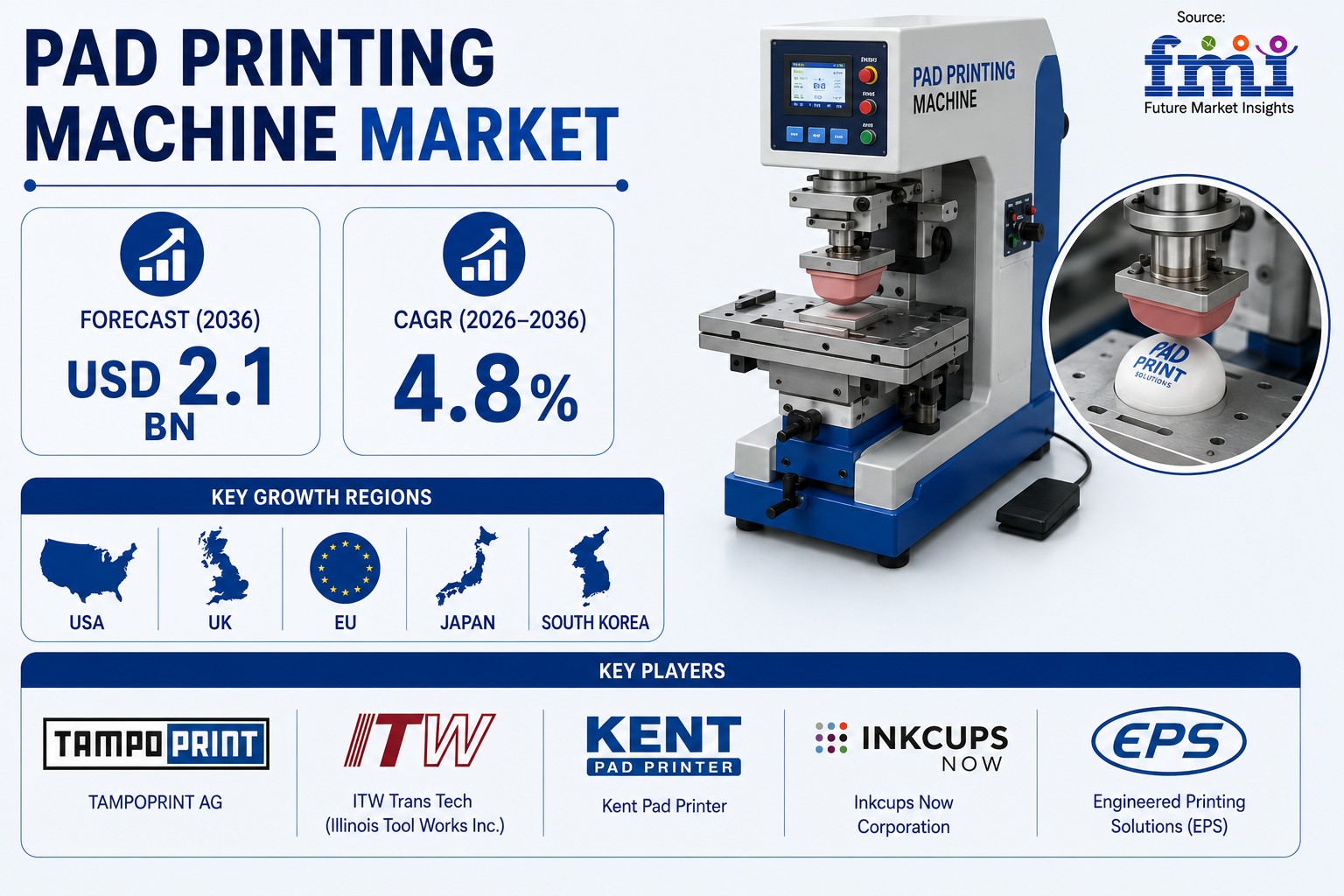
The global pad printing machine market was valued at USD 1.3 billion in 2025 and is projected to remain at approximately USD 1.3 billion by the end of 2026 before expanding steadily to USD 2.1 billion by 2036, registering a CAGR of 4.8% during the forecast period (2026–2036). Growth is supported by rising demand for precision product marking, increasing automation across manufacturing industries, and expanding production of electronics, automotive components, medical devices, and consumer goods.
Pad printing continues to remain one of the most preferred industrial printing technologies due to its ability to print accurately on curved, uneven, textured, and irregular surfaces that conventional printing methods cannot easily accommodate. As manufacturers focus on product customization, traceability, branding, and regulatory compliance, demand for advanced pad printing equipment is expected to remain stable across global industrial sectors.
Manual pad printing machines are expected to account for nearly 40.0% of total market demand in 2026, owing to their affordability and suitability for small production batches. Meanwhile, single-color printing machines continue to dominate with approximately 65.0% market share, particularly across industrial marking, promotional products, and component identification applications.
Why is the Pad Printing Machine Market Growing?
Industrial manufacturing is becoming increasingly automated while maintaining higher quality standards for product identification and branding. This transformation has significantly increased the need for precise, repeatable, and high-speed printing technologies that can operate across different materials including plastics, metals, ceramics, and glass.
The electronics industry remains one of the strongest contributors to market demand. Printed circuit boards, switches, connectors, keyboards, mobile accessories, and electronic housings require permanent markings with exceptional accuracy. Pad printing provides manufacturers with excellent print resolution while maintaining productivity even for complex component geometries.
Medical device manufacturing has also become an important growth driver. Regulatory requirements demand permanent identification marks, dosage information, calibration scales, and traceability codes on syringes, catheters, surgical instruments, and diagnostic equipment. Pad printing machines offer the precision required to meet these strict compliance standards.
Automotive manufacturers continue to invest heavily in component marking solutions. Dashboard controls, switches, trim components, logos, safety indicators, and interior accessories increasingly require durable, wear-resistant printed graphics that maintain appearance throughout vehicle life.
Consumer goods manufacturers are simultaneously expanding demand for customized branding, decorative printing, and promotional products. As brand differentiation becomes increasingly important across competitive markets, manufacturers continue investing in printing technologies capable of producing premium-quality graphics on diverse substrates.
Automation is Transforming Industrial Printing Operations
Manufacturers are increasingly replacing traditional manual production methods with semi-automatic and fully automatic pad printing systems that improve consistency while reducing labor costs.
Modern production facilities prioritize equipment capable of integrating directly into automated production lines. Inline printing systems now synchronize with robotic handling systems, conveyor lines, inspection equipment, and packaging operations, allowing continuous production with minimal human intervention.
Although manual machines remain popular among small manufacturers due to their lower capital investment, medium- and high-volume production facilities are steadily adopting automated equipment to improve production efficiency, reduce defects, and achieve faster turnaround times.
Industry 4.0 initiatives are further accelerating demand for smart printing machines equipped with digital controls, automated ink management, programmable printing sequences, and predictive maintenance capabilities.
Material Compatibility Expands Market Opportunities
One of the primary advantages of pad printing technology is its exceptional versatility across multiple substrates. Plastic components remain the largest application segment, particularly for ABS, polypropylene, polycarbonate, nylon, and engineering plastics used across electronics, packaging, and automotive industries.
Metal substrates continue generating significant demand as manufacturers require permanent identification on industrial tools, aluminum components, stainless steel products, and precision-engineered parts. Glass and ceramic printing applications are also expanding across cosmetics packaging, beverage bottles, pharmaceutical containers, promotional products, and decorative consumer goods. This flexibility enables manufacturers to standardize production processes while serving multiple industries using the same printing platform.
Market Segmentation Highlights
Based on product type, manual pad printing machines are projected to remain the leading segment with approximately 40.0% market share during 2026. Their relatively low acquisition cost and operational simplicity make them attractive for small manufacturers, prototype production, and customized printing jobs.
Semi-automatic machines are expected to witness faster adoption throughout the forecast period as manufacturers seek improved productivity while maintaining operational flexibility.
From a printing capability perspective, single-color printing machines account for nearly 65.0% of total market demand, primarily serving industrial component marking and product identification applications. Multi-color printing systems continue gaining popularity across premium consumer goods, automotive interiors, medical devices, and decorative packaging.
Among end-use industries, electronics and electrical manufacturing remains the dominant application due to continuous expansion in semiconductor production, consumer electronics, and electrical component manufacturing.
Regional Outlook
Asia Pacific continues to dominate the global pad printing machine market, supported by its extensive manufacturing ecosystem and strong industrial investments.
South Korea is projected to record the fastest growth through 2036, driven by continued expansion of semiconductor fabrication, display manufacturing, electric vehicle battery production, and government support for smart manufacturing technologies.
Japan continues investing heavily in factory automation and replacement of aging manufacturing equipment. High-quality production standards and precision engineering requirements further support demand for advanced printing systems.
China remains one of the world’s largest manufacturing hubs, with continued investments across electronics, automotive production, medical devices, and industrial automation creating sustained opportunities for equipment manufacturers.
North America also represents an attractive market. The United States benefits from reshoring initiatives, semiconductor investments supported by the CHIPS Act, and infrastructure modernization programs that encourage domestic manufacturing expansion.
European countries continue emphasizing energy-efficient manufacturing, industrial automation, and compliance with environmental regulations. These factors encourage replacement of older printing systems with more efficient and digitally integrated equipment.
Competitive Landscape
Competition within the pad printing machine market remains technology-driven, with manufacturers focusing on automation, printing precision, equipment reliability, and production flexibility.
TAMPOPRINT AG maintains a leading market position through its extensive product portfolio, integrated automation solutions, and global distribution network. The company continues investing in modular automation systems designed for high-volume industrial applications.
ITW Trans Tech (Illinois Tool Works Inc.) remains another major participant, offering specialized printing systems for electronics, medical devices, automotive components, and industrial manufacturing.
Other established manufacturers including Kent Pad Printer, Inkcups Now Corporation, and Engineered Printing Solutions (EPS) continue expanding their presence through product innovation, aftermarket support, and application-specific printing solutions.
Emerging companies such as Teca-Print AG, Comec Italia S.r.l., and Printex USA are strengthening their competitive positions by targeting specialized industrial applications and regional customer segments.
Future Outlook
The pad printing machine market is expected to experience stable and sustainable growth throughout the forecast period as manufacturing industries continue prioritizing automation, precision, and product traceability. Rising production of electronics, automotive components, healthcare devices, and premium consumer products will continue supporting long-term equipment demand.
Manufacturers capable of delivering automated solutions, lower operating costs, digital integration, and consistent print quality will be well positioned to capitalize on future opportunities. As industrial production becomes increasingly sophisticated, pad printing machines will remain an essential component of modern manufacturing operations, enabling efficient, high-quality marking across an expanding range of industrial and commercial applications.
Related Research Reports
Padded Divider Market: The padded divider market is forecast to expand to USD 555.25 million by 2036 at a 2.70% CAGR
Single Colour Pad Printing Machines Market: The Single Colour Pad Printing Machines Market is projected to reach USD 1,453.0 million by 2035.
Padded Mailers Market: The padded mailers market is expected to grow from USD 3.8 billion in 2025 to USD 8.1 billion by 2036 at a 7.0% CAGR
About Future Market Insights (FMI)
Future Market Insights is a leading provider of market intelligence, consulting services, and syndicated research reports. FMI delivers actionable insights across packaging, logistics, industrial manufacturing, food and beverage, healthcare, chemicals, and emerging technologies, helping organizations identify growth opportunities and make informed strategic decisions in rapidly evolving markets.
Contact
Future Market Insights Inc.
Christiana Corporate
200 Continental Drive, Suite 401
Newark, Delaware 19713, USA
Email: sales@futuremarketinsights.com
Website: www.futuremarketinsights.com