


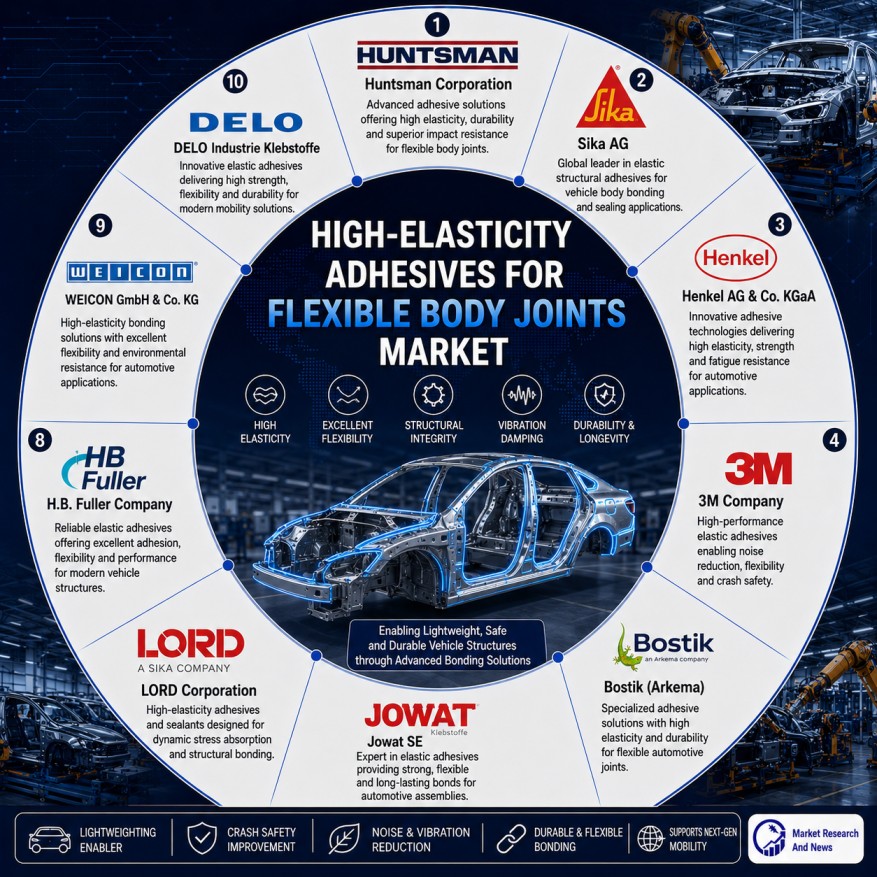
The global High-Elasticity Adhesives for Flexible Body Joints Market is projected to grow from USD 1.4 billion in 2026 to USD 2.9 billion by 2036, registering a compound annual growth rate (CAGR) of 7.6% during the forecast period. Rising adoption of lightweight vehicle architectures, increasing use of mixed-material body structures, and expanding automation in automotive manufacturing are expected to fuel market growth through 2036.
Vehicle manufacturers are increasingly replacing conventional mechanical fastening methods with advanced elastic bonding solutions that improve structural integrity, reduce vehicle weight, minimize vibration, and enhance long-term durability. High-elasticity adhesives are becoming an integral component of modern body-in-white (BIW) assembly, particularly as automotive OEMs accelerate the transition toward electric and fuel-efficient vehicles.
Demand for Lightweight and Mixed-Material Vehicle Bodies Accelerates Market Growth
Automotive manufacturers continue to adopt combinations of steel, aluminum, and advanced composites to reduce vehicle weight while maintaining structural performance. These mixed-material body structures require adhesive technologies capable of accommodating different thermal expansion rates and continuous body movement without compromising bond strength.
High-elasticity adhesives provide the flexibility necessary to absorb stress generated by vibration, road conditions, and repeated opening and closing of vehicle components such as doors, hoods, and closure panels. Their ability to maintain durable bonds while reducing fatigue-related failures has made them increasingly valuable in next-generation passenger vehicle production.
Growing emphasis on vehicle refinement, cabin comfort, and long-term durability is further strengthening demand for advanced flexible bonding solutions across global automotive manufacturing.
Passenger Cars Continue to Lead Market Demand
Passenger cars are expected to remain the largest vehicle segment, accounting for 71.0% of the global market in 2026.
The increasing production of passenger vehicles, coupled with rising consumer expectations for improved ride quality, reduced noise, and enhanced structural safety, continues to encourage greater adoption of high-elasticity adhesives. Automakers are integrating these materials throughout body structures to reduce panel vibration, improve crash performance, and enhance corrosion protection while minimizing vehicle weight.
The rapid expansion of electric vehicle production is also contributing to increased adhesive consumption, as EV platforms rely heavily on lightweight body construction and advanced joining technologies.
Robotic Dispensing Becomes the Preferred Application Method
Robotic dispensing is projected to account for 59.0% of the market in 2026, making it the dominant application method for high-elasticity adhesives.
Modern automotive assembly lines require precise adhesive bead placement across long seams, roof structures, closure panels, and complex body geometries. Robotic dispensing systems ensure consistent application thickness, minimize material waste, improve production speed, and support high-volume manufacturing.
As automotive manufacturers continue investing in Industry 4.0 technologies and fully automated body shops, robotic adhesive application is expected to remain a key driver of market expansion.
Modified Epoxy and Polyurethane Systems Drive Product Innovation
Modified epoxy adhesives continue to lead the resin chemistry segment due to their ability to combine high structural strength with flexibility. These advanced formulations offer excellent fatigue resistance, movement absorption, and compatibility with modern vehicle manufacturing processes.
Polyurethane adhesives also remain an important segment, particularly in applications requiring high elongation and durable bonding across flexible body joints. Their superior elasticity makes them well suited for closure panels, doors, roof structures, and other vehicle components exposed to repeated stress and vibration.
Manufacturers continue investing in resin technologies that deliver stronger adhesion while supporting faster curing cycles and improved manufacturing efficiency.
Anti-Flutter Joint Applications Gain Momentum
Anti-flutter joints represent one of the most significant application areas for high-elasticity adhesives.
Vehicle manufacturers increasingly utilize flexible bonding solutions to minimize panel vibration in hood assemblies, door skins, roof panels, and other exterior components. These adhesives improve ride comfort by reducing noise, vibration, and harshness (NVH) while enhancing the structural stability of body panels over the vehicle’s service life.
As consumers increasingly prioritize vehicle quality and refinement, anti-flutter adhesive applications are expected to remain an important growth area throughout the forecast period.
Technological Advancements Enhance Adhesive Performance
Ongoing innovation in adhesive chemistry is enabling manufacturers to meet increasingly demanding automotive production requirements.
Low-temperature curing technologies are reducing energy consumption during e-coat processing while improving manufacturing efficiency. Adhesive formulations capable of bonding oily steel and aluminum substrates without extensive surface preparation are simplifying production and lowering assembly costs.
Manufacturers are also developing sustainable adhesive solutions incorporating renewable and bio-based raw materials, supporting the automotive industry’s broader environmental objectives.
Additionally, flexible acrylic adhesive technologies offering elongation levels of up to 200% are expanding opportunities for complex mixed-material body assemblies requiring exceptional flexibility and long-term durability.
Asia-Pacific Emerges as the Primary Growth Hub
China and India continue to strengthen their position as major automotive manufacturing centers through expanding vehicle production capacity and increased investment in automated body-shop facilities.
India is forecast to be the fastest-growing national market, registering a CAGR of 8.7% through 2036. Rising passenger vehicle production, increasing localization of automotive manufacturing, expanding electric vehicle adoption, and ongoing investments in advanced manufacturing technologies are expected to support sustained market growth.
North America also remains a significant market, driven by established body-in-white production facilities, mature automotive supply chains, and continuous investments in advanced vehicle assembly technologies.
Competitive Landscape
Competition within the high-elasticity adhesives for flexible body joints market is increasingly centered on product performance, OEM approvals, application engineering expertise, and manufacturing support.
Leading adhesive suppliers are developing advanced formulations that deliver superior elongation, fatigue resistance, corrosion protection, and compatibility with automated dispensing systems. Companies capable of providing technical support, process optimization, and validated adhesive performance across multiple vehicle platforms are strengthening their partnerships with automotive manufacturers.
As automakers seek to reduce production complexity and improve long-term vehicle performance, suppliers with proven body-shop compatibility and strong OEM relationships are expected to secure greater market opportunities.
Future Outlook
The future of the high-elasticity adhesives for flexible body joints market remains highly promising as automotive manufacturers continue pursuing lightweight construction, enhanced structural performance, and greater manufacturing efficiency.
Growing adoption of mixed-material vehicle platforms, increasing investment in electric vehicle production, expanding automation in body-shop operations, and continuous innovation in adhesive technologies are expected to sustain market growth through 2036.
Manufacturers that deliver high-performance adhesive solutions capable of combining structural strength, flexibility, corrosion resistance, and seamless integration into automated production environments are expected to play a pivotal role in the next generation of automotive manufacturing.
Browse More Reports
Business Jet Market – https://www.openpr.com/news/4536884/business-jet-market-to-reach-usd-59-4-billion-by-2036-driven
Locomotive Pantographs Market – https://www.openpr.com/news/4536940/locomotive-pantographs-market-to-reach-usd-804-4-million
Automotive Telematics Sales Analysis in APAC – https://www.openpr.com/news/4536987/automotive-telematics-market-in-apac-to-reach-usd-420-2-billion