

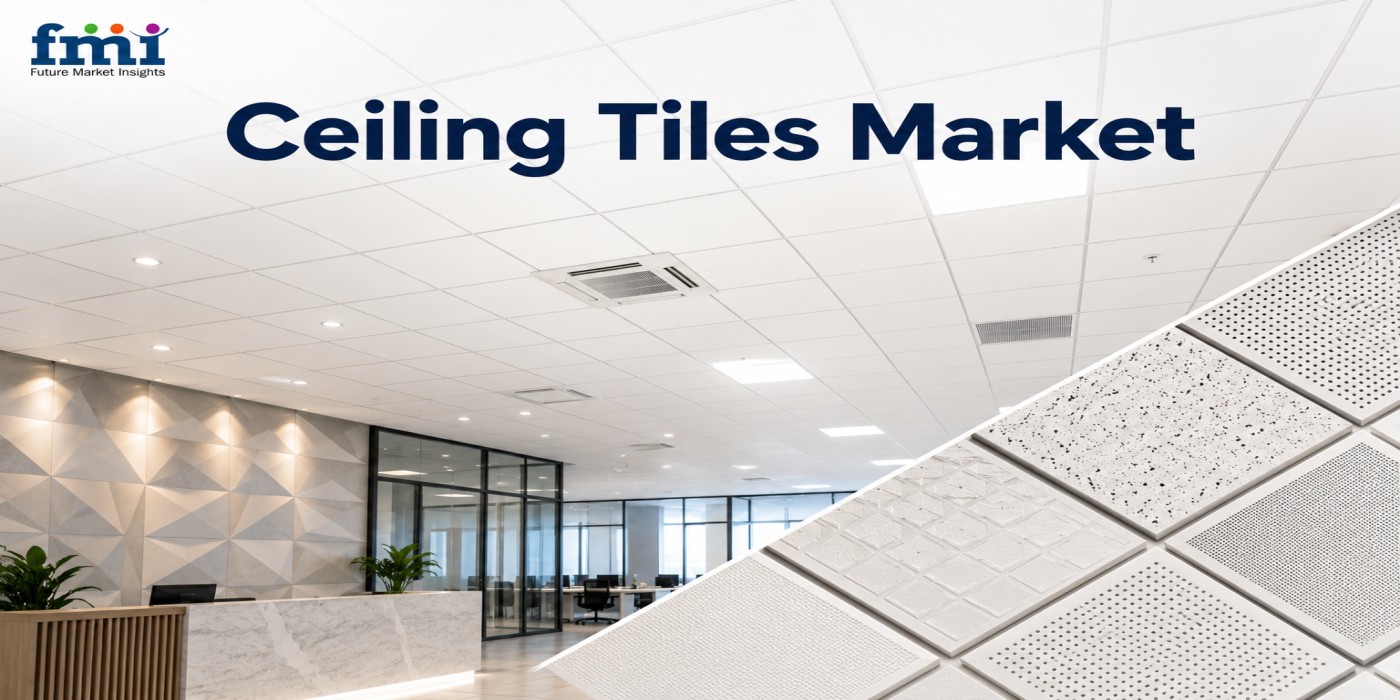
The global ceiling tiles market continues to witness steady expansion as commercial construction, institutional infrastructure development, and renovation projects generate sustained demand for high-performance ceiling systems. Ceiling tiles have evolved beyond their traditional decorative role to become essential components of modern buildings, contributing to acoustic control, fire safety, thermal insulation, maintenance accessibility, and interior aesthetics across offices, healthcare facilities, educational institutions, retail spaces, transportation hubs, and public infrastructure.
As architects, contractors, and building owners increasingly prioritize application-specific performance, material selection is shifting from cost-based decisions toward functional optimization.
Market Outlook
The ceiling tiles market is projected to expand steadily throughout the forecast period, supported by increasing commercial construction, modernization of existing buildings, rising infrastructure investments, and growing emphasis on sustainable interior construction solutions.
The market is expected to grow from USD 10,070.0 million in 2026 to USD 18,033.8 million by 2036, reflecting a CAGR of 6.0%. Unlike previous growth cycles that relied heavily on new construction, future demand is increasingly influenced by commercial renovation, public infrastructure upgrades, office modernization, healthcare expansion, and educational facility development.
Mineral Fiber Ceiling Tiles Continue to Lead Product Demand
One of the strongest factors supporting market growth is the continued dominance of mineral fiber ceiling tiles across commercial interiors.
Mineral fiber remains the leading product segment, accounting for approximately 42.0% of total product demand in 2026. Its widespread use across offices, schools, hospitals, retail outlets, government buildings, and institutional facilities continues to support significant consumption volumes.
The material offers an effective balance of acoustic performance, affordability, lightweight construction, and compatibility with suspended ceiling systems. Contractors also benefit from simplified installation, broad product availability, and the ability to replace individual damaged tiles without disturbing the entire ceiling structure, making mineral fiber particularly attractive for high-volume commercial projects.
Suspended Ceiling Systems Reinforce Mineral Fiber Leadership
Suspended ceiling systems continue to dominate installation methods, representing approximately 63.0% of installation demand in 2026.
Grid-based suspended systems remain the preferred solution for commercial interiors because they conceal HVAC systems, electrical wiring, lighting, fire protection equipment, and other building services while allowing easy maintenance access.
Mineral fiber tiles integrate seamlessly into these systems, providing facility managers with convenient replacement options while minimizing operational disruptions during maintenance or renovations.
Metal Ceiling Tiles Gain Momentum in Premium Commercial Applications
Metal ceiling tiles continue strengthening their position across projects where durability, hygiene, premium aesthetics, and long-term performance are prioritized.
Unlike mineral fiber, metal ceiling systems are selected for specialized applications including airports, transportation terminals, laboratories, hospitals, commercial kitchens, industrial facilities, luxury retail environments, and high-traffic public buildings.
Their superior impact resistance, cleanability, fire performance, and architectural versatility make them particularly suitable for demanding operating environments. Perforated metal panels combined with acoustic backing also provide an attractive combination of sound absorption and premium visual appeal.
Gypsum Ceiling Systems Maintain Strong Position Across Fire-Rated Interiors
Gypsum continues to serve an important role across commercial and residential construction where smooth finishes, structural rigidity, and fire-rated performance are primary project requirements.
Gypsum ceiling systems are widely specified for corridors, lobbies, institutional buildings, residential developments, and projects emphasizing seamless architectural finishes.
Although gypsum may require additional planning for maintenance access compared to modular suspended systems, it remains highly attractive in applications where continuous ceiling appearance, fire resistance, and design continuity are prioritized over frequent service access.
Commercial Construction Continues to Shape Material Selection
Commercial buildings remain the largest end-use segment, accounting for approximately 54.0% of overall market demand in 2026.
Offices, educational institutions, healthcare facilities, retail developments, hospitality projects, government buildings, and public infrastructure continue to drive purchasing decisions across all major ceiling tile materials.
Each project increasingly incorporates multiple ceiling solutions depending on room function. Office workspaces often utilize mineral fiber for acoustic performance, while entrance lobbies may feature metal systems for enhanced aesthetics, and corridors frequently incorporate gypsum ceilings to achieve seamless finishes and fire-rated construction.
Renovation Activity Expands Market Opportunities
Building renovation continues to emerge as an increasingly important growth driver within the ceiling tiles market.
Existing commercial buildings frequently utilize suspended ceiling grids that can be upgraded simply by replacing outdated mineral fiber panels with newer products offering improved acoustic performance, higher light reflectance, moisture resistance, and enhanced sustainability credentials.
More extensive renovation projects may incorporate metal or gypsum ceiling systems where architectural redesign, premium aesthetics, or improved building performance justify complete ceiling replacement.
Product Innovation Supports Market Expansion
Innovation within the ceiling tiles market increasingly focuses on enhancing building performance while improving installation efficiency and environmental sustainability.
Manufacturers continue investing in higher acoustic ratings, improved sag resistance, recycled material content, low-emission certifications, enhanced cleanability, moisture resistance, and expanded design options.
Metal ceiling manufacturers are developing lightweight modular systems with integrated acoustic backing, while gypsum producers continue advancing fire-rated and moisture-resistant product portfolios suitable for specialized commercial environments.
Challenges Facing the Market
Despite favorable growth prospects, the ceiling tiles market faces several challenges.
Raw material cost fluctuations, transportation expenses, and evolving sustainability regulations continue influencing manufacturing costs across mineral fiber, metal, and gypsum products.
Competitive pressure also continues increasing as project specifications become more performance-driven. Contractors, architects, and facility managers increasingly evaluate products based on acoustic ratings, fire performance, maintenance requirements, environmental certifications, durability, and lifecycle value rather than purchase price alone.
Segmentation Highlights
Mineral fiber ceiling tiles represent approximately 42.0% of total product demand, making them the leading material category within the global ceiling tiles market.
Suspended ceiling systems account for approximately 63.0% of installation demand, highlighting the continued importance of modular commercial ceiling construction.
Commercial applications contribute approximately 54.0% of overall end-use demand, reinforcing the sector’s central role in shaping product development and procurement strategies.
Regional Trends
North America continues to maintain a significant market position, supported by mature commercial construction practices, extensive renovation activity, and continued demand for high-performance ceiling systems across institutional and office environments.
Europe remains an important growth region as sustainable building renovation, public infrastructure modernization, and stringent environmental regulations encourage adoption of advanced ceiling solutions with improved acoustic and energy performance.
Asia-Pacific continues to emerge as one of the fastest-growing regional markets, driven by rapid urbanization, expanding commercial infrastructure, rising office construction, healthcare investments, and increasing adoption of modern suspended ceiling systems across rapidly developing economies.
Competitive Landscape and Future Outlook
The ceiling tiles market remains highly competitive, with manufacturers focusing on application-specific innovation, sustainability, material diversification, and expanded architectural design capabilities.
Leading suppliers continue investing in enhanced mineral fiber performance, premium metal ceiling systems, advanced gypsum formulations, recycled material integration, and environmentally certified product portfolios to strengthen market positioning.
Rather than competing through a single material platform, manufacturers are increasingly offering comprehensive ceiling solutions capable of meeting varying functional requirements throughout modern commercial buildings.
Conclusion: Application-Driven Material Selection Defines the Future of the Ceiling Tiles Market
The ceiling tiles market is entering a new phase of growth where material selection is increasingly determined by building function, performance expectations, and lifecycle value rather than simple cost comparisons.
While mineral fiber continues to dominate overall market volume through its strong acoustic performance, affordability, and compatibility with suspended ceiling systems, metal ceiling tiles are expanding across premium, high-durability applications, and gypsum continues strengthening its position within fire-rated and seamless architectural interiors.
Explore More Related Studies Published by FMI Research:
About Future Market Insights (FMI)
Future Market Insights, Inc. (FMI) is an ESOMAR-certified, ISO 9001:2015 market research and consulting organization trusted by Fortune 500 companies and global enterprises. With operations across the United States, United Kingdom, India, and Dubai, FMI delivers data-driven market intelligence, strategic consulting, and actionable insights across more than 30 industries and 1,200 markets worldwide.