

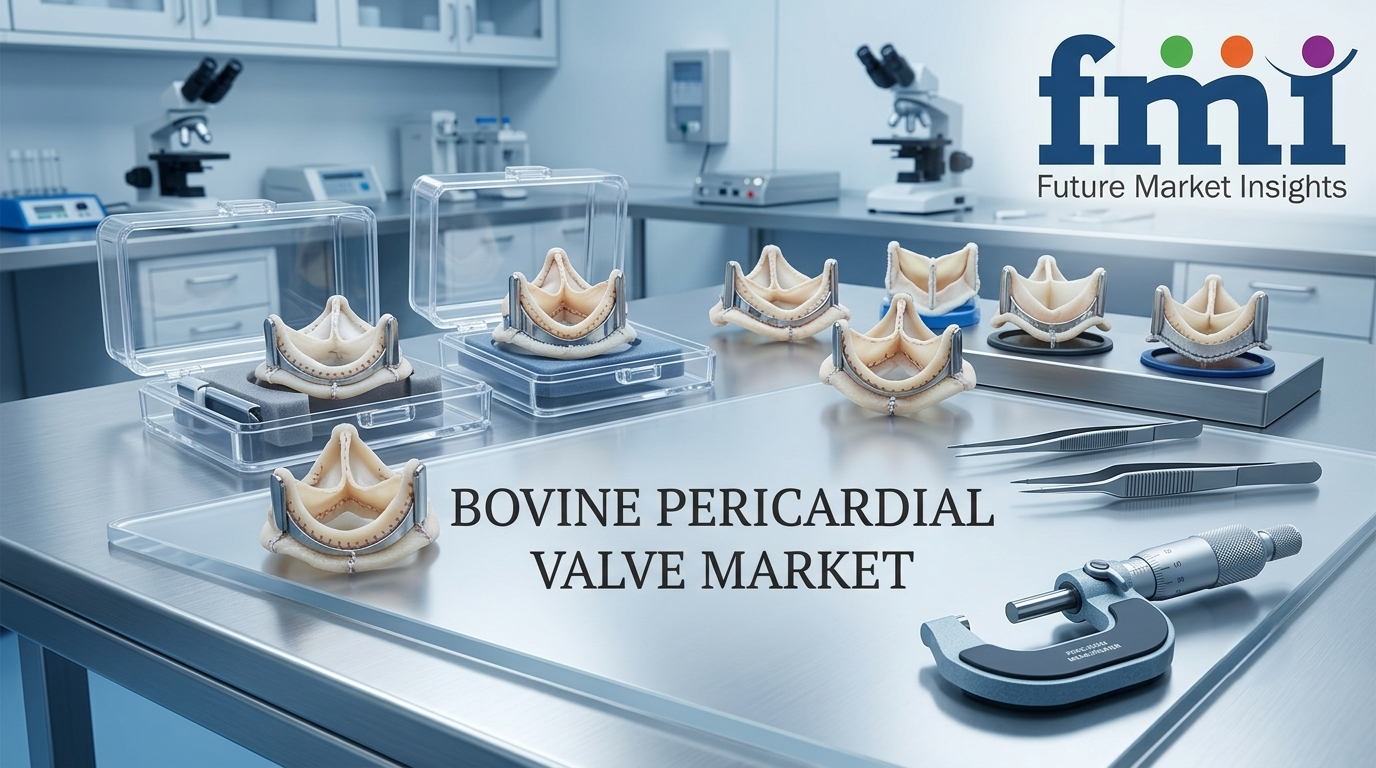
The global bovine pericardial valve market is entering a transformative phase as healthcare systems increasingly align procurement decisions with long-term clinical outcomes and economic sustainability. Valued at USD 2.2 billion in 2026, the market is projected to reach USD 3.6 billion by 2036, expanding at a compound annual growth rate (CAGR) of 5.1% during the forecast period. The transition toward value-based cardiac care is encouraging hospitals and healthcare providers to prioritize technologies that demonstrate durability, procedural efficiency, improved patient quality of life, and reduced long-term healthcare costs rather than focusing solely on device acquisition prices.
Bovine pericardial valves are gaining wider clinical acceptance due to their tissue-based design, which reduces the need for lifelong anticoagulation therapy in appropriately selected patients. At the same time, healthcare organizations are evaluating the total episode of care—including hospitalization duration, readmission risk, postoperative recovery, and future intervention requirements—when selecting heart valve replacement technologies.
Market Overview
The bovine pericardial valve market continues to experience stable growth as biological heart valve replacement becomes an increasingly important component of modern cardiovascular care. Rising incidences of valvular heart disease, population aging, and expanding access to advanced cardiac surgery are supporting consistent procedural volumes across both developed and emerging healthcare systems.
Market value is forecast to increase from USD 2.2 billion in 2026 to USD 3.6 billion by 2036, representing a 5.1% CAGR over the forecast period. While demographic trends remain a fundamental demand driver, the industry’s strategic direction is increasingly influenced by healthcare payment reforms emphasizing measurable patient outcomes and efficient resource utilization.
Key Growth Drivers
- Rising global prevalence of valvular heart disease and aging populations increasing cardiac intervention volumes.
- Growing adoption of value-based healthcare models emphasizing long-term patient outcomes and healthcare efficiency.
- Increasing preference for tissue-based heart valves that reduce the need for lifelong anticoagulation therapy in selected patients.
- Greater focus on total episode-of-care economics, including hospitalization costs, readmission rates, and quality-of-life improvements.
- Expansion of specialized cardiac centers and modernization of healthcare infrastructure in emerging economies.
- Increasing clinical emphasis on durability, procedural compatibility, and evidence-based performance during procurement decisions.
Technology & Innovation Trends
Clinical innovation within the bovine pericardial valve market is increasingly centered on maximizing long-term durability while improving procedural efficiency. Healthcare providers are demanding technologies capable of delivering consistent hemodynamic performance alongside reduced postoperative complications.
Manufacturers are investing in enhanced tissue processing techniques, improved valve durability, optimized implantation compatibility, and stronger clinical evidence generation. These advancements support healthcare providers seeking technologies that align with value-based reimbursement models where patient outcomes are directly linked to healthcare spending.
Market Challenges & Restraints
Despite favorable long-term growth prospects, the bovine pericardial valve market continues to face several structural challenges.
Healthcare systems remain under significant budgetary pressure, particularly in emerging markets where affordability continues to influence procurement decisions. Although value-based reimbursement recognizes long-term economic benefits, hospitals often balance these advantages against immediate capital expenditure constraints.
Manufacturers are also expected to generate increasingly comprehensive clinical evidence demonstrating superior durability, lower complication rates, and improved patient outcomes. As reimbursement frameworks evolve, failure to provide robust long-term data may reduce competitive positioning even for technologically advanced products.
Furthermore, procurement decisions are becoming increasingly complex as providers evaluate clinical effectiveness alongside healthcare resource utilization, making market differentiation dependent on both medical performance and economic evidence.
Segment Analysis
Product segmentation reflects evolving procedural demand across cardiovascular surgery.
The aortic valve segment is expected to account for approximately 55.0% of total valve type demand by 2026, supported by the high prevalence of aortic valve disease and consistently large procedural volumes worldwide. Continued improvements in surgical techniques and growing patient eligibility for biological valve replacement further reinforce the segment’s market leadership.
From a materials perspective, cobalt-chrome alloys are projected to represent nearly 40.0% of total material usage. Their widespread adoption reflects proven mechanical strength, durability, biocompatibility, and established physician confidence across multiple cardiac valve replacement procedures.
Regional Analysis
Regional market dynamics demonstrate varying stages of value-based healthcare adoption.
Developed healthcare markets are increasingly integrating outcome-based reimbursement into procurement practices. Hospitals across these regions are placing greater emphasis on technologies capable of reducing long-term healthcare costs while improving patient outcomes. This shift is strengthening demand for bovine pericardial valves that demonstrate durability and lower overall treatment burden.
Emerging economies continue to present substantial expansion opportunities as healthcare infrastructure improves and access to advanced cardiovascular procedures increases.
Among major growth markets, China is projected to register the fastest expansion with a 6.9% CAGR through 2036, driven by rising investments in specialized cardiac care facilities and healthcare modernization initiatives. India is expected to grow at a 6.4% CAGR, supported by expanding procedural volumes, broader healthcare accessibility, and increasing adoption of advanced cardiovascular treatments.
Markets such as Germany and Brazil also present meaningful opportunities as providers gradually incorporate long-term clinical value into procurement strategies while expanding access to biological valve therapies.
Competitive Landscape
Competition within the bovine pericardial valve market is shifting beyond conventional pricing strategies toward evidence-based value creation.
Healthcare providers increasingly evaluate manufacturers based on durability, procedural reliability, physician confidence, technical support capabilities, and long-term clinical performance. Procurement frameworks are becoming increasingly sophisticated, requiring companies to demonstrate measurable improvements in healthcare efficiency rather than relying solely on product specifications.
Leading Companies Analysis
Industry participants are increasingly strengthening their market positions by investing in clinical evidence generation, physician training, and product performance validation.
Manufacturers capable of demonstrating reduced hospitalization, improved postoperative quality of life, lower reintervention risk, and optimized healthcare resource utilization are expected to gain competitive advantages under evolving reimbursement models. Premium pricing remains achievable for technologies that consistently deliver measurable improvements across the entire continuum of patient care.
Investment & Strategic Developments
Healthcare modernization initiatives and investments in specialized cardiac infrastructure continue to expand the addressable market for bovine pericardial valves.
Governments, hospitals, and healthcare providers are increasing investments in advanced cardiovascular treatment capacity, while reimbursement systems increasingly reward technologies capable of improving both clinical and economic outcomes.
Future Outlook
The long-term outlook for the bovine pericardial valve market remains favorable as value-based healthcare becomes more deeply embedded within cardiovascular medicine.
Future growth will increasingly depend on manufacturers’ ability to combine technological innovation with strong clinical evidence supporting improved patient outcomes and healthcare efficiency. Expanding procedural volumes, aging populations, healthcare infrastructure development, and broader adoption of biological valve therapies are expected to sustain market expansion through 2036.
Companies aligning product development with provider priorities—including durability, procedural compatibility, patient-centered care, and long-term economic value—are likely to achieve stronger market positioning as reimbursement systems continue to evolve.
Related Reports:
FMI Custom Research: Strategic Intelligence for Confident Decision-Making
In today’s rapidly evolving business environment, leadership teams need more than market data—they need clear, actionable intelligence tailored to their strategic objectives. FMI’s Custom Research solutions are designed around the specific business questions organizations need answered, enabling executives to evaluate growth opportunities, validate investments, assess competitive dynamics, and reduce uncertainty before making critical decisions. By combining deep industry expertise, primary research, and proprietary market intelligence, FMI delivers insights that help organizations move from assumptions to evidence-based strategies with greater speed and confidence.
Key Executive Benefits
- Decision-Ready Insights: Research tailored to your specific business challenges, growth plans, and investment priorities.
- Reduced Strategic Risk: Validate market opportunities, customer demand, and competitive positioning before committing resources.
- Market Entry Confidence: Assess opportunity size, regulatory barriers, channel dynamics, and competitive landscapes with precision.
- Competitive Advantage: Gain proprietary intelligence unavailable through syndicated reports or internal datasets.
- Faster Growth Decisions: Accelerate expansion, product development, portfolio optimization, and investment planning.
- Primary Market Validation: Access real-world customer, buyer, and stakeholder insights that support high-confidence decision-making.
- Global Industry Expertise: Powered by 100+ analysts, 20,000+ published reports, and 1.6 million+ hours of research experience.
- Proven Track Record: Over 7,000 market-entry engagements completed across six regions and 14 industry sectors with strong client retention.
Business Impact
FMI helps organizations transform market complexity into strategic clarity, enabling leadership teams to identify growth opportunities faster, optimize resource allocation, strengthen competitive positioning, and make high-stakes business decisions with confidence.
To explore how FMI Custom Research can support your strategic priorities, please connect with our team at – sales@futuremarketinsights.com