

According to the latest insights by Future Market Insights, the global Construction Polymer Market is entering a phase of accelerated growth as construction companies, infrastructure developers, and commercial real estate stakeholders increasingly adopt high-performance polymer solutions to improve durability, energy efficiency, and lifecycle performance of buildings and infrastructure assets. Rising investments in urban development, industrial facilities, transportation networks, and commercial construction projects are expected to create substantial opportunities for construction polymer manufacturers worldwide.
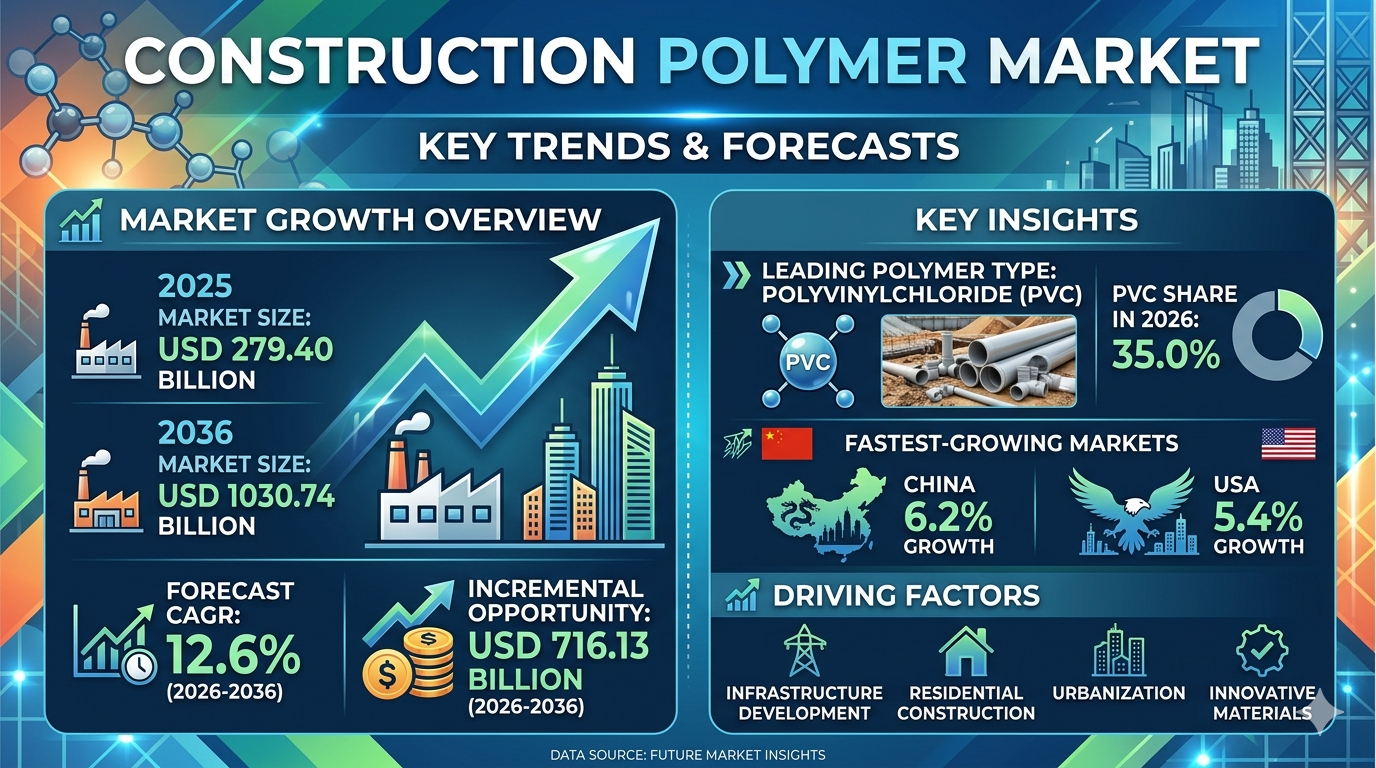
The market is projected to grow from USD 314.6 billion in 2026 to USD 1,030.7 billion by 2036, registering a CAGR of 12.6% during the forecast period. Increasing specification upgrades, evolving building standards, and the growing preference for lightweight, corrosion-resistant, and cost-efficient materials are supporting widespread adoption across multiple construction applications.
As construction activities expand across emerging and developed economies, polymers are becoming indispensable materials in modern infrastructure development, supporting enhanced structural performance, insulation efficiency, waterproofing, and sustainability objectives.
Quick Market Highlights
- Construction Polymer Market expected to reach USD 1,030.7 billion by 2036
- Strong CAGR of 12.6% forecast between 2026 and 2036
- Polyvinylchloride projected to account for 35.0% share of polymer type demand
- Commercial Real Estate Construction expected to contribute 35.0% of end-user demand
- Thermoplastic Polymers anticipated to hold 31.8% share of polymer form demand
- China and the United States expected to remain key growth markets through 2036
Infrastructure Development Drives Long-Term Market Expansion
Global investments in infrastructure modernization continue to create significant opportunities for construction polymer manufacturers. Governments and private developers are prioritizing projects involving transportation infrastructure, utility networks, commercial facilities, and urban development programs, all of which require advanced materials capable of delivering durability and cost efficiency.
Construction polymers offer advantages including enhanced weather resistance, improved insulation performance, corrosion protection, lightweight construction, and longer service life. These characteristics are becoming increasingly important as developers seek materials that reduce maintenance costs while meeting modern construction standards.
Industry stakeholders are also placing greater emphasis on lifecycle value, driving demand for polymers that improve building performance and contribute to long-term operational savings.
Polyvinylchloride Maintains Leadership Across Construction Applications
Polyvinylchloride (PVC) is expected to account for 35.0% of total polymer type demand in 2026, maintaining its position as the dominant segment within the construction polymer market.
The material’s popularity stems from its versatility, affordability, durability, and broad applicability across pipes, window profiles, roofing systems, flooring materials, insulation products, and waterproofing membranes. Established supply chains and extensive industry acceptance continue to strengthen PVC’s market position across both developed and emerging economies.
In addition to PVC, epoxy resins, polyurethane, polypropylene, polyethylene, and polycarbonate materials are witnessing growing adoption in specialized construction applications requiring enhanced strength, chemical resistance, and environmental performance.
Commercial Real Estate Construction Generates Significant Demand
Commercial Real Estate Construction is projected to account for 35.0% of end-user demand throughout the forecast period.
The segment benefits from increasing investments in office complexes, mixed-use developments, retail facilities, hospitality projects, logistics centers, and commercial infrastructure. Developers are increasingly incorporating advanced polymer materials to improve building efficiency, sustainability, and structural integrity.
As modern commercial buildings become more technologically sophisticated, demand for specialized adhesives, sealants, insulation materials, coatings, and weather-resistant systems is expected to grow steadily.
Industry analysts note that evolving building regulations and performance-based construction standards are encouraging the use of higher-quality polymer materials across commercial projects worldwide.
Thermoplastic Polymers Gain Momentum Through Material Innovation
Thermoplastic Polymers are expected to account for 31.8% of polymer form demand, reflecting growing industry preference for versatile and recyclable construction materials.
These polymers offer advantages including reusability, ease of processing, lightweight properties, and enhanced design flexibility. Their application across piping systems, insulation products, protective membranes, and structural components continues to expand as construction firms seek materials that support both performance and sustainability objectives.
Ongoing innovation in polymer chemistry and manufacturing technologies is enabling suppliers to develop advanced solutions capable of meeting increasingly stringent construction specifications.
Manufacturers are focusing on:
- Improved material durability
- Enhanced thermal insulation performance
- Greater chemical and moisture resistance
- Lightweight structural solutions
- Sustainable and recyclable material development
China and the United States Lead Global Growth Opportunities
China is expected to emerge as the fastest-growing major market, expanding at a CAGR of 6.2% through 2036.
Large-scale urbanization initiatives, industrial expansion programs, infrastructure investment, and government-backed development projects continue to drive significant demand for construction polymers across the country. Domestic manufacturing capabilities and increasing quality standards further support market expansion.
The United States is projected to grow at a CAGR of 5.4%, supported by infrastructure modernization programs, commercial construction activity, reshoring initiatives, and rising adoption of advanced building materials.
Federal infrastructure investments and growing demand for sustainable construction solutions are expected to strengthen procurement activity throughout the forecast period.
Other notable growth markets include:
- South Korea (5.1%)
- United Kingdom (4.7%)
- Germany (4.6%)
- Australia (4.4%)
Regulatory Standards and Sustainability Goals Influence Procurement Decisions
Environmental regulations and sustainability targets are increasingly shaping purchasing decisions within the construction industry.
Developers and contractors are seeking polymer solutions that support energy efficiency, reduce material waste, improve building performance, and contribute to green building certification requirements.
At the same time, compliance requirements across Europe, North America, and Asia continue to evolve, creating opportunities for manufacturers capable of delivering certified products that meet diverse regional standards.
Companies with strong quality assurance programs and established certification portfolios are expected to gain a competitive advantage as procurement processes become increasingly performance-focused.
Supply Chain Optimization and Raw Material Volatility Remain Key Challenges
Despite strong growth prospects, the construction polymer market continues to face challenges associated with raw material price fluctuations, supply chain disruptions, and intense competitive pricing pressure.
Manufacturers are responding by diversifying sourcing strategies, investing in regional production facilities, and improving supply chain resilience. Buyers are increasingly prioritizing suppliers that can provide consistent product quality, dependable delivery schedules, and long-term contractual stability.
Industry participants are also investing in digital supply chain management tools to improve forecasting accuracy and procurement efficiency.
Competitive Landscape Focuses on Scale, Innovation, and Technical Expertise
Competition within the construction polymer market remains intense as global manufacturers expand production capabilities and strengthen technical support services.
Leading companies are focusing on:
- Capacity expansion in high-growth regions
- Development of advanced polymer formulations
- Sustainability-focused product innovation
- Strategic partnerships with construction firms
- Enhanced technical support and application expertise
- Regional manufacturing and distribution network expansion
Major industry participants include BASF SE, Arkema S.A., Evonik Industries AG, Henkel AG and Co. KGaA, Sika AG, H.B. Fuller Company, Momentive Performance Materials Inc., Solvay SA, E.I Dupont De Nemours and Company, and SCG Chemicals Co., Ltd.
Recent developments include portfolio expansion initiatives by BASF SE and new advanced manufacturing solutions introduced by Arkema S.A. targeting commercial construction applications.
Outlook: Construction Polymers Become Essential to Next-Generation Infrastructure
Looking ahead to 2036, construction polymers are expected to play an increasingly critical role in supporting global infrastructure development, sustainable construction practices, and advanced building technologies.
As developers prioritize durability, energy efficiency, and lifecycle performance, polymer-based materials will continue to gain importance across commercial, residential, industrial, transportation, and utility infrastructure projects.
The next decade is expected to favor manufacturers capable of combining production scale, technical innovation, regulatory compliance, and cost competitiveness while delivering application-specific solutions that address the evolving needs of the global construction industry.
Related Reports:
Construction Repair Composites Market
Have a specific Requirements and Need Assistant on Report Pricing or Limited Budget please contact us – sales@futuremarketinsights.com
About Future Market Insights (FMI)
Future Market Insights, Inc. (FMI) is an ESOMAR-certified, ISO 9001:2015 market research and consulting organization, trusted by Fortune 500 clients and global enterprises. With operations in the U.S., UK, India, and Dubai, FMI provides data-backed insights and strategic intelligence across 30+ industries and 1200 markets worldwide.
Contact Us:
Future Market Insights Inc.
Christiana Corporate, 200 Continental Drive,
Suite 401, Newark, Delaware – 19713, USA
T: +1-347-918-3531
Why FMI: https://www.futuremarketinsights.com/why-fmi
For Sales Enquiries: sales@futuremarketinsights.com
Website: https://www.futuremarketinsights.com