

According to the latest insights by Future Market Insights, the global construction polymer industry is witnessing strong expansion as green building requirements increasingly influence material selection across insulation, sealants, coatings, waterproofing systems, pipes, membranes, and building envelope applications. In 2026, rising demand for sustainable, durable, and high-performance construction materials is accelerating market growth worldwide.
Industry analysts indicate that while construction polymers have historically been selected primarily for cost, durability, and functional performance, long-term market growth is increasingly shaped by carbon reduction targets, lifecycle performance, recyclability, and compliance with green building standards. Manufacturers capable of delivering lower-carbon, performance-driven polymer solutions with strong environmental documentation are expected to strengthen their competitive positioning in the evolving construction materials landscape.
Rising Green Building Requirements Drive Construction Polymer Market Growth
Green building standards are increasingly reshaping procurement decisions in commercial, residential, and infrastructure construction, placing greater emphasis on material efficiency, durability, and environmental performance.
Growing demand contributes to:
- Increased adoption of sustainable building materials
• Rising demand for recyclable polymer solutions
• Higher investment in energy-efficient construction
• Growing focus on embodied carbon reduction
• Increased demand for certified low-emission materials
As sustainability becomes a strategic priority across global construction markets, buyers increasingly evaluate materials based on both performance and environmental impact.
Organizations are moving toward solutions that improve building efficiency while supporting long-term regulatory and certification requirements.
Traditional Material Selection Limitations Accelerate Polymer Innovation
Conventional construction material selection often prioritizes upfront cost and immediate performance, with limited consideration of lifecycle environmental impact.
Key challenges include:
- High embodied carbon in traditional materials
• Limited recyclability in certain applications
• Poor lifecycle transparency
• Inadequate sustainability documentation
• Rising regulatory compliance pressure
Traditional procurement methods may fail to account for long-term energy savings, durability benefits, and waste reduction opportunities.
In increasingly regulated construction environments, limited sustainability visibility creates compliance risks and weaker competitive positioning.
As green building adoption rises, demand is increasing for materials that combine strong technical performance with measurable sustainability benefits.
Construction Polymers Improve Efficiency, Durability, and Sustainability
Construction polymers address traditional limitations by improving thermal efficiency, moisture resistance, durability, and lifecycle performance across multiple building applications.
Key benefits include:
- Improved thermal insulation
• Enhanced weather resistance
• Reduced air leakage
• Better waterproofing performance
• Longer service life
Polymer-based materials improve operational efficiency by reducing heat loss, minimizing maintenance needs, and extending infrastructure lifespan.
Integrated use of advanced polymer technologies helps improve building envelope performance while reducing long-term repair and replacement costs.
Construction polymers are especially valuable in insulation systems, waterproof membranes, pipes, adhesives, coatings, and sealant applications.
Decarbonization and Green Certification Strengthen Market Demand
Green building certification frameworks are increasingly driving demand for construction materials with lower environmental impact.
Organizations are prioritizing:
- Lower embodied carbon
• Energy efficiency improvement
• Reduced operational emissions
• Improved material traceability
• Better lifecycle performance
Frameworks such as U.S. Green Building Council’s LEED v5 emphasize decarbonization across operational and embodied emissions, increasing scrutiny around material choices.
Construction polymers directly support these objectives by improving insulation performance, reducing energy loss, and extending building service life.
As a result, market demand is increasingly linked to measurable environmental and economic value.
Procurement Dynamics Shift Toward Performance and Documentation
Procurement strategies are evolving under sustainability-driven and performance-based frameworks.
Buyers increasingly evaluate:
- Environmental Product Declarations (EPDs)
• Recycled content levels
• VOC emissions compliance
• Lifecycle durability
• Regulatory certifications
Historically, procurement focused heavily on price and immediate application suitability.
Today, buyers increasingly prefer materials that combine performance with documented environmental benefits.
This shift is placing pressure on suppliers lacking sustainability data while creating pricing advantages for manufacturers offering verified low-carbon solutions.
Manufacturers unable to demonstrate lifecycle value may face growing margin pressure in premium construction segments.
Segment Insights Highlight Strong Demand for Thermoplastic Polymers
Segment analysis indicates strong market concentration in thermoplastic and PVC-based construction polymer solutions.
Key segment highlights include:
- Polyvinyl Chloride (PVC) — 35.0% market share in 2026
• Thermoplastic Polymers — 31.8% market share by form
• Commercial Real Estate — 35.0% end-user share
• Growing demand for recyclable polymer systems
PVC dominates due to its cost efficiency, durability, versatility, and widespread use in pipes, flooring, membranes, profiles, and cable insulation.
Thermoplastics are gaining strategic importance because of their recyclability and potential contribution to circular construction models.
Growing use of recycled-content polymers is improving sustainability positioning across non-critical and semi-structural applications.
Procurement and Buyer Behavior Favor Lifecycle Value
Procurement decisions increasingly prioritize long-term value over short-term material costs.
Organizations are focusing on:
- Lifecycle cost savings
• Building energy performance
• Product durability
• Waste reduction
• Vendor sustainability compliance
Procurement teams increasingly involve architects, sustainability consultants, engineers, contractors, and compliance specialists.
This multidisciplinary evaluation reflects the strategic importance of material selection in modern green construction projects.
Long-term supplier relationships are becoming more common as buyers prioritize consistent documentation, certification support, and product stewardship.
Competitive Landscape Shifts from Commodity Supply to Sustainable Solutions
The competitive environment is increasingly defined by sustainability leadership rather than commodity supply alone.
Industry stakeholders are investing in:
- Low-carbon polymer formulations
• Recycled-content products
• Advanced insulation materials
• Lightweight polymer systems
• Circular economy initiatives
• Material traceability solutions
Manufacturers that successfully combine strong performance with sustainability documentation are gaining stronger competitive positions.
Technology partnerships and recycling collaborations are accelerating as suppliers expand circular construction capabilities.
The ability to prove both environmental and functional performance is becoming a major competitive differentiator.
Strategic Implications for Manufacturers
The shift toward green building standards and decarburization is accelerating the transformation of construction polymers from commodity materials into strategic infrastructure solutions.
Organizations increasingly demand materials that support:
- Carbon reduction
• Energy efficiency
• Regulatory compliance
• Lifecycle durability
• Long-term cost reduction
Manufacturers capable of aligning product development with sustainability requirements and performance expectations are expected to capture substantial market opportunities.
Future market leadership will increasingly depend on measurable environmental and economic value rather than cost competitiveness alone.
Future Outlook
The future of the Construction Polymer industry will be increasingly shaped by green building adoption, circular economy initiatives, and rising investments in sustainable construction technologies.
Growing adoption of recyclable polymers, low-carbon formulations, and high-performance insulation systems is expected to create substantial opportunities across global markets.
Manufacturers capable of combining durability, sustainability, and compliance-ready documentation are likely to achieve sustained growth throughout the forecast period.
As construction ecosystems increasingly prioritize carbon accountability and lifecycle efficiency, construction polymers are expected to remain critical components of future building infrastructure.
Key Takeaways
- Green building requirements are reshaping procurement decisions
• Construction polymers improve thermal efficiency and durability
• Sustainability is accelerating demand for documented performance
• Thermoplastics support circular economy initiatives
• Market growth is increasingly driven by environmental and economic outcomes
Construction Polymer Market Snapshot
| Attributes | Key Insights |
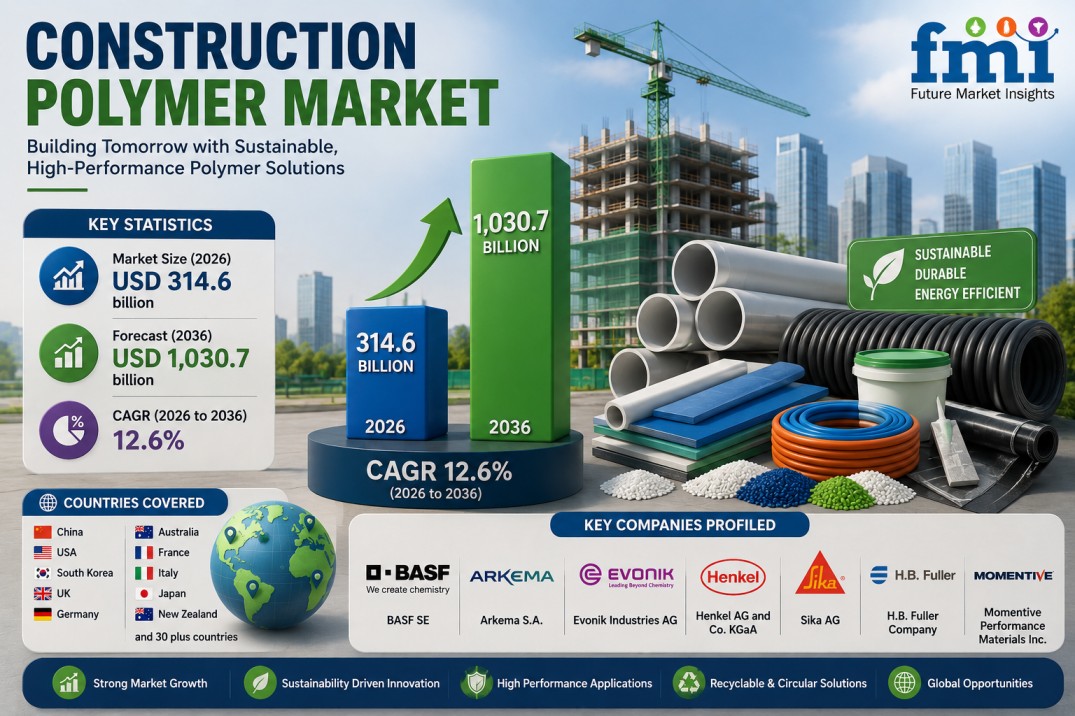
| Estimated Market Size (2026) | USD 314.6 Billion |
| Projected Market Value (2036) | USD 1,030.7 Billion |
| CAGR (2026 to 2036) | 12.6% |
Market Summary
The global Construction Polymer Market is projected to grow from USD 314.6 billion in 2026 to USD 1,030.7 billion by 2036, reflecting rising demand for sustainable, durable, and energy-efficient construction materials.
Segment highlights include:
- Polyvinyl Chloride (PVC) — 35.0% market share in 2026
• Thermoplastic Polymers — 31.8% market share by form
• Commercial Real Estate — 35.0% end-user share
• Key growth regions — Asia-Pacific, North America, and Europe
• High-growth markets — China, USA, South Korea, UK, Germany, and Australia
Country-wise Growth Outlook
| Country | CAGR |
| China | 6.2% |
| United States | 5.4% |
| South Korea | 5.1% |
| United Kingdom | 4.7% |
| Germany | 4.6% |
| Australia | 4.4% |
Explore More Related Studies Published by FMI Research
- The global modular & prefabricated construction market is expected to expand from USD 173.5 billion in 2025 to USD 302.0 billion by 2035. The market is anticipated to register a 5.7% CAGR during the 2025 to 2035 forecast period.
- The Construction Waste Market is projected to grow from USD 256.90 billion in 2025 to USD 448.68 billion by 2036, at a CAGR of 5.2%.
- The Construction Fabric Market is projected to grow from USD 19.10 million in 2025 to USD 31.32 million by 2036, at a CAGR of 4.6%.
FMI Custom Research: Strategic Intelligence for Confident Decision-Making
In today’s rapidly evolving business environment, leadership teams need more than market data—they need clear, actionable intelligence tailored to their strategic objectives. FMI’s Custom Research solutions are designed around the specific business questions organizations need answered, enabling executives to evaluate growth opportunities, validate investments, assess competitive dynamics, and reduce uncertainty before making critical decisions. By combining deep industry expertise, primary research, and proprietary market intelligence, FMI delivers insights that help organizations move from assumptions to evidence-based strategies with greater speed and confidence.
Key Executive Benefits
- Decision-Ready Insights: Research tailored to your specific business challenges, growth plans, and investment priorities.
- Reduced Strategic Risk: Validate market opportunities, customer demand, and competitive positioning before committing resources.
- Market Entry Confidence: Assess opportunity size, regulatory barriers, channel dynamics, and competitive landscapes with precision.
- Competitive Advantage: Gain proprietary intelligence unavailable through syndicated reports or internal datasets.
- Faster Growth Decisions: Accelerate expansion, product development, portfolio optimization, and investment planning.
- Primary Market Validation: Access real-world customer, buyer, and stakeholder insights that support high-confidence decision-making.
- Global Industry Expertise: Powered by 100+ analysts, 20,000+ published reports, and 1.6 million+ hours of research experience.
- Proven Track Record: Over 7,000 market-entry engagements completed across six regions and 14 industry sectors with strong client retention.
Business Impact
FMI helps organizations transform market complexity into strategic clarity, enabling leadership teams to identify growth opportunities faster, optimize resource allocation, strengthen competitive positioning, and make high-stakes business decisions with confidence.
To explore how FMI Custom Research can support your strategic priorities, please connect with our team at – sales@futuremarketinsights.com
Contact Us
Future Market Insights Inc.
Christiana Corporate, 200 Continental Drive,
Suite 401, Newark, Delaware – 19713, USA
T: +1-347-918-3531
Why FMI: Future Market Insights – Why FMI
Website: Future Market Insights