

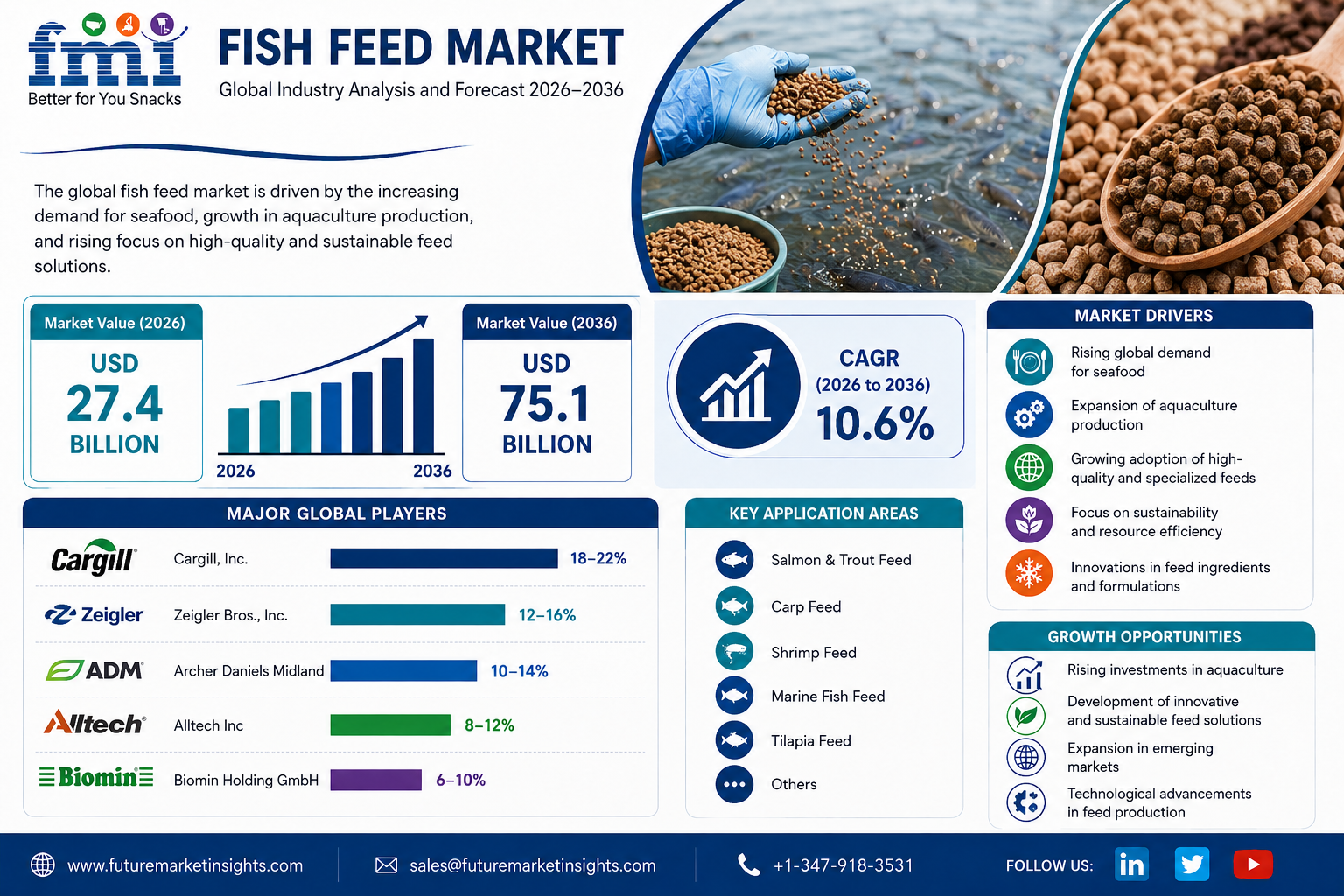
According to the latest insights by Future Market Insights, the global Fish Feed market is experiencing significant transformation as aquaculture producers and feed manufacturers increasingly focus on cost management, marine ingredient security, formulation flexibility, and supply chain resilience. In 2026, rising fishmeal and fish oil costs, quota-driven supply disruptions, and growing adoption of alternative proteins are reshaping fish feed pricing dynamics across global aquaculture markets.
Industry analysts highlight that fish feed pricing is no longer determined only by raw material availability but is increasingly influenced by marine ingredient dependency, fisheries regulation, sustainability requirements, energy costs, logistics conditions, and manufacturers’ ability to optimise nutritional performance while controlling production economics.
Markets with high dependence on imported marine ingredients and intensive aquaculture production are experiencing stronger pricing pressure, while species with flexible nutritional requirements are benefiting from accelerated ingredient substitution strategies.
Marine Ingredient Scarcity Drives Fish Feed Price Volatility
Fishmeal and fish oil remain among the most influential cost drivers in global aquafeed production due to their high nutritional value, digestibility, and essential omega-3 fatty acid contribution.
Unlike conventional agricultural ingredients, marine ingredients are supplied through capture fisheries with limited production flexibility. This creates a supply structure where biological conditions, fishing quotas, and regulatory decisions directly influence feed pricing.
Fish feed manufacturers are increasingly exposed to:
- Fishmeal price fluctuations
• Fish oil supply constraints
• Fisheries quota reductions
• Climate-driven catch variability
• Global commodity market movements
Marine ingredients provide critical amino acids, protein quality, EPA, and DHA required for high-performance aquaculture species. As a result, shortages or price increases quickly translate into higher feed production costs.
For commercial aquaculture operations, even moderate increases in fishmeal and fish oil prices can significantly impact production economics due to the large volume of feed required throughout the farming cycle.
Quota-Driven Supply Shocks Become Key Pricing Influencers
Quota systems across major fishing regions strongly influence global fishmeal and fish oil availability.
Major producing regions including Peru, Chile, and Nordic fisheries play a central role in determining marine ingredient supply conditions. Changes in catch limits, seasonal closures, and conservation measures directly affect global pricing benchmarks.
Quota reductions caused by:
- Ocean temperature changes
• El Niño and La Niña events
• Fish biomass variation
• Juvenile stock recruitment changes
• Sustainability regulations
can create immediate supply constraints.
When marine ingredient availability declines, feed manufacturers face higher raw material costs, forcing adjustments through:
- Higher feed prices
• Reformulation strategies
• Alternative ingredient adoption
• Long-term sourcing agreements
The concentration of marine ingredient production creates additional vulnerability, as disruptions in a limited number of fisheries can influence global aquafeed economics.
Species-Specific Marine Ingredient Dependence Shapes Pricing Impact
Fish feed pricing exposure varies significantly depending on species nutritional requirements.
Carnivorous species such as salmon and marine finfish maintain higher dependence on marine ingredients due to requirements for premium protein quality and omega-3 fatty acids.
These species typically experience stronger cost pressure when fishmeal and fish oil prices increase.
Shrimp production also maintains meaningful marine ingredient dependence due to the importance of digestibility and palatability.
Meanwhile, freshwater species such as tilapia, carp, and catfish have transitioned toward more plant-based formulations, reducing exposure to marine ingredient volatility.
This creates different pricing sensitivity levels across aquaculture segments:
- High marine dependence species – greater feed cost exposure
• Moderate dependence species – balanced substitution opportunities
• Low dependence species – stronger cost insulation
As a result, marine ingredient volatility affects aquaculture markets unevenly.
Ingredient Substitution Strategies Reshape Fish Feed Economics
The growing need to manage fishmeal and fish oil price volatility is accelerating innovation in alternative feed ingredients.
Plant-based proteins have become one of the most widely adopted substitution strategies, helping manufacturers reduce dependence on marine resources while maintaining nutritional performance.
Common alternatives include:
- Soy protein concentrate
• Rapeseed meal
• Pea protein
• Faba beans
• Other plant-derived proteins
These ingredients provide cost advantages and supply availability, although formulation adjustments are often required to overcome amino acid limitations.
Advanced feed formulations increasingly use:
- Synthetic amino acids
• Nutritional balancing technologies
• Functional additives
• Precision nutrition strategies
to maintain growth performance while reducing marine ingredient inclusion.
Fish oil replacement is more challenging due to the importance of EPA and DHA. However, algae-based oils and emerging biotechnology solutions are creating new opportunities for omega-3 supply diversification.
Alternative Fat and Protein Sources Influence Future Pricing Trends
Vegetable oils, algae-derived oils, and novel proteins are becoming important tools for reducing exposure to marine ingredient volatility.
Plant oils such as:
- Rapeseed oil
• Soy oil
• Other vegetable oils
can replace fish oil for energy requirements but may require additional solutions to maintain omega-3 nutritional value.
Algae-based omega-3 ingredients provide a more stable supply alternative by reducing dependence on fisheries.
Emerging ingredients including:
- Insect meal
• Single-cell proteins
• Fermentation-derived proteins
are also gaining attention as future solutions for improving supply security.
However, substitution economics remain dependent on relative ingredient prices. When fishmeal prices rise significantly, alternative ingredients become increasingly commercially attractive.
Sustainability Standards Increase Feed Production Costs
Sustainability and traceability requirements are becoming increasingly important factors influencing fish feed pricing.
Certification frameworks and regulatory standards require manufacturers to improve transparency across marine ingredient supply chains.
Companies are increasingly focusing on:
- Responsible fishery sourcing
• Traceable marine ingredients
• Certified supply chains
• Environmental compliance
These requirements increase operational costs through:
- Ingredient verification systems
• Supply chain documentation
• Certification processes
• Monitoring requirements
Certified marine ingredients may command premium pricing due to limited availability and additional compliance costs.
As sustainability expectations expand, feed markets are increasingly separating into:
- Cost-focused commodity feed segments
• Premium sustainable feed segments
with different pricing structures.
Energy, Freight, and Currency Volatility Amplify Feed Pricing Changes
Fish feed manufacturing requires significant processing energy, particularly for extrusion, drying, and pellet production.
Energy price fluctuations influence:
- Manufacturing costs
• Processing expenses
• Storage economics
• Regional competitiveness
Global logistics conditions further impact final feed pricing as marine ingredients often travel long distances from fishing regions to aquaculture production centres.
Freight costs are influenced by:
- Fuel prices
• Container availability
• Shipping capacity
• Port congestion
Currency fluctuations also create additional exposure because many marine ingredients are traded internationally in US dollars.
A weaker local currency can increase imported ingredient costs even when global commodity prices remain stable.
Large integrated producers often manage these risks through contracts and hedging strategies, while smaller manufacturers may experience greater pricing volatility.
Regional Supply Structures Accelerate Market Transformation
Aquaculture regions with limited domestic marine ingredient production are experiencing stronger pressure from global supply fluctuations.
Import-dependent markets rely heavily on international fishmeal and fish oil supply chains, increasing exposure to:
- Freight costs
• Currency movements
• Supply disruptions
• Global commodity cycles
Countries with advanced feed industries are increasingly investing in:
- Local ingredient sourcing
• Alternative protein development
• Flexible formulation systems
• Strategic inventory management
These strategies help reduce vulnerability and improve long-term supply stability.
Future Outlook
The future of the Fish Feed industry will be shaped by marine ingredient availability, quota management, alternative ingredient innovation, sustainability requirements, and evolving aquaculture production models.
Manufacturers are expected to continue investing in:
- Flexible feed formulations
• Precision nutrition technologies
• Sustainable ingredient sourcing
• Supply chain diversification
Growing global seafood demand, expanding aquaculture production, and increasing pressure on marine resources will continue driving innovation across the fish feed sector.
As the industry evolves, pricing competitiveness, ingredient security, and nutritional optimisation will remain the defining factors influencing global fish feed consumption and pricing trends.
FMI Custom Research: Strategic Intelligence for Confident Decision-Making
In today’s rapidly evolving business environment, leadership teams need more than market data—they need clear, actionable intelligence tailored to their strategic objectives. FMI’s Custom Research solutions are designed around the specific business questions organizations need answered, enabling executives to evaluate growth opportunities, validate investments, assess competitive dynamics, and reduce uncertainty before making critical decisions.
By combining deep industry expertise, primary research, and proprietary market intelligence, FMI delivers insights that help organizations move from assumptions to evidence-based strategies with greater speed and confidence.
Key Executive Benefits
- Decision-Ready Insights: Research tailored to specific business challenges, expansion plans, and investment priorities.
- Reduced Strategic Risk: Validate market opportunities, supply risks, and competitive positioning before allocating resources.
- Market Entry Confidence: Assess market size, regulations, supply structures, and competitive landscapes.
- Competitive Advantage: Gain proprietary intelligence beyond traditional syndicated research.
- Faster Growth Decisions: Support product development, geographic expansion, and strategic planning.
- Primary Market Validation: Access real-world buyer and stakeholder insights.
- Global Industry Expertise: Powered by 100+ analysts, 20,000+ published reports, and 1.6 million+ hours of research experience.
- Proven Track Record: Over 7,000 market-entry engagements completed across six regions and 14 industry sectors.
Business Impact
FMI helps organizations transform market complexity into strategic clarity, enabling leadership teams to identify growth opportunities faster, optimise resources, strengthen competitive positioning, and make high-impact business decisions with confidence.
To explore how FMI Custom Research can support your strategic priorities, please connect with our team at: sales@futuremarketinsights.com
Explore More Related Studies Published by FMI Research:
Aquaculture Market: Global Industry Analysis and Opportunity Assessment 2025–2035
Fish Oil Market: Global Industry Analysis 2015 – 2024 and Opportunity Assessment 2025 – 2035
About Future Market Insights (FMI)
Future Market Insights, Inc. (FMI) is an ESOMAR-certified, ISO 9001:2015 market research and consulting organization, trusted by Fortune 500 clients and global enterprises.
With operations in the U.S., UK, India, and Dubai, FMI provides data-backed insights and strategic intelligence across 30+ industries and 1200 markets worldwide.
Contact Us:
Future Market Insights Inc.
Christiana Corporate, 200 Continental Drive,
Suite 401, Newark, Delaware – 19713, USA
T: +1-347-918-3531
Why FMI: https://www.futuremarketinsights.com/why-fmi
Website: https://www.futuremarketinsights.com