

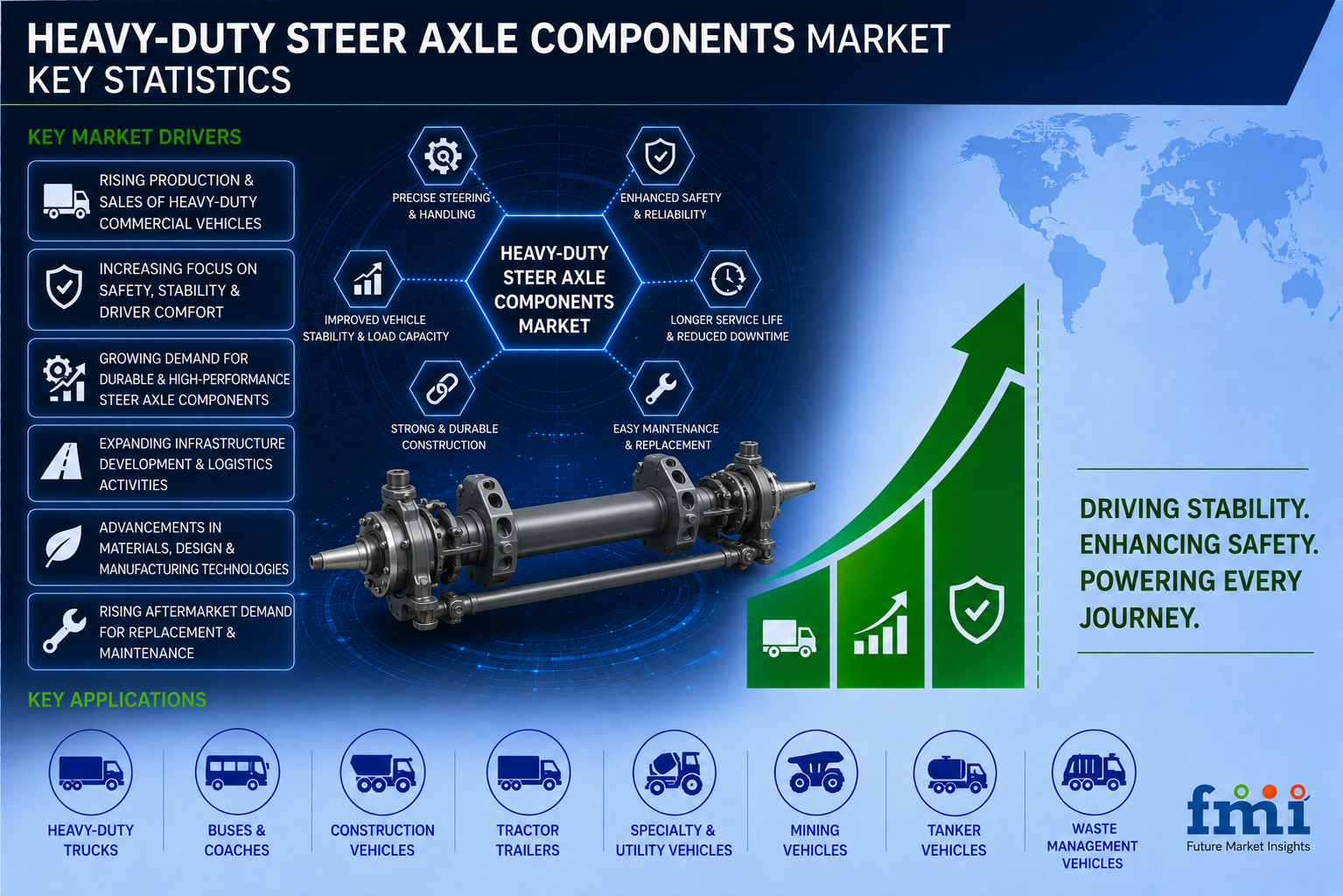
The global Heavy-Duty Steer Axle Components Market is witnessing steady growth as commercial vehicle manufacturers and fleet operators place increasing emphasis on vehicle reliability, steering precision, and operational uptime. As freight transportation volumes rise and heavy trucks accumulate greater annual mileage, front axle systems are becoming critical components for ensuring vehicle safety, handling performance, and maintenance efficiency.
According to Future Market Insights (FMI), the heavy-duty steer axle components market was valued at USD 3.51 billion in 2025 and is projected to reach USD 3.65 billion by the end of 2026. The market is forecast to expand at a CAGR of 4.0% between 2026 and 2036, surpassing USD 5.40 billion by 2036.
The industry is evolving beyond a conventional truck component segment into a chassis performance and fleet uptime category, where durability, precision engineering, and replacement accessibility play a decisive role in purchasing decisions.
Front Axle Reliability Becomes a Core Fleet Priority
Heavy-duty trucks operate under demanding conditions that expose front axle systems to continuous stress from steering movements, braking forces, uneven road surfaces, and heavy payloads. Components such as axle beams, steering knuckles, kingpin kits, tie rod ends, drag links, and wheel hubs experience gradual wear that directly affects vehicle handling and tire life.
Fleet operators increasingly recognize that steer axle performance has a direct impact on vehicle uptime and operating costs. Steering looseness, misalignment, or excessive component wear can result in premature tire replacement, increased maintenance expenses, and costly downtime.
As commercial vehicles accumulate higher annual mileage, replacement demand for steer axle components continues to rise across freight transportation, construction, municipal services, mining operations, and bus fleets.
OEM Validation Drives Market Leadership
Original equipment manufacturers remain highly selective when sourcing steer axle components because steering geometry and front axle performance directly influence vehicle safety and warranty outcomes.
OEM supply is expected to account for approximately 60.0% of total sales channel demand in 2026. Truck manufacturers prioritize validated axle assemblies and steering systems that can consistently meet durability, load-bearing, and performance requirements throughout a vehicle’s operational life.
Unlike many aftermarket components, steer axle assemblies undergo extensive validation before integration into commercial vehicle platforms. Manufacturers must demonstrate fatigue resistance, dimensional accuracy, structural integrity, and long-term reliability under heavy-duty operating conditions.
As a result, established suppliers with proven engineering expertise and OEM relationships continue to hold a competitive advantage in the market.
Forged Steel Remains the Dominant Material Choice
Material selection remains one of the most important factors in steer axle component design. Forged steel is expected to account for approximately 68.0% of the material segment in 2026, maintaining its position as the preferred material across heavy-duty front axle systems.
The widespread use of forged steel is driven by its exceptional strength, fatigue resistance, and ability to withstand repeated stress cycles associated with heavy commercial vehicle operation. Critical components such as axle beams and steering knuckles rely heavily on forged steel construction to maintain structural integrity under extreme load conditions.
Although materials such as ductile iron, alloy steel, and composite bushings serve specialized applications, forged steel continues to offer the optimal combination of durability, reliability, and cost-effectiveness required by truck manufacturers and fleet operators.
Axle Beams Lead Component Demand
Among component categories, axle beams are projected to account for approximately 31.0% of total component type demand in 2026.
As the primary structural element of front axle assemblies, axle beams bear significant responsibility for load distribution, steering stability, and vehicle handling performance. Their high material content and engineering complexity contribute to their substantial market value.
The increasing use of higher-capacity front axle systems in Class 8 trucks, construction vehicles, and vocational applications is driving demand for stronger and lighter axle beam designs capable of supporting growing payload requirements.
Manufacturers are investing in advanced forging techniques, precision machining processes, and weight-optimization strategies to enhance axle beam performance without compromising durability.
Freight Growth Fuels Replacement Demand
The expansion of freight transportation continues to create long-term opportunities for steer axle component suppliers.
As trucking fleets operate vehicles over longer distances and under increasingly demanding conditions, wear rates for kingpin kits, bushings, tie rod ends, and steering joints continue to rise. Replacement cycles are becoming a major revenue contributor for manufacturers serving the aftermarket sector.
Fleet managers are increasingly adopting proactive maintenance strategies to prevent steering-related failures and reduce unexpected vehicle downtime. Components that support predictable service intervals and simplified replacement procedures are gaining stronger market acceptance.
The growing availability of OE-grade replacement parts through distributor networks and fleet service providers is further supporting aftermarket growth.
Electric Commercial Vehicles Create New Engineering Challenges
The ongoing transition toward vehicle electrification is creating additional opportunities for steer axle component innovation.
Electric trucks and buses introduce unique front axle design requirements due to battery placement, altered weight distribution, and changing chassis architectures. These factors require manufacturers to develop lighter yet stronger steering components capable of maintaining performance while supporting new vehicle configurations.
Suppliers are increasingly focusing on weight reduction, packaging efficiency, and advanced validation processes to meet the evolving needs of electric commercial vehicle platforms.
As electric vehicle adoption expands across public transportation and commercial logistics sectors, steer axle manufacturers are expected to play a vital role in supporting next-generation vehicle designs.
India Emerges as a High-Growth Market
Among major markets, India is projected to record the strongest growth through 2036, expanding at a CAGR of 5.1%.
The country’s rapidly growing commercial vehicle industry, expanding freight transportation network, and increasing localization of automotive manufacturing are creating favorable conditions for steer axle component suppliers.
Strong truck production activity around manufacturing hubs such as Pune and Chennai continues to support OEM demand for axle beams, steering knuckles, and other front axle assemblies. At the same time, growing freight movement across major logistics corridors is increasing replacement demand for kingpin kits and tie rod ends.
India’s emphasis on domestic sourcing and localized manufacturing is also encouraging investment in forged steel components and precision-machined steering systems.
Cost Pressures Remain a Key Industry Challenge
Despite favorable demand fundamentals, the market continues to face cost-related challenges associated with steel-intensive manufacturing.
Axle beams, steering knuckles, and other structural components require significant volumes of high-quality steel along with energy-intensive forging, heat treatment, and machining processes. Fluctuations in steel prices and alloy availability can influence supplier profitability and procurement decisions.
While raw material costs may occasionally soften, component pricing remains affected by labor costs, machining complexity, quality assurance requirements, and warranty obligations.
Manufacturers are increasingly seeking production efficiencies and supply chain optimization strategies to maintain competitiveness while preserving product quality.
Future Outlook: Steering Precision and Fleet Uptime Will Define Market Success
Looking ahead, the heavy-duty steer axle components market is expected to benefit from continued growth in global freight activity, rising commercial vehicle production, and expanding replacement demand.
Fleet operators will continue prioritizing components that reduce downtime, improve steering performance, and extend service intervals. OEMs will focus on validated front axle systems capable of meeting increasingly stringent safety and durability requirements.
At the same time, trends such as vehicle electrification, lightweighting initiatives, and predictive maintenance technologies will reshape product development strategies across the industry.
As commercial vehicles become more sophisticated and uptime becomes increasingly valuable, steer axle components will remain essential to the performance, safety, and reliability of heavy-duty transportation systems worldwide.
Browse More Industry Reports :
Axle Housing and Carrier Assembly Components Market