


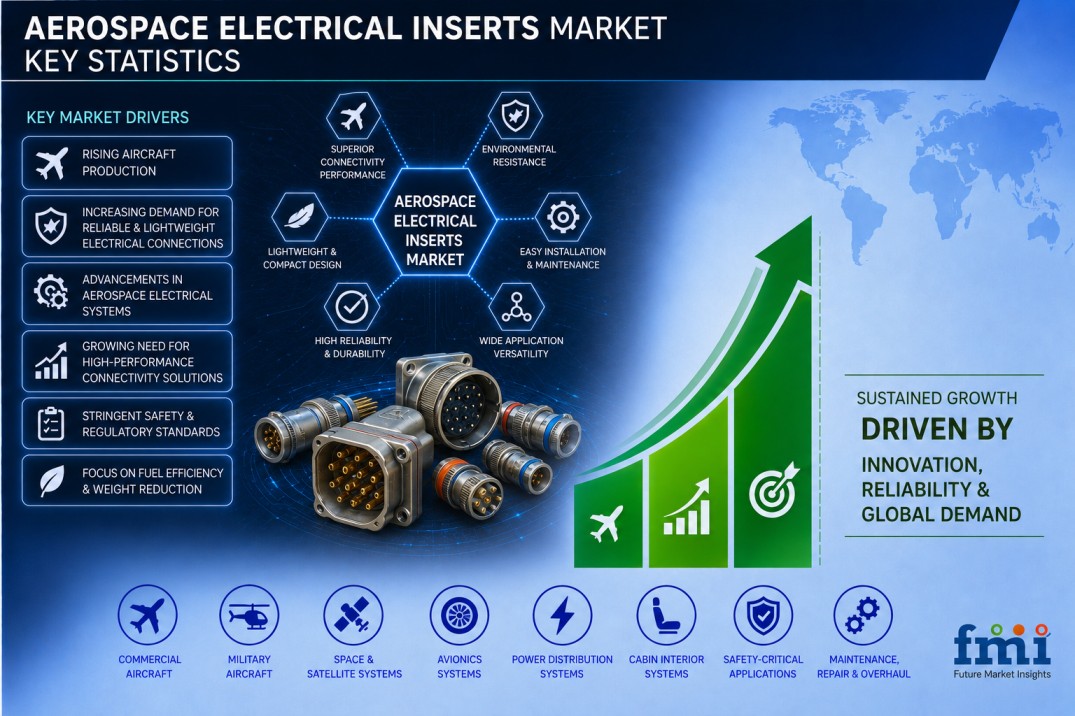
The global Aerospace Electrical Inserts Market is entering a new phase of growth as airlines modernize cabin interiors, expand premium service offerings, and adopt connected galley technologies. Traditionally viewed as supporting cabin equipment, electrical inserts—including ovens, coffee makers, chillers, water boilers, and waste compactors—are increasingly becoming critical components of airline operational efficiency and passenger experience strategies.
As aircraft manufacturers ramp up production and airlines invest heavily in retrofit programs, demand for advanced galley equipment is rising steadily. According to Future Market Insights, the Aerospace Electrical Inserts Market is projected to reach USD 58.6 billion by 2036, expanding at a CAGR of 6.4% during the forecast period. Ovens are expected to maintain the largest share of demand in 2026 as carriers continue to prioritize onboard meal service capabilities.
Aircraft Production Growth Establishes a Strong Demand Foundation
One of the primary drivers supporting market expansion is the sustained increase in global aircraft production. Aircraft galley systems are essential components of every commercial aircraft delivery, making production volumes a direct indicator of future demand for electrical inserts.
Commercial aviation manufacturers continue to report robust order books, particularly in the narrowbody segment. Growing production schedules for single-aisle aircraft are creating a stable long-term demand environment for galley equipment suppliers. Every new aircraft entering service requires fully integrated galley systems equipped with certified electrical inserts capable of supporting modern food and beverage operations.
The rising importance of premium economy and business-class services on narrowbody aircraft is further increasing equipment requirements, creating opportunities for higher-value insert installations.
Passenger Traffic Growth Increases Service Requirements
The recovery and continued expansion of global air travel is creating additional demand for advanced galley systems. Airlines are carrying more passengers while simultaneously seeking to improve onboard service quality and operational efficiency.
Higher passenger loads increase pressure on cabin crews to deliver consistent food and beverage service, making reliable galley equipment essential. Electrical inserts play a central role in maintaining service standards, particularly on long-haul and extended-range flights where meal preparation and beverage service are critical components of the passenger experience.
As airlines compete to differentiate themselves through onboard offerings, investments in modern galley technology are becoming increasingly strategic.
Market Evolution: From Basic Equipment to Connected Cabin Infrastructure
Between 2015 and 2025, purchasing decisions for aerospace electrical inserts were largely driven by equipment reliability, compliance requirements, and compatibility with existing galley layouts. Demand was closely linked to aircraft deliveries, periodic cabin upgrades, and replacement cycles.
From 2026 to 2036, however, the market is expected to evolve toward a more digitally integrated model.
Connected inserts capable of collecting operational data, monitoring equipment performance, and supporting predictive maintenance are becoming increasingly attractive to airlines seeking greater efficiency. Buyers are beginning to view galley equipment as part of a broader operational ecosystem rather than standalone cabin hardware.
Future purchasing decisions are likely to place greater emphasis on connectivity, energy efficiency, modularity, and data-driven maintenance capabilities.
Airline Retrofit Programs Create Significant Revenue Opportunities
Aircraft retrofit programs are becoming a major source of demand across the aerospace electrical inserts market. Airlines worldwide are investing heavily in cabin modernization initiatives designed to improve passenger comfort, increase operational efficiency, and extend aircraft service life.
Large-scale refurbishment projects often involve comprehensive galley upgrades, including the replacement of ovens, beverage systems, refrigeration units, and waste management equipment. These modernization efforts are creating substantial opportunities for manufacturers offering next-generation insert technologies.
As airlines continue to upgrade aging fleets, retrofit demand is expected to remain a major growth contributor throughout the forecast period.
Connected Galley Technologies Reshape Competitive Dynamics
Technology innovation is rapidly transforming the competitive landscape. Leading suppliers are introducing intelligent galley solutions that combine traditional food-service functionality with advanced digital capabilities.
Connected inserts can monitor equipment usage patterns, identify maintenance requirements, and provide real-time performance data to airline operators. These capabilities help reduce unexpected failures, improve maintenance planning, and enhance overall fleet efficiency.
Manufacturers are also introducing advanced steam ovens, combi-convection cooking systems, and premium beverage preparation equipment designed to improve service quality while optimizing crew workflows.
As digitalization becomes more important, connectivity and analytics are expected to become major differentiators in both line-fit and retrofit procurement programs.
Certification and Compliance Remain Critical Market Challenges
Despite growing technological innovation, regulatory compliance continues to be one of the most important considerations in aerospace electrical insert development.
Galley equipment must satisfy rigorous aviation safety requirements covering electrical systems, thermal management, fire prevention, electromagnetic compatibility, vibration resistance, and environmental performance. Certification processes often require extensive testing and qualification procedures before products can be approved for commercial aircraft installation.
These requirements can extend development timelines and increase project costs for both manufacturers and airline customers. As a result, certification expertise remains a key competitive advantage within the industry.
Electrical Power Management Emerges as a Strategic Priority
As aircraft cabins become increasingly connected and service-intensive, electrical power management is emerging as a critical design consideration.
Modern galleys represent some of the largest power-consuming systems onboard commercial aircraft. The addition of premium meal services, advanced cooking equipment, and connected appliances is increasing overall energy demand across cabin environments.
Aircraft operators are therefore focusing on smarter power distribution systems capable of supporting growing electrical loads while maintaining operational reliability. Future galley architectures are expected to incorporate intelligent energy management features that optimize power consumption and improve system performance.
Future Outlook: Smart, Connected, and Modular Galley Systems
Looking ahead, the Aerospace Electrical Inserts Market is expected to benefit from several long-term industry trends, including increasing aircraft production, fleet modernization programs, digital cabin transformation, and rising passenger service expectations.
The growing role of narrowbody aircraft on longer routes will increase demand for advanced galley capabilities traditionally associated with widebody operations. Airlines will continue investing in ovens, chillers, beverage systems, and waste management technologies capable of supporting premium onboard experiences.
At the same time, smart galley concepts featuring connectivity, predictive maintenance, real-time analytics, and modular equipment configurations are expected to gain widespread adoption.
As commercial aviation moves toward more data-driven and passenger-centric operations, aerospace electrical inserts will evolve from supporting cabin hardware into intelligent infrastructure that helps airlines improve efficiency, enhance service quality, and maximize aircraft utilization.
Browse more industry reports: