

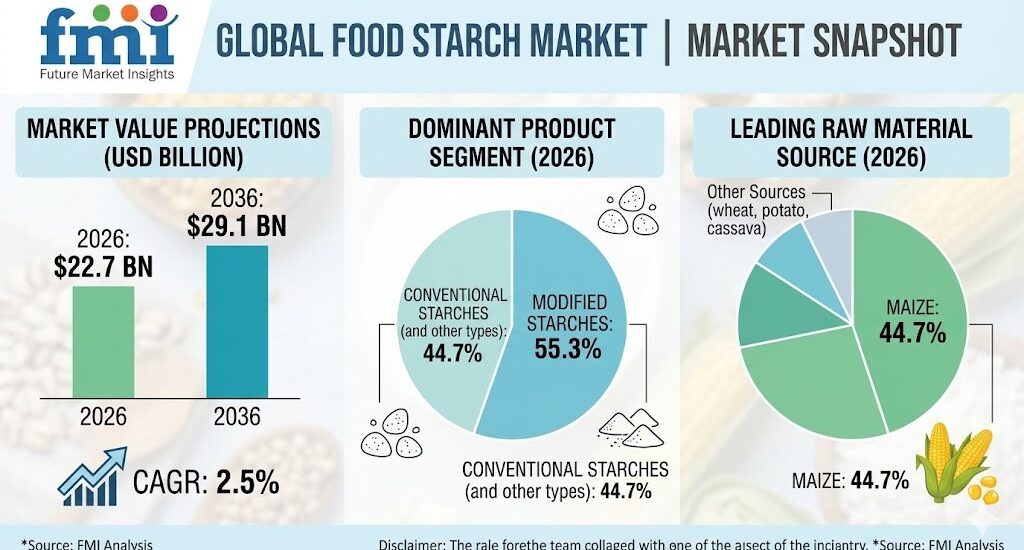
The global food starch market is witnessing steady expansion, supported by rising demand for clean-label ingredients, improved food texture systems, and regulatory pressure for ingredient transparency. Valued at USD 22.7 billion in 2026, the market is projected to reach USD 29.1 billion by 2036, growing at a CAGR of 2.5% during the forecast period.
Growth is primarily driven by increasing use of starch in processed foods, bakery, confectionery, and convenience products, where functionality such as thickening, stabilization, and moisture retention is critical. Regulatory frameworks such as FDA retail food program standards and FSSAI guidelines are accelerating the shift toward high-purity, traceable, and compliant starch ingredients, reshaping global supply chains.
Get detailed market forecasts, competitive benchmarking, and strategic insights: https://www.futuremarketinsights.com/reports/sample/rep-gb-15445
Market Transformation Through Clean-Label and Functional Innovation
Clean-label reformulation is redefining product development strategies across the food industry. Consumers increasingly prefer recognizable ingredients, pushing manufacturers to replace synthetic additives with native and modified starch solutions that maintain texture and stability. This “clean-label paradox” is driving innovation in functional starch systems that balance performance with transparency.
Technological advancements in enzymatic modification, fermentation-based processing, and emulsification techniques are enhancing starch functionality. These innovations allow improved freeze-thaw stability, viscosity control, and mouthfeel enhancement across packaged and ready-to-eat foods.
Modified Starch Leads Product Segment Growth
Modified starch dominates the market with approximately 55.3% share in 2026, due to its superior performance in high-temperature, high-shear, and acidic food processing environments. It is widely used in sauces, soups, dairy alternatives, and frozen meals where consistency and shelf stability are essential.
Native starch continues to serve clean-label applications, but functional limitations restrict its broader industrial use. As a result, manufacturers increasingly rely on modified and specialty starch systems to meet complex formulation requirements.
Speak to Analyst: Customize insights for your business strategy – https://www.futuremarketinsights.com/customization-available/rep-gb-15445
Maize Remains the Leading Raw Material Source
Maize-based starch accounts for around 44.7% of total raw material usage, supported by its cost efficiency, high starch yield, and well-established global supply chain. Major players leverage corn processing infrastructure to ensure consistent supply for large-scale food manufacturing.
Alternative sources such as tapioca, potato, and pea starch are gaining traction in niche applications, particularly in allergen-free and plant-based formulations. However, maize continues to dominate due to price stability and scalability.
Regional Growth Outlook
North America and Europe remain mature yet innovation-driven markets, supported by strong demand for clean-label reformulation and functional nutrition. The United States is growing at 2.2% CAGR, driven by premiumization and regulatory transparency.
Asia-Pacific is the fastest-growing region, led by India at 3.5% CAGR, followed by South Korea (2.6%) and Japan (2.5%). Rising processed food consumption, urbanization, and increasing awareness of food safety standards are accelerating demand across the region.
Competitive Landscape and Strategic Shifts
The food starch market is highly consolidated, with key players including Cargill, Ingredion, Tate & Lyle, ADM, Roquette, and Samyang Corporation. These companies are investing in specialty starch portfolios, clean-label solutions, and integrated texture systems.
A major industry shift is the move from standalone starch ingredients to bundled functional systems combining starches, gums, and hydrocolloids. Strategic acquisitions and product launches are strengthening capabilities in mouthfeel enhancement, stability, and nutritional performance.
Unlock 360° insights for strategic decision making and investment planning: https://www.futuremarketinsights.com/checkout/15445
Emerging Market Trends and Future Opportunities
Key trends shaping the market include the rise of integrated texture systems, expansion of clean-label starches, and increasing adoption of GLP-1-aligned nutrition formats focused on satiety and controlled calorie intake. Functional starch is also gaining importance in medical nutrition and personalized diet applications.
Future opportunities lie in AI-driven formulation development, sustainable raw material sourcing, and fermentation-based starch innovation. As food manufacturers prioritize health, transparency, and performance, starch is evolving from a commodity ingredient into a high-value functional solution.
About FMI
Future Market Insights (FMI) is a leading provider of market intelligence and consulting services, delivering actionable insights across food and beverage, healthcare, chemicals, and industrial sectors. FMI’s research helps organizations make data-driven strategic decisions in dynamic global markets.
Contact Us
Future Market Insights Inc.
Christiana Corporate, 200 Continental Drive,
Suite 401, Newark, Delaware – 19713, USA
T: +1-347-918-3531
Email: sales@futuremarketinsights.com
Website: https://www.futuremarketinsights.com
