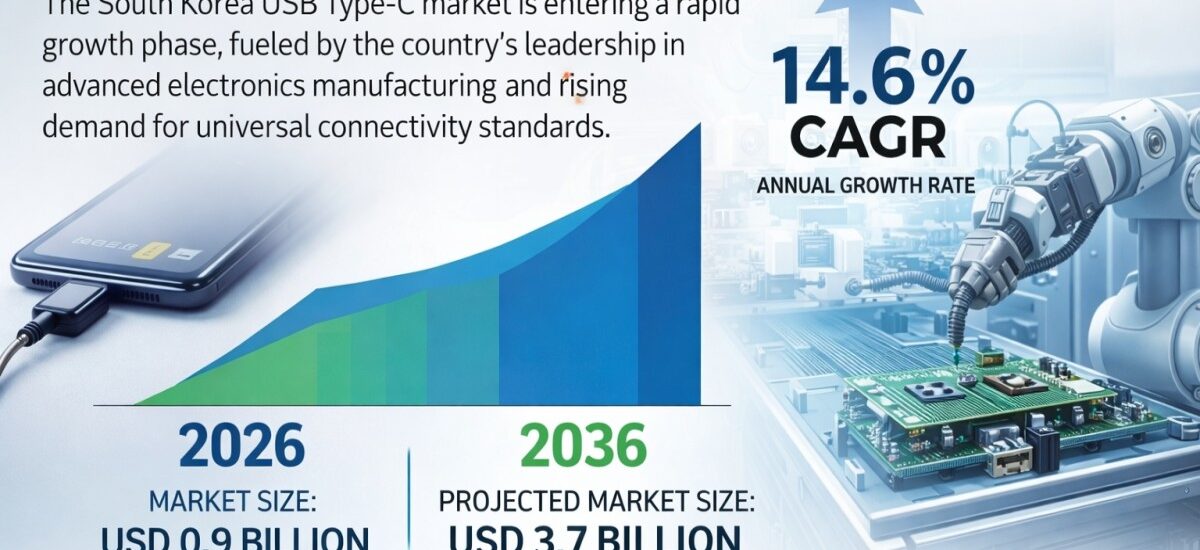
The South Korea USB Type-C market is entering a rapid growth phase, fueled by the country’s leadership in advanced electronics manufacturing and rising demand for universal connectivity standards. According to the latest analysis, the market is valued at USD 0.9 billion in 2026 and is projected to reach USD 3.7 billion by 2036, expanding at a robust CAGR of 14.6%.
This strong growth trajectory reflects South Korea’s strategic push toward high-speed data transfer, universal charging ecosystems, and next-generation digital infrastructure. USB Type-C is becoming a critical interface across consumer electronics, automotive systems, and emerging industrial applications.
Get detailed market forecasts, competitive benchmarking, and pricing trends
https://www.futuremarketinsights.com/reports/sample/rep-gb-31496
Featured Snippet: Key Market Answer
Q: What is driving the growth of the USB Type-C market in South Korea?
A: Growth is driven by the rapid expansion of consumer electronics manufacturing, increasing adoption of high-speed data transfer and universal charging standards, and integration of USB Type-C in automotive and smart infrastructure systems.
Quick Stats
• Market Size (2026): USD 0.9 billion
• Forecast (2036): USD 3.7 billion
• CAGR (2026-2036): 14.6%
• Leading Region: South Gyeongsang (15.4%)
• Leading Product Segment: USB Type-C Receptacle (55.1%)
• Leading Protocol: USB 3.2 (38.0%)
• Leading Industry Segment: Consumer Electronics (40.9%)
• Top Player Market Share: STMicroelectronics NV (25.0%)
Market Overview: Transition to Universal Connectivity Standards
The South Korea USB Type-C market is defined by the widespread adoption of a single, high-performance interface that supports both power delivery and high-speed data transmission. The shift toward USB Type-C reflects a broader transformation in device architecture and connectivity ecosystems.
Three structural forces are driving this evolution:
• Rapid scaling of consumer electronics production
• Expansion of automotive electronics and EV ecosystems
• National investments in digital infrastructure and smart cities
Together, these trends are positioning USB Type-C as a standardized connectivity backbone across industries.
Key Growth Drivers
1. Expansion of Consumer Electronics Manufacturing
South Korea’s dominance in smartphones, laptops, and display technologies is accelerating the adoption of USB Type-C as the default interface for:
• Fast charging
• High-speed data transfer
• Device interoperability
2. Automotive Industry Transformation
The rise of connected and electric vehicles is increasing demand for USB Type-C connectors in:
• In-vehicle infotainment systems
• Charging ports
• Data communication interfaces
3. Demand for High-Speed Data & Power Delivery
USB Type-C, particularly with advanced protocols, enables:
• Faster data transfer rates
• Efficient power delivery
• Simplified cable ecosystems
Market Trends Shaping the Industry
• Universal Charging Standardization: USB Type-C replacing legacy ports across devices
• Rise of Smart Infrastructure: Integration into smart homes, cities, and IoT ecosystems
• Miniaturization & Design Efficiency: Supporting slimmer and more compact devices
• Growth in Automotive Connectivity: Increasing use in EVs and connected cars
• IoT Expansion: Adoption across industrial automation, healthcare, and robotics
Speak to Analyst
https://www.futuremarketinsights.com/customization-available/rep-gb-31496
Segment Insights
Product Leadership: USB Type-C Receptacle (55.1%)
The USB Type-C receptacle dominates the market due to:
• Integration into host devices (smartphones, laptops, vehicles)
• Central role in power and data interface
• High-volume manufacturing demand
Protocol Leadership: USB 3.2 (38.0%)
USB 3.2 leads due to its:
• High-speed data transfer capabilities
• Compatibility with existing systems
• Suitability for mainstream applications
Industry Leadership: Consumer Electronics (40.9%)
Consumer electronics remains the largest demand segment driven by:
• Massive device production volumes
• Continuous product upgrades
• Demand for faster charging and connectivity
Emerging Segment:
• Automotive electronics is rapidly growing due to EV and connected vehicle adoption
Regional Insights
Top Growth Regions (CAGR 2026-2036)
• Jeju: 17.6% – Smart city initiatives and early tech adoption
• South Gyeongsang: 15.4% – Industrial manufacturing hub
• South Jeolla: 13.9% – Expanding tech and energy projects
• North Jeolla: 11.7% – Growing industrial automation
Regional Dynamics
• South Gyeongsang: Strong demand from heavy industries and manufacturing clusters
• Jeju: High adoption driven by smart infrastructure and innovation initiatives
• Jeolla Regions: Growth supported by renewable energy and technology parks
Market Dynamics
Key Drivers
• Continuous innovation in electronics manufacturing
• Growth of EV and connected vehicle ecosystems
• Government support for digital transformation
Key Challenges
• Interoperability issues across devices and cables
• Cost pressures in competitive consumer markets
• Rapid technological obsolescence
Opportunities
• Expansion into industrial automation and robotics
• Growth of IoT-enabled devices
• Development of next-generation USB protocols
Threats
• Semiconductor supply chain disruptions
• Intense global competition
• Shifts in international standards and trade policies
Competitive Landscape
The South Korea USB Type-C market is highly competitive, with companies focusing on:
• Advanced power management solutions
• High-speed data integrity technologies
• Strategic partnerships with OEMs
Key Players
• STMicroelectronics NV
• Texas Instruments, Inc.
• NXP Semiconductors
• Infineon Technologies AG
• Analog Devices, Inc.
Competitive Differentiation Factors
• Miniaturization and design innovation
• Supply chain reliability
• Protocol integration capabilities
• OEM partnerships
Recent Developments
• Advancements in high-speed USB protocol integration
• Innovation in compact and energy-efficient connector designs
• Expansion of USB Type-C into automotive and industrial applications
Expert Insight
The South Korea USB Type-C market is evolving from a component-level opportunity into a strategic enabler of digital ecosystems. As industries converge around universal connectivity standards, USB Type-C is becoming indispensable across consumer, automotive, and industrial domains.
Companies that invest in high-speed protocols, power delivery innovation, and supply chain resilience are expected to gain a competitive edge in this rapidly expanding market.
FAQs
1. What is the future outlook for the South Korea USB Type-C market?
The market is projected to reach USD 3.7 billion by 2036, growing at a CAGR of 14.6%.
2. Which segment dominates the market?
USB Type-C receptacles lead with a 55.1% share due to their integration in host devices.
3. Why is USB Type-C adoption increasing in South Korea?
Due to demand for high-speed data transfer, universal charging, and growth in electronics and automotive sectors.
4. What are the key challenges in the market?
Interoperability issues, cost pressures, and rapid technological changes.
5. Which regions show the highest growth potential?
Jeju and South Gyeongsang lead due to smart infrastructure and industrial concentration.
Full Report for Detailed Insights:
https://www.futuremarketinsights.com/reports/south-korea-usb-type-c-market
Conclusion
The South Korea USB Type-C market is at the forefront of the global shift toward unified, high-performance connectivity solutions. With strong growth driven by consumer electronics, automotive innovation, and digital infrastructure, the market presents significant opportunities for stakeholders across the value chain.
As the demand for faster, more efficient, and standardized connectivity continues to rise, USB Type-C is set to become a core technology powering the next generation of digital devices and ecosystems.