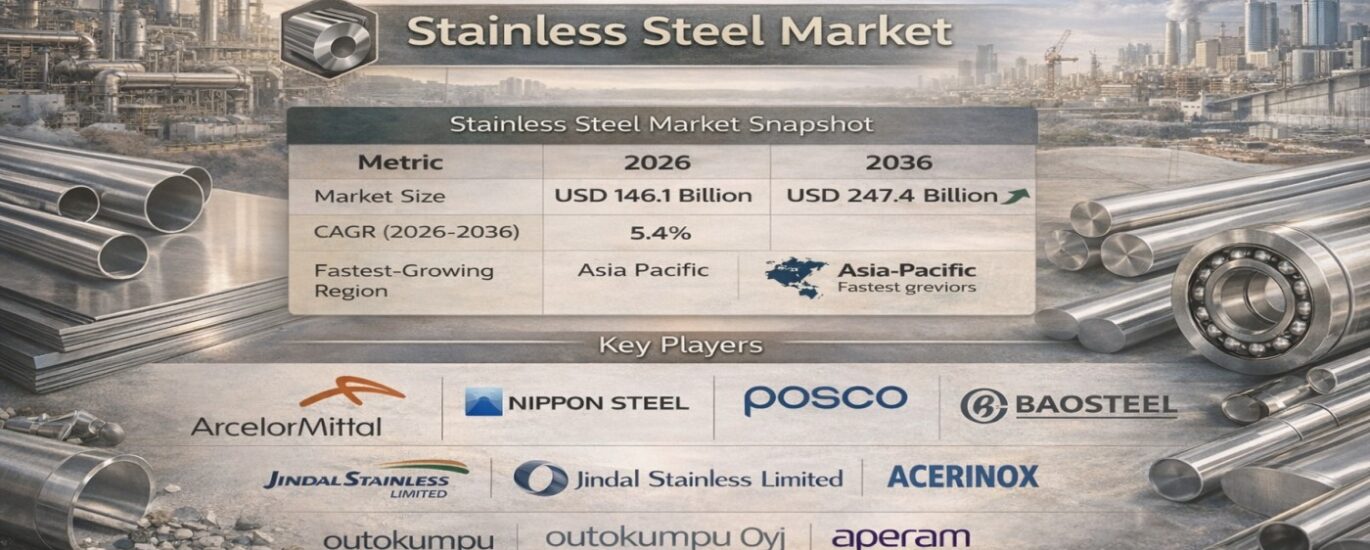
The global stainless steel market is projected to grow from USD 146.1 billion in 2026 to USD 247.4 billion by 2036, registering a CAGR of 5.4% during the forecast period. Growth is driven by increasing demand for corrosion-resistant and durable materials across construction, automotive, and industrial processing applications.
Stainless steel, known for its corrosion resistance, strength, and low maintenance properties, plays a critical role in modern infrastructure and manufacturing. Its ability to maintain structural integrity under harsh environmental conditions makes it an essential material across multiple end-use industries.
Market Growth Drivers
A major growth driver is the increasing demand for corrosion-resistant materials in construction and infrastructure projects. Stainless steel provides long-term durability, reducing maintenance costs and improving lifecycle efficiency in bridges, buildings, and industrial structures.
The expansion of automotive manufacturing is also contributing to market growth. Stainless steel is widely used in exhaust systems, structural components, and safety applications due to its strength and resistance to high temperatures.
Additionally, industrial processing industries are driving demand for stainless steel in chemical equipment, machinery, and pressure vessels where corrosion resistance and performance reliability are critical.
Get detailed market forecasts, competitive benchmarking, and pricing trends: https://www.futuremarketinsights.com/reports/sample/rep-gb-13116
Key Market Trends
- Dominance of Austenitic Stainless Steel
Austenitic stainless steel holds around 53.2% market share due to:
• Superior corrosion resistance
• Excellent formability and weldability
• Wide application across industries - Growth in Infrastructure Applications
Construction and infrastructure lead with 44.8% share, driven by:
• Increasing urbanization
• Expansion of commercial and residential projects
• Demand for durable building materials - Rising Use in Automotive Sector
Automotive applications account for 22.1%, supported by:
• Demand for lightweight and durable components
• Growth in vehicle production
• Need for high-performance exhaust systems
Segment Insights
By Application
• Construction & infrastructure (44.8%) dominate demand
• Automotive manufacturing (22.1%) follows
• Industrial processing (18.7%) remains significant
• Consumer goods and others contribute remaining share
By Grade Type
• Austenitic stainless steel (53.2%) leads
• Ferritic stainless steel (24.6%) serves cost-sensitive uses
• Duplex stainless steel (15.8%) used in high-strength applications
• Martensitic stainless steel (6.4%) used in wear-resistant tools
By End-Use Industry
• Construction remains the largest consumer
• Automotive and industrial equipment drive steady demand
• Consumer appliances contribute niche applications
Regional Market Dynamics
The market shows strong regional trends driven by industrial expansion and infrastructure development:
- India (6.2% CAGR) leads growth due to infrastructure expansion and manufacturing development
• China (5.8%) driven by large-scale construction and export capabilities
• Brazil (5.4%) supported by industrial and construction growth
• United States (4.9%) driven by advanced manufacturing and infrastructure upgrades
• Germany (4.6%) focused on quality-driven industrial applications
Asia Pacific remains the dominant region, while North America and Europe emphasize high-quality and specialty stainless steel applications.
Competitive Landscape
The stainless steel market is highly competitive, with key players focusing on production capacity, quality control, and global supply chain strength.
Key companies include:
• ArcelorMittal
• Nippon Steel Corporation
• POSCO
• Baosteel Group
• Jindal Stainless Limited
• Acerinox S.A.
• Outokumpu Oyj
• Aperam S.A.
Challenges and Constraints
Despite steady growth, the market faces several challenges:
• Volatility in raw material prices such as nickel and chromium
• High energy consumption in production processes
• Competition from alternative materials in cost-sensitive applications
• Environmental regulations impacting steel manufacturing
Future Outlook
The stainless steel market is expected to evolve with a focus on high-performance materials, sustainability, and advanced processing technologies. Growth will be supported by:
- Expansion of global infrastructure projects
• Increasing demand for corrosion-resistant materials
• Advancements in steel processing technologies
• Rising focus on recyclable and sustainable materials
As industries continue to prioritize durability, efficiency, and long-term performance, stainless steel will remain a critical material across global construction, automotive, and industrial sectors through 2036.
About Future Market Insights (FMI)
Future Market Insights, Inc. (ESOMAR certified, recipient of the Stevie Award, and a member of the Greater New York Chamber of Commerce) offers profound insights into the driving factors that are boosting demand in the market. FMI stands as the leading global provider of market intelligence, advisory services, consulting, and events for the Packaging, Food and Beverage, Consumer Technology, Healthcare, Industrial, and Chemicals markets. With a vast team of over 400 analysts worldwide, FMI provides global, regional, and local expertise on diverse domains and industry trends across more than 110 countries.
Contact Us:
Future Market Insights Inc.
Christiana Corporate, 200 Continental Drive,
Suite 401, Newark, Delaware – 19713, USA
T: +1-347-918-3531
For Sales Enquiries: sales@futuremarketinsights.com
Website: https://www.futuremarketinsights.com
LinkedIn| Twitter| Blogs | YouTube