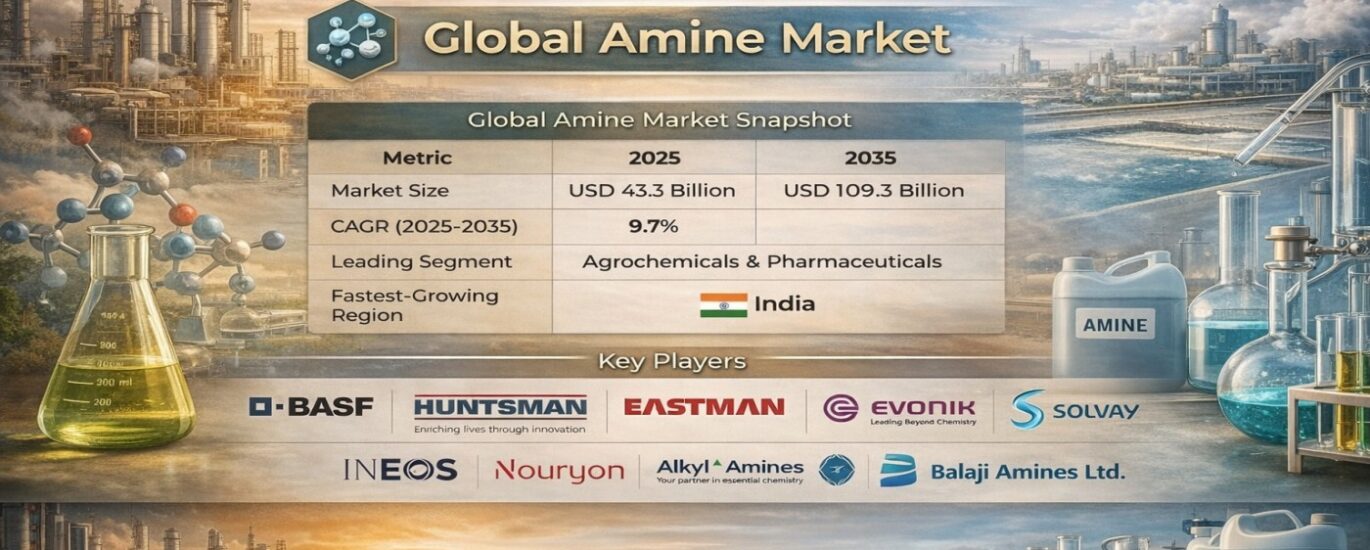
The global amine market is set for robust expansion, growing from USD 43.3 billion in 2025 to USD 109.3 billion by 2035, registering a strong CAGR of 9.7% during the forecast period. Growth is being driven by rising demand across agrochemicals, pharmaceuticals, gas treatment, and industrial cleaning applications.
Amines serve as essential chemical intermediates across diverse industries, enabling critical functions such as herbicide synthesis, drug formulation, carbon capture, and water treatment. Their versatility and reactivity make them indispensable in both industrial and consumer-facing applications.
Market Growth Drivers
A major driver of the amine market is the rapid expansion of the agrochemical sector. Amines are key intermediates in herbicides such as glyphosate and glufosinate, supporting global food production and agricultural efficiency.
The pharmaceutical industry is another strong growth engine, with amines widely used in the synthesis of active pharmaceutical ingredients (APIs), including analgesics, antihistamines, and specialty drugs. Rising demand for generics and advanced therapeutics continues to boost consumption.
In addition, industrial applications such as gas treatment are accelerating demand. Amines are extensively used in natural gas processing and refining to remove carbon dioxide and hydrogen sulfide, supporting cleaner fuel production and environmental compliance.
Get detailed market forecasts, competitive benchmarking, and pricing trends: https://www.futuremarketinsights.com/reports/sample/rep-gb-13026
Key Market Trends
- Dominance of Ethanol Amines
Ethanol amines account for approximately 42% of market share due to:
• Strong demand in carbon capture solvents
• Widespread use in surfactants and detergents
• Versatility in agrochemical intermediates - Growth in Carbon Capture Applications
Amine-based solvents such as monoethanolamine (MEA) are widely used in:
• CO₂ capture from industrial emissions
• Natural gas sweetening
• Climate mitigation initiatives - Shift Toward Sustainable Production
The market is witnessing increased adoption of:
• Bio-based amine production routes
• Low-emission manufacturing technologies
• Circular economy-driven innovations
Segment Insights
By Product Type
• Ethanol amines (42%) dominate the market
• Aliphatic amines (23%) support pharmaceuticals and water treatment
• Aromatic and fatty amines contribute to polymers and specialty uses
By Technology/Route
• Petrochemical routes (71%) lead due to integrated ethylene oxide value chains
• Bio-based routes are gaining traction under sustainability pressures
By End Use
• Agrochemicals lead demand, followed by pharmaceuticals
• Water & gas treatment and industrial cleaning provide steady growth
Regional Market Dynamics
Global growth is strongly influenced by industrial expansion and chemical manufacturing capabilities:
- India (11.6% CAGR) leads global growth with strong agrochemical and pharmaceutical production
• China (11.2%) benefits from large-scale manufacturing and export capabilities
• Australia (10.7%) sees growth from mining and agrochemical demand
• United States (5.5%) and Germany (5.1%) focus on specialty applications and carbon capture
Asia Pacific remains the dominant growth hub, while North America and Europe emphasize innovation and sustainability.
Competitive Landscape
The amine market is moderately consolidated, with competition centered on integrated production, product purity, and application expertise.
Key players include:
• BASF SE
• Huntsman International
• Eastman Chemical Company
• Evonik Industries AG
• Solvay S.A.
• INEOS
• Nouryon
• Alkyl Amines Chemicals Ltd.
• Balaji Amines Ltd.
These companies focus on expanding production capacity, developing high-purity specialty grades, and investing in sustainable manufacturing technologies.
Challenges and Constraints
Despite strong growth prospects, the market faces several challenges:
• Volatility in raw material prices such as ethylene oxide and ammonia
• Environmental concerns related to amine emissions and toxicity
• Regulatory pressures, especially in Europe
• Competition from alternative technologies in carbon capture
Future Outlook
The amine market is expected to transition toward high-value, sustainable, and application-specific solutions. Growth will be supported by:
• Increasing global demand for agrochemicals and pharmaceuticals
• Expansion of carbon capture and clean energy initiatives
• Rising need for advanced water and gas treatment systems
• Technological advancements in synthesis and purification
As industries prioritize efficiency, sustainability, and performance, amines will remain critical building blocks across global chemical value chains through 2035.
About Future Market Insights (FMI)
Future Market Insights, Inc. (ESOMAR certified, recipient of the Stevie Award, and a member of the Greater New York Chamber of Commerce) offers profound insights into the driving factors that are boosting demand in the market. FMI stands as the leading global provider of market intelligence, advisory services, consulting, and events for the Packaging, Food and Beverage, Consumer Technology, Healthcare, Industrial, and Chemicals markets. With a vast team of over 400 analysts worldwide, FMI provides global, regional, and local expertise on diverse domains and industry trends across more than 110 countries.
Contact Us:
Future Market Insights Inc.
Christiana Corporate, 200 Continental Drive,
Suite 401, Newark, Delaware – 19713, USA
T: +1-347-918-3531
For Sales Enquiries: sales@futuremarketinsights.com
Website: https://www.futuremarketinsights.com
LinkedIn| Twitter| Blogs | YouTube