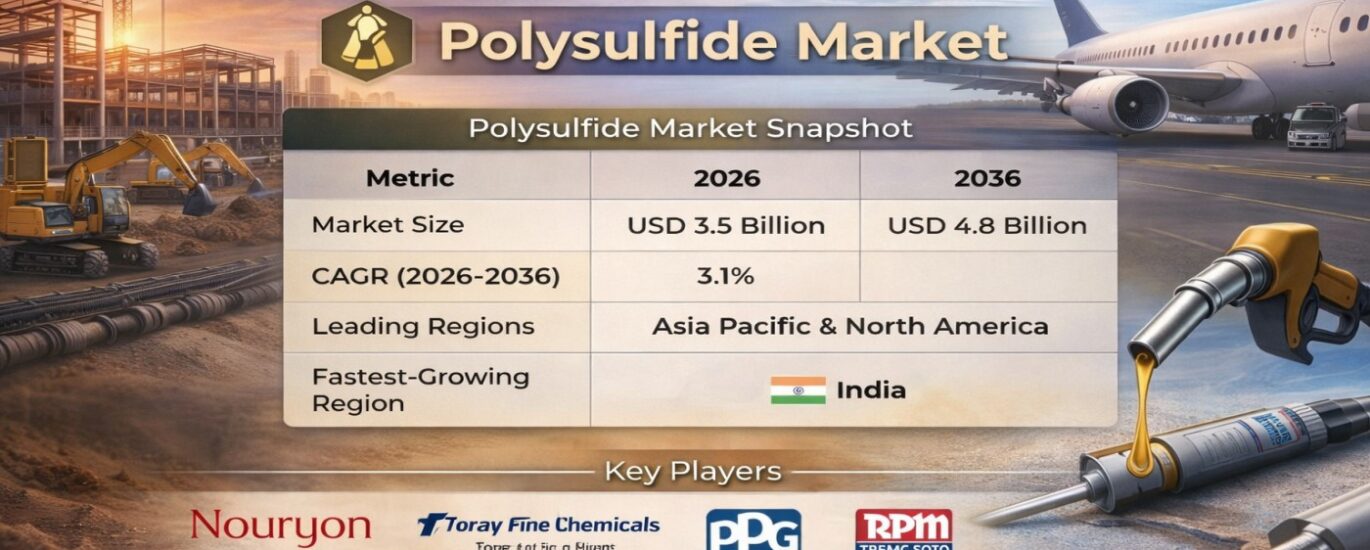
The global polysulfide market is projected to witness steady expansion, growing from USD 3.5 billion in 2026 to USD 4.8 billion by 2036, registering a CAGR of 3.1% during the forecast period. The market continues to play a crucial role in high-performance sealing and bonding applications, particularly where resistance to chemicals, fuels, and extreme environmental conditions is essential.
Polysulfide-based materials are widely utilized across construction, aerospace, automotive, and industrial sectors due to their superior flexibility, durability, and long-term sealing performance. Their ability to maintain integrity under stress and exposure makes them indispensable in mission-critical applications.
Market Growth Drivers
A key growth driver is the increasing demand from the construction industry, where polysulfide sealants are extensively used in glazing, expansion joints, curtain walls, and roofing systems. As infrastructure projects expand globally, the need for durable, weather-resistant sealing materials continues to rise.
In parallel, the aerospace and defense sectors are major contributors to market growth. Polysulfides are essential in aircraft manufacturing for sealing fuel tanks, fuselage joints, and structural components that must withstand pressure, vibration, and temperature extremes.
Additionally, automotive and industrial sectors rely on these materials for sealing components exposed to oils, fuels, and harsh chemicals, further reinforcing demand.
Get detailed market forecasts, competitive benchmarking, and pricing trends: https://www.futuremarketinsights.com/reports/sample/rep-gb-12908
Key Market Trends
- Shift Toward High-Performance Formulations
The market is moving toward advanced formulations that offer:
• Enhanced chemical and fuel resistance
• Longer service life
• Faster curing times for modern production lines - Expansion in Infrastructure and Energy Projects
Polysulfide sealants are increasingly used in:
• Airports and metro rail systems
• Energy plants and marine infrastructure
• Commercial building envelopes - Integration with Automated Manufacturing
Manufacturers are developing products compatible with automated dispensing systems, improving:
• Application precision
• Production efficiency
• Quality consistency
Segment Insights
By Product Type
• Thiokols (58%) dominate due to superior fuel resistance, flexibility, and sealing durability
• Solid polysulfide elastomers are used in molded components and industrial gaskets
By End Use
• Aerospace & transportation (32%) lead due to high-performance requirements
• Building & construction follows with strong demand in glazing and waterproofing
• Industrial processing and coatings contribute steady consumption
Regional Market Dynamics
Global demand is driven by industrial development, infrastructure growth, and aerospace manufacturing capabilities:
- India (3.9% CAGR) emerges as a key growth engine due to rapid urbanization, infrastructure expansion, and manufacturing growth
• United States (3.4%) maintains steady demand driven by aerospace production and building renovation projects
• Germany (3.3%) leads in engineering-intensive applications across automotive and construction
• South Korea (3.3%) benefits from shipbuilding, electronics, and precision manufacturing
• France (3.2%) and United Kingdom (3.1%) show stable growth supported by infrastructure and defense sectors
East Asia, Europe, and North America remain dominant markets, while emerging regions gain traction through infrastructure and industrial expansion.
Competitive Landscape
The polysulfide market is moderately consolidated, with a limited number of global players competing on formulation expertise, product reliability, and regulatory compliance.
Leading companies include:
• Nouryon
• Toray Fine Chemicals
• PPG Industries (PRC DeSoto)
• RPM International (Tremco CPG)
• Flamemaster Corporation
• JSC Kazan Synthetic Rubber Plant
• Robinson Brothers Ltd.
These companies focus on developing application-specific solutions, particularly for aerospace and infrastructure sectors where certification and performance standards are stringent.
Challenges and Constraints
Despite stable growth, the market faces several challenges:
• Volatility in raw material prices
• Competition from alternative sealant technologies
• Stringent environmental and chemical regulations
• Cost sensitivity in non-critical applications
Addressing these issues requires continuous innovation and improved formulation efficiency.
Future Outlook
Looking ahead, the polysulfide market is expected to evolve toward high-performance, application-specific solutions. Growth will be driven by:
• Expansion in global aviation and defense programs
• Increasing infrastructure and smart city projects
• Rising demand for durable, weather-resistant building materials
• Growth in energy and industrial processing sectors
As industries prioritize durability, chemical resistance, and long-term reliability, polysulfide materials will remain integral to advanced manufacturing and construction ecosystems through 2036.
About Future Market Insights (FMI)
Future Market Insights, Inc. (ESOMAR certified, recipient of the Stevie Award, and a member of the Greater New York Chamber of Commerce) offers profound insights into the driving factors that are boosting demand in the market. FMI stands as the leading global provider of market intelligence, advisory services, consulting, and events for the Packaging, Food and Beverage, Consumer Technology, Healthcare, Industrial, and Chemicals markets. With a vast team of over 400 analysts worldwide, FMI provides global, regional, and local expertise on diverse domains and industry trends across more than 110 countries.
Contact Us:
Future Market Insights Inc.
Christiana Corporate, 200 Continental Drive,
Suite 401, Newark, Delaware – 19713, USA
T: +1-347-918-3531
For Sales Enquiries: sales@futuremarketinsights.com
Website: https://www.futuremarketinsights.com
LinkedIn| Twitter| Blogs | YouTube