Market Overview: Strong Growth Driven by Convenience, Sustainability, and Smart Packaging
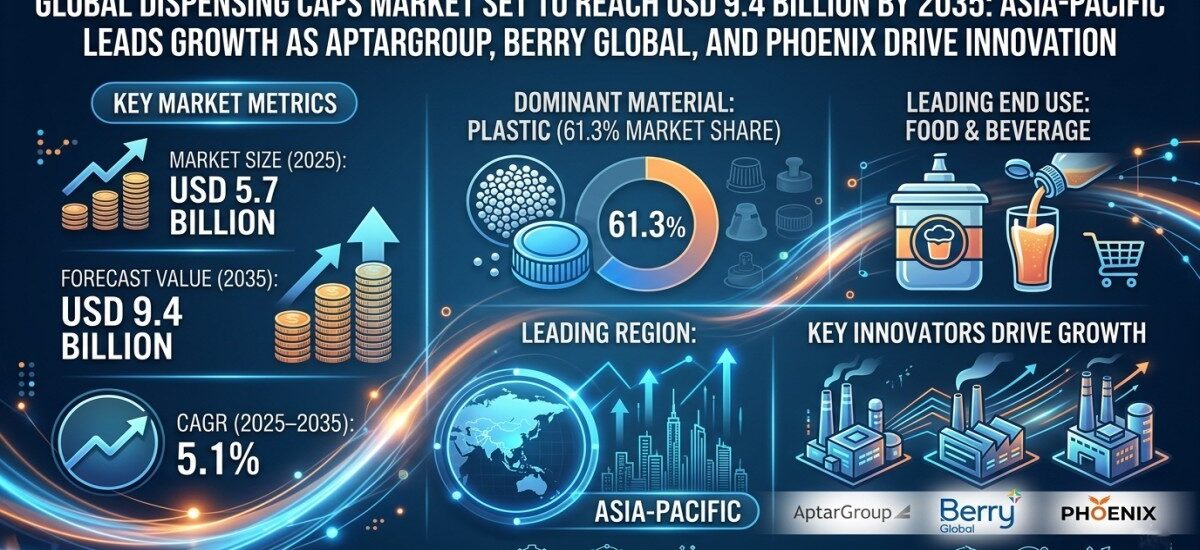
The global dispensing caps market is poised for robust expansion, projected to grow from USD 5.7 billion in 2025 to USD 9.4 billion by 2035, registering a CAGR of 5.1% during the forecast period. This steady growth reflects increasing demand across industries such as food & beverage, personal care, and healthcare, where precision, hygiene, and user convenience are paramount.
Dispensing caps ranging from flip-top and disc-top closures to trigger mechanisms play a vital role in modern packaging by enabling controlled product dispensing, enhancing user experience, and ensuring product safety. Their integration into liquid and semi-liquid packaging formats has become essential in today’s fast-paced, convenience-driven consumer landscape.
Growth is further fueled by sustainability initiatives, advancements in materials science, and the integration of smart packaging technologies that align with evolving regulatory frameworks and consumer expectations.
Key Market Metrics
- Market Size (2025): USD 5.7 Billion
- Forecast Value (2035): USD 9.4 Billion
- CAGR (2025–2035): 5.1%
- Dominant Material: Plastic (61.3% market share)
- Leading End Use: Food & Beverage
- Leading Region: Asia-Pacific
Get detailed market forecasts, competitive benchmarking, and pricing trends:
https://www.futuremarketinsights.com/reports/sample/rep-gb-13175
Key Demand Drivers
- Rising Demand for Convenience Packaging
Consumers increasingly prefer packaging solutions that offer ease of use, portability, and minimal spillage. Dispensing caps enable controlled flow, resealability, and hygienic application, making them indispensable across everyday products.
- Sustainability and Circular Economy Initiatives
The shift toward eco-friendly packaging is reshaping the dispensing caps market. Manufacturers are adopting recyclable polymers, bio-based plastics, and tethered closures to comply with environmental regulations and meet sustainability targets.
- Growth in Food & Beverage Consumption
The surge in packaged food, beverages, condiments, and dairy products is significantly driving demand for dispensing closures. These caps ensure portion control, freshness, and convenience, especially in e-commerce and takeaway formats.
- Technological Advancements in Manufacturing
Innovations such as precision injection molding, lightweighting, and automation have improved efficiency and scalability. Smart features like tamper-evident seals and dosage control are enhancing product value.
Supply Chain Analysis: Who Supplies Whom
The dispensing caps market operates within a structured and interconnected supply chain:
- Raw Material Suppliers: Provide plastics (PP, PE, PET) and metals like aluminum and steel.
- Component & Additive Providers: Supply colorants, bio-resins, and functional additives for durability and safety.
- Closure Manufacturers: Convert materials into dispensing caps using molding, assembly, and printing technologies.
- End-Use Industries: Food & beverage brands, personal care companies, and pharmaceutical manufacturers integrate caps into packaging.
- Distribution & Recycling Ecosystem: Focuses on collection, recycling, and reprocessing to support circular economy goals.
Pricing Trends & Cost Dynamics
- Raw Material Volatility: Fluctuating prices of plastics and resins directly impact manufacturing costs.
- Lightweighting Strategies: Companies are reducing material usage to control costs and improve sustainability.
- Premium Pricing for Smart Features: Caps with tamper-evident, dosing, or smart functionalities command higher margins.
- Regional Cost Advantages: Asia-Pacific benefits from lower production costs and large-scale manufacturing capabilities.
Segmentation Insights
By Product Type
- Flip-top closures
- Disc-top closures
- Trigger closures
Flip-top closures dominate due to ease of use and widespread adoption across multiple industries.
By Material
- Plastic (PP, PE, PET, PVC, PS, Polycarbonate)
- Metal (Aluminum, Stainless Steel)
Plastic remains the leading material due to its versatility, lightweight properties, and cost-effectiveness.
By End Use
- Food & Beverages
- Healthcare
- Cosmetics & Personal Care
- Chemical & Automotive Industries
Food & beverages lead the segment, driven by high consumption of liquid packaged goods.
Regional Analysis
Asia-Pacific: The Growth Engine
Asia-Pacific dominates the global dispensing caps market due to rising disposable incomes, expanding middle-class populations, and increasing consumption of packaged goods in countries like India and China. The region’s manufacturing strength and cost advantages further boost its leadership.
North America: Innovation Hub
North America is characterized by high adoption of advanced dispensing technologies, sustainable materials, and smart packaging solutions. Strong demand from personal care and healthcare sectors supports market growth.
Europe: Sustainability-Driven Market
Europe’s strict environmental regulations and focus on circular economy practices are driving innovation in recyclable and biodegradable dispensing caps. Companies are investing heavily in eco-friendly materials and precision engineering.
Unlock 360° insights for strategic decision making and investment planning: https://www.futuremarketinsights.com/checkout/13175
Competitive Landscape
The market is highly competitive, with companies focusing on sustainability, innovation, and customization to gain a competitive edge.
Key Players Include:
- AptarGroup, Inc.
- Berry Global Inc.
- Silgan Holdings Inc.
- PHOENIX Closures
- RPC Group (now part of Berry Global)
- Regional and niche manufacturers
Strategic Focus Areas:
- Development of recyclable and bio-based materials
- Lightweight and ergonomic designs
- Smart dispensing solutions with enhanced functionality
- Automation and AI integration in manufacturing
Technology & Innovation Trends
- Smart Dispensing Systems: Integration of IoT and intelligent dosing technologies
- Tamper-Evident Features: Enhanced safety and compliance
- Biopolymer Integration: Sustainable material innovation
- AI-Driven Manufacturing: Improved quality control and efficiency
- Self-Sealing Mechanisms: Next-generation user-friendly designs
Challenges
- Raw Material Price Fluctuations: Affect profit margins and production planning
- Stringent Environmental Regulations: Require continuous innovation in materials
- Supply Chain Disruptions: Geopolitical and logistical challenges impact availability
- Balancing Cost and Sustainability: Maintaining affordability while meeting eco-standards
Opportunities & Investment Outlook
- Sustainable Packaging Solutions: Growing demand for biodegradable and recyclable caps
- E-Commerce Expansion: Increased need for leak-proof and travel-friendly packaging
- Customization & Branding: Unique designs enhance product differentiation
- Emerging Markets Growth: Asia-Pacific and Latin America offer high growth potential
- Smart Packaging Integration: High ROI in advanced dispensing technologies
Speak to Analyst: Customize insights for your business strategy: https://www.futuremarketinsights.com/customization-available/rep-gb-13175
Future Outlook (2025–2035)
The dispensing caps market is transitioning from a functional packaging component to a value-added solution driven by innovation, sustainability, and consumer-centric design. The next decade will witness:
- Widespread adoption of circular economy practices
- Growth of refillable and reusable packaging models
- Integration of smart and connected dispensing technologies
- Expansion across healthcare, personal care, and food sectors
By 2035, companies that prioritize eco-friendly materials, smart functionality, and scalable manufacturing will lead the market. The convergence of sustainability and technology will redefine dispensing caps as a critical element in modern packaging ecosystems.
Why FMI: https://www.futuremarketinsights.com/why-fmi
About Future Market Insights (FMI)
Future Market Insights, Inc. (FMI) is an ESOMAR-certified, ISO 9001:2015 market research and consulting organization, trusted by Fortune 500 clients and global enterprises. With operations in the U.S., UK, India, and Dubai, FMI provides data-backed insights and strategic intelligence across 30+ industries and 1200 markets worldwide.
Contact Us:
Future Market Insights Inc., Christiana Corporate, 200 Continental Drive, Suite 401, Newark, Delaware – 19713, USA
T: +1-347-918-3531
For Sales Enquiries: sales@futuremarketinsights.com
Website: https://www.futuremarketinsights.com
LinkedIn| Twitter| Blogs | YouTube