

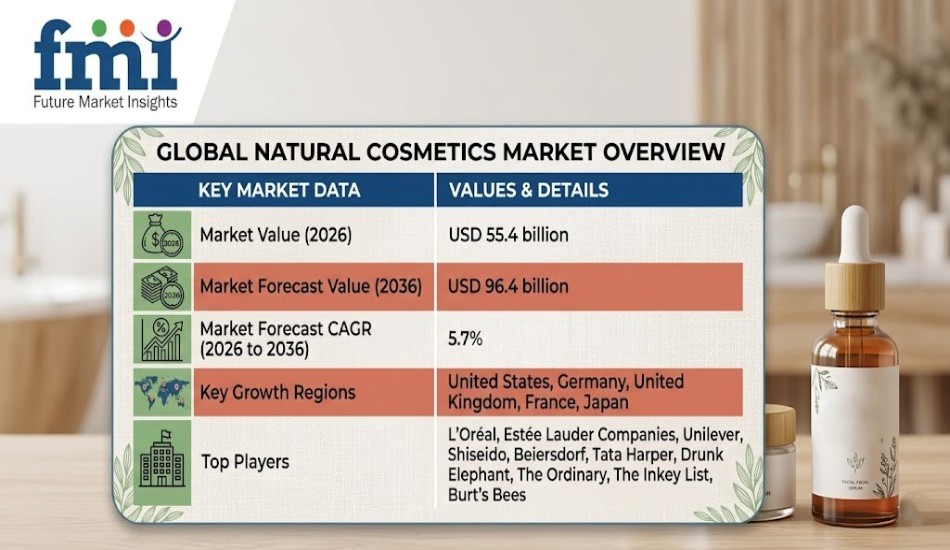
The global natural cosmetics market is witnessing sustained expansion, driven by increasing consumer preference for plant-based, organic, and minimally processed personal care products. According to industry analysis, the market is valued at USD 55.4 billion in 2026 and is projected to reach USD 96.4 billion by 2036, growing at a CAGR of 5.7% over the forecast period.
This growth reflects a long-term shift in consumer behavior toward ingredient transparency, safety, and sustainability, positioning natural cosmetics as a mainstream category across skincare, haircare, and beauty routines.
Market Snapshot: Natural Cosmetics Market
Key Market Metrics
- Market Size (2026): USD 55.4 Billion
- Forecast Value (2036): USD 96.4 Billion
- CAGR (2026–2036): 5.7%
- Leading Ingredient Segment: Herbal (42% share)
- Dominant Product Category: Skincare (38% share)
- Key Growth Regions: United States, Germany, United Kingdom, France, Japan
- Key Players: L’Oréal, Estée Lauder Companies, Unilever, Shiseido, Beiersdorf, Tata Harper, Drunk Elephant, The Ordinary, The Inkey List, Burt’s Bees, Weleda, Korres, Juice Beauty, RMS Beauty
Discover Growth Opportunities in the Market – Get Your Sample Report Now: https://www.futuremarketinsights.com/reports/sample/rep-gb-8588
Growth Dynamics and Demand Drivers
The natural cosmetics market is expanding steadily as consumers increasingly seek products formulated with plant-derived, organic, and chemical-free ingredients. Rising awareness around skin sensitivities, environmental impact, and long-term health effects of synthetic chemicals is accelerating this transition.
Modern formulations incorporate botanical extracts, essential oils, and bioactive compounds that deliver both efficacy and safety. The industry is shifting from niche “green beauty” offerings to mainstream adoption across mass and premium segments.
Sustainability is a major driver, with consumers favoring ethically sourced ingredients, eco-friendly packaging, and cruelty-free production processes. Regulatory frameworks supporting ingredient disclosure and certification are further reinforcing market growth.
Segment Insights
By Product Type
- Skincare leads with approximately 38% share due to high usage frequency and broad applicability
- Haircare, makeup, and toiletries are expanding with clean-label demand
- Multifunctional products (e.g., SPF moisturizers, antioxidant serums) are gaining traction
By Ingredient Type
- Herbal ingredients dominate with 42% share due to proven efficacy and consumer trust
- Organic, vegan, and cruelty-free formulations are growing rapidly
- Increasing emphasis on traceability and certification compliance
By Distribution Channel
- Supermarkets and specialty stores dominate offline sales
- E-commerce is rapidly expanding due to accessibility and product awareness
- Premium brands benefit from specialty retail and direct-to-consumer channels
Supply Chain and Industry Structure
The natural cosmetics supply chain is centered on sourcing certified, high-quality raw materials such as herbal extracts, essential oils, and plant-based actives. Manufacturers prioritize formulation stability, regulatory compliance, and certification standards.
Global players like Unilever and L’Oréal leverage advanced R&D and large-scale sourcing networks, while niche brands focus on artisanal production and ingredient purity.
Distribution spans retail, e-commerce, specialty beauty stores, and salons, enabling brands to reach diverse consumer segments efficiently.
Pricing and Value Trends
Pricing in the natural cosmetics market reflects a premium positioning driven by ingredient quality, certification, and formulation complexity. While natural products often carry higher upfront costs, value is increasingly defined by safety, efficacy, and sustainability.
Premium brands emphasize clinical validation and ingredient traceability, while mass-market players focus on affordability and accessibility. Margin concentration favors companies that can maintain consistent quality and certification compliance.
Competitive Landscape
The market is highly competitive, with a mix of global corporations and niche clean beauty brands.
Established players such as Estée Lauder Companies and Shiseido leverage brand trust, innovation, and global distribution networks. Meanwhile, emerging brands differentiate through ingredient transparency, minimalist formulations, and sustainability-driven branding.
Fragmentation remains high, particularly among regional and artisanal producers, while large companies maintain pricing power through scale and certification capabilities.
Regional Analysis
North America
- United States (5.8% CAGR): Strong demand driven by clean beauty awareness and retail expansion
- Growth supported by e-commerce and premium product adoption
Europe
- Germany, UK, France (5.0% CAGR): Mature markets with strong regulatory frameworks
- High adoption of certified organic and eco-friendly products
Asia Pacific
- Japan (3.6% CAGR): Moderate growth due to established beauty routines
- Increasing awareness of natural alternatives is driving gradual adoption
Future Outlook and Opportunities
The natural cosmetics market is expected to strengthen its position as a core segment of the global beauty industry.
Key opportunities include:
- Development of advanced botanical and bioactive formulations
- Expansion of certified organic and vegan product lines
- Growth in emerging markets with rising awareness of clean beauty
- Integration of sustainability and ethical sourcing into brand identity
Companies that successfully combine product efficacy, ingredient transparency, and regulatory compliance will be best positioned to capture long-term growth.
Conclusion
The rise of natural cosmetics reflects a broader transformation toward safe, sustainable, and transparent beauty solutions. As consumers prioritize wellness and environmental responsibility, natural formulations are moving from niche to mainstream adoption.
With steady growth projected through 2036, the market is set to play a pivotal role in redefining global personal care standards, emphasizing quality, integrity, and sustainability in everyday beauty routines.
Why FMI: https://www.futuremarketinsights.com/why-fmi
About Future Market Insights (FMI)
Future Market Insights, Inc. (FMI) is an ESOMAR-certified, ISO 9001:2015 market research and consulting organization, trusted by Fortune 500 clients and global enterprises. With operations in the U.S., UK, India, and Dubai, FMI provides data-backed insights and strategic intelligence across 30+ industries and 1200 markets worldwide.
Contact Us:
Future Market Insights Inc.
Christiana Corporate, 200 Continental Drive,
Suite 401, Newark, Delaware – 19713, USA
T: +1-347-918-3531
For Sales Enquiries: sales@futuremarketinsights.com
Website: https://www.futuremarketinsights.com
LinkedIn| Twitter| Blogs | YouTube




