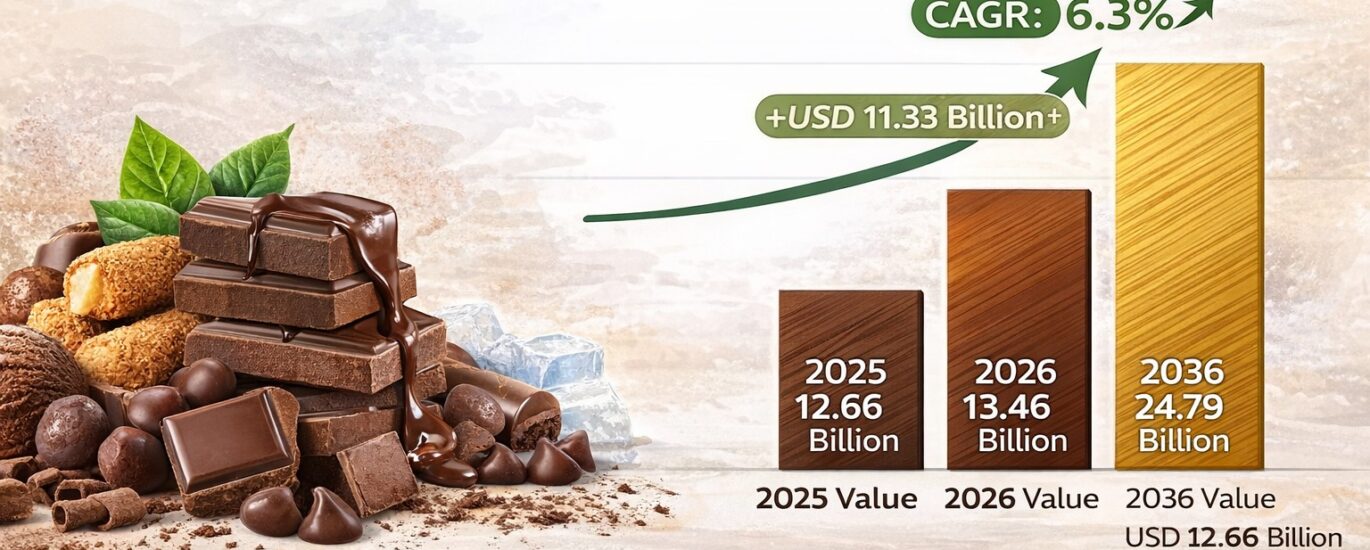
The global compound chocolate market was valued at USD 12.66 billion in 2025 and is projected to reach USD 24.79 billion by 2036. Demand is estimated to grow to USD 13.46 billion in 2026, reflecting a CAGR of 6.3% during the forecast period.
The market is expected to create an absolute dollar opportunity of USD 11.33 billion between 2026 and 2036. Growth is being driven by rising demand across bakery, confectionery, ice cream, and snack manufacturing applications, where compound chocolate offers cost efficiency, easier handling, and tempering-free processing compared to couverture chocolate.
Get detailed market forecasts, competitive benchmarking, and pricing trends: https://www.futuremarketinsights.com/reports/sample/rep-gb-14586
Market Overview
The compound chocolate market is expanding steadily as food manufacturers seek affordable chocolate alternatives that maintain taste, appearance, and processing efficiency. Compound chocolate is increasingly used in coatings, chips, slabs, sauces, spreads, biscuits, wafers, cakes, and frozen desserts.
By 2030, the market is expected to surpass USD 17.5 billion, generating strong incremental growth in the first half of the forecast period. Demand is particularly strong in industrial bakery and confectionery manufacturing, where compound chocolate’s ability to perform in warm climates and across high-volume production lines provides a significant advantage.
Key Growth Drivers
The primary growth driver is the continued expansion of bakery and confectionery production globally. Manufacturers increasingly prefer compound chocolate because it eliminates the tempering process required for real chocolate, improving operational efficiency and reducing manufacturing costs.
Demand is also increasing for dark compound chocolate, driven by consumer interest in dark chocolate flavor profiles, antioxidant benefits, and premium positioning. In addition, rising vegan and dairy-free food demand is encouraging the use of plant-based compound chocolate formulations made without milk ingredients.
Speak to Analyst : Customize insights for your business strategy – https://www.futuremarketinsights.com/customization-available/rep-gb-14586
Supply Chain and Pricing Trends
The compound chocolate supply chain includes cocoa processors, vegetable fat suppliers, ingredient manufacturers, bakery and confectionery producers, and food service distributors.
- Cocoa processors provide cocoa powder and cocoa derivatives.
- Vegetable fat suppliers provide palm kernel oil, coconut oil, and other cocoa butter substitutes.
- Ingredient manufacturers produce coatings, chips, slabs, and specialty chocolate formulations.
- Bakery and confectionery companies use compound chocolate in biscuits, wafers, cakes, pastries, and snacks.
- Ice cream manufacturers use compound chocolate coatings for bars, cones, and frozen desserts.
Segment Analysis
By product type, milk chocolate leads the market with a 46.7% share in 2026 due to its broad consumer acceptance and compatibility with mainstream confectionery and bakery applications.
Dark compound chocolate is emerging as a high-growth segment and is projected to account for 42.5% of the market in 2026. Demand is rising due to consumer preference for richer flavor profiles and perceived health benefits.
Regional Outlook
Europe remains one of the most mature markets for compound chocolate, supported by strong bakery, confectionery, and premium chocolate manufacturing sectors. France is projected to record the fastest growth among major markets, with a CAGR of 7.2% through 2036.
Asia Pacific is emerging as a high-growth region due to rising confectionery production, urbanization, and increasing snack consumption. Thailand is expected to grow at a CAGR of 6.9%, driven by its expanding export-oriented confectionery industry.
Unlock 360° insights for strategic decision making and investment planning- https://www.futuremarketinsights.com/checkout/14586
Competitive Landscape
The compound chocolate market is moderately concentrated, with major players focusing on capacity expansion, sustainable cocoa sourcing, and product innovation.
Key players include: Barry Callebaut, Cargill Incorporated, Blommer Chocolate Company, PURATOS, ADM WILD Europe GmbH, Wilmar International Limited, Mondelez International, CEMOI, HERZA Schokolade GmbH & Co. KG, Clasen Quality Coatings Inc., Nestle S.A., and Puratos Group.
Recent Developments
- Barry Callebaut expanded its compound chocolate manufacturing capacity in Suzhou, China, in February 2024 to meet growing demand from Asian confectionery manufacturers.
- PURATOS launched new dark compound chocolate coating variants with single-origin cocoa and Rainforest Alliance certification in April 2024.
Future Outlook
The compound chocolate market is expected to remain a strong growth category over the next decade. Future investment opportunities are likely to focus on vegan formulations, dark chocolate variants, sustainable cocoa sourcing, tropical climate coatings, and specialty applications in bakery and frozen desserts.
Despite challenges such as cocoa price volatility, changing consumer preferences, and sustainability compliance costs, the market outlook remains positive as manufacturers continue to prioritize affordability, convenience, and processing efficiency.
About FMI
Future Market Insights (FMI) is a globally recognized provider of market intelligence, delivering actionable insights across industries including food and beverage, healthcare, chemicals, and advanced manufacturing. Through a combination of primary research, proprietary data models, and in-depth analysis, FMI empowers business leaders, investors, and policymakers to make informed strategic decisions in an increasingly complex global marketplace.
Contact Us
Future Market Insights Inc.
Christiana Corporate, 200 Continental Drive,
Suite 401, Newark, Delaware – 19713, USA
T: +1-347-918-3531
For Sales Enquiries: sales@futuremarketinsights.com
Website: https://www.futuremarketinsights.com
LinkedIn | Twitter | Blogs | YouTube