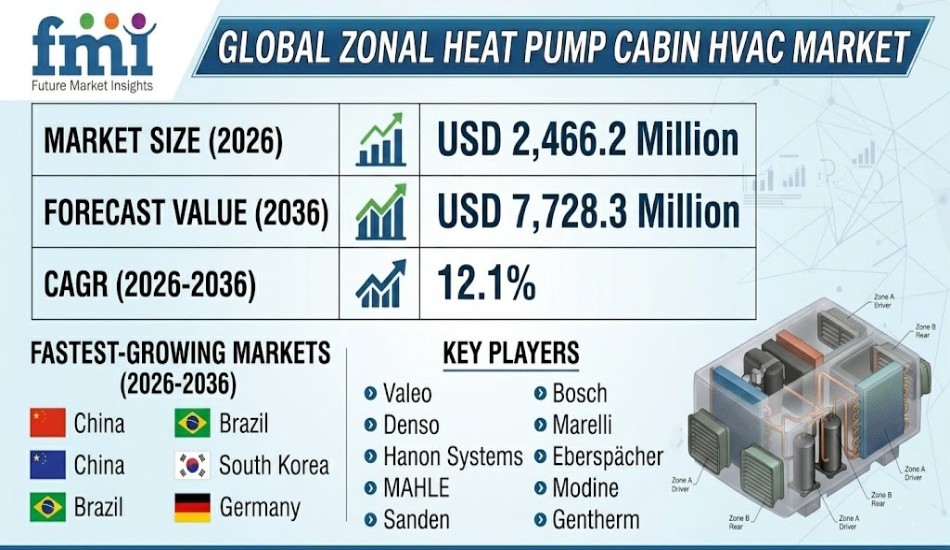
The global zonal heat pump cabin HVAC market is entering a strong expansion phase, fueled by the rapid electrification of mobility platforms, increasing demand for energy-efficient cabin climate control, and the integration of advanced thermal management systems in vehicles and specialty equipment. According to industry analysis, the market is valued at USD 2,466.2 million in 2026 and is projected to reach USD 7,728.3 million by 2036, growing at a CAGR of 12.1% over the forecast period.
This growth reflects a fundamental shift in vehicle engineering, where zonal HVAC architectures and heat pump technologies are becoming standard components in next-generation electric and hybrid platforms, enabling enhanced efficiency, localized comfort, and optimized energy consumption.
Market Snapshot: Zonal Heat Pump Cabin HVAC Market
Key Market Metrics
- Market Size (2026): USD 2,466.2 Million
- Forecast Value (2036): USD 7,728.3 Million
- CAGR (2026–2036): 12.1%
- Leading Zonal Layout: 2-Zone (34.0% share)
- Dominant Heat Pump Type: Integrated Reversible Heat Pumps (54.0% share)
- Largest Vehicle Segment: Passenger EVs (60.0% share)
- Fastest-Growing Markets: China, Brazil, USA, South Korea, Germany
- Key Players: Valeo, Denso, Hanon Systems, MAHLE, Sanden, Bosch, Marelli, Eberspächer, Modine, Gentherm
Discover Growth Opportunities in the Market – Get Your Sample Report Now: https://www.futuremarketinsights.com/reports/sample/rep-gb-30752
Growth Dynamics and Demand Drivers
The zonal heat pump cabin HVAC market is gaining momentum as vehicle manufacturers prioritize energy-efficient thermal management systems that directly impact driving range, battery performance, and occupant comfort.
Unlike conventional HVAC systems, zonal architectures enable localized temperature control, allowing selective heating and cooling of occupied cabin areas. This significantly reduces energy consumption—an essential factor for electric vehicles where thermal systems influence overall efficiency.
Key growth drivers include:
- Rapid electrification of passenger and commercial vehicles
- Increasing demand for battery-efficient heating and cooling systems
- Rising adoption in rail cabins, construction equipment, and agricultural machinery
- Regulatory emphasis on energy efficiency and operator comfort standards
Technological advancements such as integrated heat pump systems, smart control algorithms, and advanced refrigerants are further enhancing system performance and reliability.
Segment Insights
By Zonal Layout
- 2-zone systems dominate with 34.0% share due to optimal balance between cost and comfort
- 3-zone and 4+ zone systems cater to premium and high-customization applications
- Adoption reflects preference for efficient yet manageable system complexity
By Heat Pump Type
- Integrated reversible heat pumps lead with 54.0% share
- Enable both heating and cooling in a single architecture
- Alternative systems (ejector-enhanced, CO₂-based) target niche efficiency gains
By Vehicle Segment
- Passenger EVs dominate with 60.0% share
- High production volumes and range optimization needs drive adoption
- Luxury EVs leverage advanced zoning for premium comfort differentiation
Supply Chain and Industry Structure
The industry is structured around OEM-driven integration, where zonal HVAC systems are specified during vehicle development rather than added post-production.
Key supply chain characteristics include:
- Dependence on compressors, power electronics, and control modules
- Increasing shift toward modular HVAC architectures
- Strong collaboration between OEMs and Tier-1 suppliers
- Emphasis on line-fit systems over aftermarket installations
Companies are investing heavily in R&D, system integration, and compliance with refrigerant regulations, ensuring scalability across diverse vehicle platforms.
Pricing and Value Trends
Pricing dynamics are influenced by system complexity and integration costs, as zonal heat pump HVAC systems require advanced components and calibration.
However, value is driven by:
- Energy savings and improved vehicle range
- Reduced operational costs for fleets
- Enhanced occupant comfort and safety
OEMs increasingly evaluate systems based on lifecycle efficiency rather than upfront cost, supporting long-term adoption.
Competitive Landscape
The market is highly competitive, with leading players focusing on thermal efficiency, integration capabilities, and scalable platform solutions.
- Valeo leads with advanced zonal HVAC integration and efficient system design
- Denso and Hanon Systems offer high-performance thermal management solutions for electrified vehicles
- MAHLE and Bosch emphasize integrated modules and control systems
- Other players such as Sanden, Marelli, Eberspächer, Modine, and Gentherm contribute specialized components and innovations
Competitive differentiation is based on:
- System efficiency and responsiveness
- Packaging flexibility
- Compliance with automotive standards
- Global engineering and OEM support capabilities
Regional Analysis
Asia Pacific (High Growth Hub)
- China (14.1% CAGR): Driven by large-scale EV production and urban electrification
- Strong domestic supply chain and OEM integration capabilities
Latin America
- Brazil (13.9% CAGR): Growth driven by electric buses and climate-driven cooling needs
North America
- USA (11.5% CAGR): Adoption fueled by EV platform redesign and regulatory efficiency targets
Europe & East Asia
- South Korea (11.3% CAGR): Technology-driven growth with strong EV manufacturing
- Germany (11.2% CAGR): Efficiency-focused engineering and premium vehicle integration
Future Outlook and Opportunities
The zonal heat pump cabin HVAC market is expected to become a core component of next-generation vehicle architectures, driven by continuous innovation and electrification trends.
Key opportunities include:
- Development of low-energy, high-efficiency heat pump systems
- Expansion of multi-zone thermal management architectures
- Integration with battery thermal management and waste heat recovery systems
- Growth in off-highway electrified equipment and rail applications
Companies that can deliver high-performance, cost-effective, and scalable HVAC solutions will be best positioned to capitalize on this growth.
Conclusion
The evolution of zonal heat pump cabin HVAC systems marks a significant transformation in vehicle thermal management. As electrification accelerates and efficiency standards tighten, these systems are becoming essential for balancing energy consumption, occupant comfort, and operational performance.
With steady double-digit growth projected through 2036, the market is poised to play a pivotal role in shaping the future of energy-efficient mobility and intelligent cabin environments.
Why FMI: https://www.futuremarketinsights.com/why-fmi
About Future Market Insights (FMI)
Future Market Insights, Inc. (FMI) is an ESOMAR-certified, ISO 9001:2015 market research and consulting organization, trusted by Fortune 500 clients and global enterprises. With operations in the U.S., UK, India, and Dubai, FMI provides data-backed insights and strategic intelligence across 30+ industries and 1200 markets worldwide.
Contact Us:
Future Market Insights Inc.
Christiana Corporate, 200 Continental Drive,
Suite 401, Newark, Delaware – 19713, USA
T: +1-347-918-3531
For Sales Enquiries: sales@futuremarketinsights.com
Website: https://www.futuremarketinsights.com
LinkedIn| Twitter| Blogs | YouTube