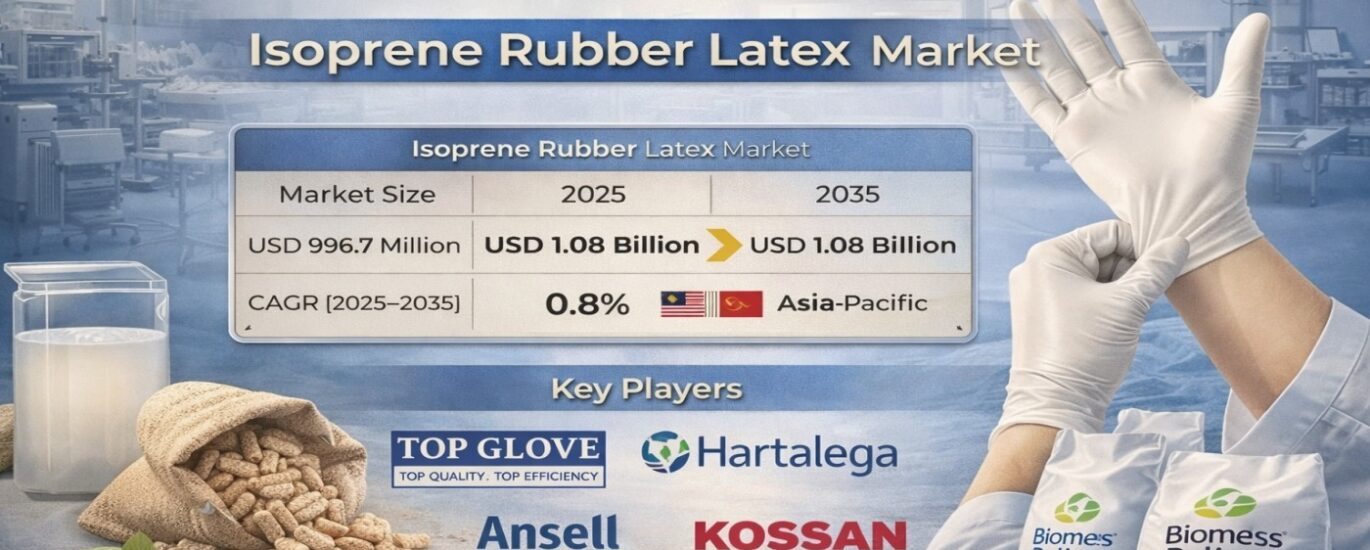
The global isoprene rubber latex market is projected to grow from USD 996.7 million in 2025 to USD 1,079.4 million by 2035, registering a modest CAGR of 0.8% over the forecast period. While growth remains relatively steady, the market is being shaped by increasing demand for latex-free medical products, rising healthcare awareness, and expanding surgical procedure volumes worldwide.
Synthetic polyisoprene latex is gaining traction as a safe and biocompatible alternative to natural rubber latex, eliminating allergenic proteins while maintaining similar elasticity, strength, and tactile sensitivity. This makes it particularly valuable in critical healthcare applications, including surgical gloves and medical devices.
Key Market Drivers
- Rising Demand for Latex-Free Medical Solutions
- Growing awareness of latex allergies among healthcare workers and patients
- Shift toward protein-free synthetic alternatives
- Increasing adoption in hospitals, surgical centers, and diagnostics
- Expansion of Healthcare Infrastructure
- Rapid growth in hospital networks and surgical facilities
- Increasing global healthcare expenditure
- Higher demand for protective medical equipment
- Advancements in Polyisoprene Technology
- Development of high-purity, medical-grade formulations
- Improved biocompatibility and regulatory compliance
- Enhanced tactile sensitivity and durability
Get detailed market forecasts, competitive benchmarking, and pricing trends: https://www.futuremarketinsights.com/reports/sample/rep-gb-7639
Market Segmentation Analysis
By Application
- Medical Gloves – 51.6% (Dominant Segment)
- Condoms
- Catheters
- Medical Balloons
- Adhesives
Medical gloves lead due to high demand for allergy-free, high-performance protective solutions, especially in surgical environments.
By End Use
- Medical – 57.0% (Largest Share)
- Consumer Goods – 28.0%
- Industrial – 15.0%
The medical sector dominates as healthcare systems prioritize patient safety, infection control, and regulatory compliance.
By Form
- Powder-Free Surgical Gloves (Premium Segment)
- Examination Gloves
- Catheter Components
- Medical Adhesives
Powder-free gloves are gaining traction due to reduced contamination risks and better compliance with healthcare standards.
Supply Chain Analysis (Who Supplies Whom)
The isoprene rubber latex market operates through a specialized and quality-driven supply chain:
Upstream
- Petrochemical feedstock suppliers
- Synthetic polymer producers
Midstream Manufacturers
- Polyisoprene latex producers
- Glove and medical device manufacturers
Distribution Channels
- Medical distributors
- Hospital procurement networks
End Users
- Hospitals and surgical centers
- Medical device OEMs
- Consumer healthcare product manufacturers
Pricing Trends and Cost Dynamics
- Prices influenced by petrochemical raw material volatility
- Higher costs compared to natural rubber latex alternatives
- Premium pricing for medical-grade and high-purity formulations
Despite cost challenges, demand remains strong due to critical safety benefits and regulatory requirements.
Regional Analysis
Dominant Regions
- Asia Pacific – manufacturing hub led by Malaysia, China, and India
- North America – strong demand from advanced healthcare systems
- Europe – regulatory-driven adoption of safe medical materials
Top Growth Countries
- India – 12.0% CAGR
- China – 8.9% CAGR
- Malaysia – 7.4% CAGR
- Spain – 6.1% CAGR
- United States – 4.5% CAGR
India and China are emerging as high-growth markets, driven by healthcare expansion and domestic manufacturing capabilities.
Competitive Landscape
The market is moderately concentrated, with leading players focusing on medical-grade innovation and large-scale manufacturing.
Key Players
- Top Glove Corp Bhd
- Hartalega Holdings Bhd
- Kossan Rubber Industries Bhd
- Supermax Corp Bhd
- Ansell Limited
Technology & Material Specialists
- Zeon Corporation
- JSR Corporation
- Kraton Corporation
These companies compete on biocompatibility, product quality, regulatory compliance, and manufacturing efficiency.
Key Trends Shaping the Market
- Increasing shift toward latex allergy-free medical products
- Rising adoption of powder-free surgical gloves
- Growth in advanced polyisoprene formulations
- Expansion of medical device manufacturing globally
Market Restraints and Risks
- Low CAGR (0.8%) indicating mature market dynamics
- Volatility in raw material pricing
- Higher cost compared to natural rubber latex
- Complex manufacturing and strict regulatory requirements
Investment Opportunities
- Development of next-generation biocompatible materials
- Expansion in emerging healthcare markets (India, China)
- Growth in specialized surgical and medical device applications
- Investment in automated, high-quality manufacturing systems
Future Outlook
The isoprene rubber latex market is expected to experience steady, safety-driven growth, supported by:
- Increasing focus on patient safety and allergy prevention
- Expansion of global healthcare infrastructure
- Continuous innovation in medical-grade polymer technologies
Future growth will be shaped by:
- Advanced biocompatible formulations
- Integration with medical device innovation
- Expansion into specialized healthcare applications
As the healthcare industry continues to prioritize safety, performance, and compliance, isoprene rubber latex will remain a critical material in next-generation medical products and protective solutions.