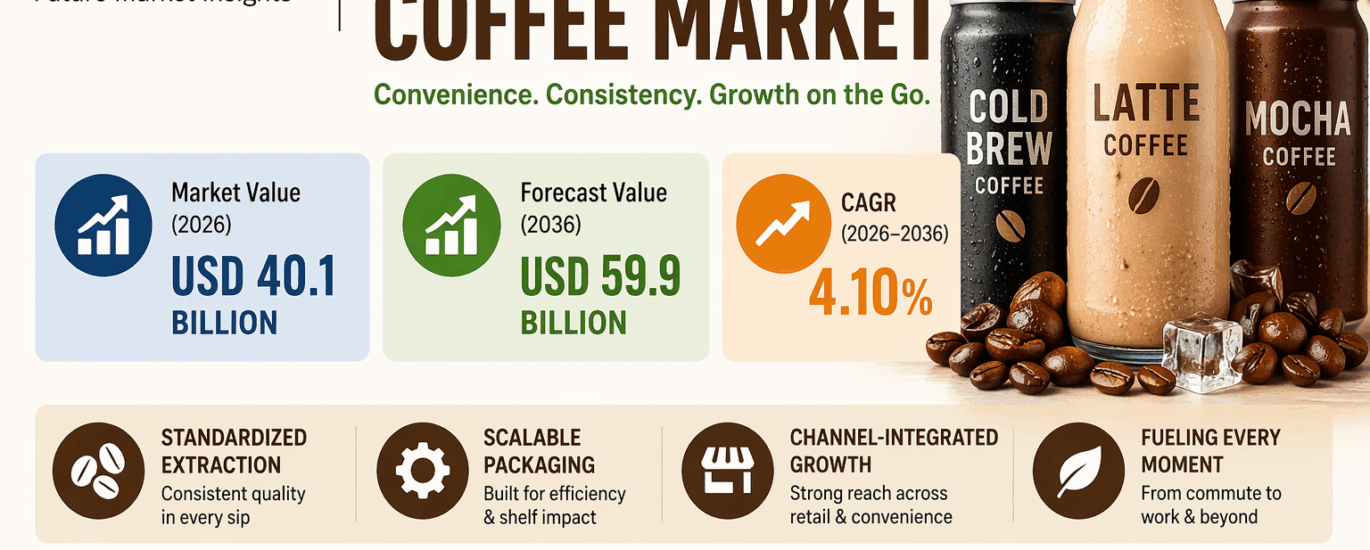
The global ready-to-drink coffee market is valued at USD 40.1 billion in 2026 and is projected to reach USD 59.9 billion by 2036, expanding at a CAGR of 4.1% during the forecast period. The market is expected to create an absolute dollar opportunity of USD 19.8 billion, supported by rising demand for convenient, single-serve coffee beverages.
Growth is increasingly being driven by extraction standardization, packaging scalability, and route-to-market efficiency rather than short-term flavor innovation. Manufacturers are investing in cold brew extraction systems, nitrogen infusion technology, and concentrate-based production methods to improve flavor consistency, caffeine calibration, and shelf stability.
Get detailed market forecasts, competitive benchmarking, and pricing trends: https://www.futuremarketinsights.com/reports/sample/rep-gb-14329
Market Overview
Ready-to-drink coffee has become an important segment within the global beverage industry due to its convenience, portability, and compatibility with modern retail systems. Unlike freshly brewed coffee, RTD coffee is designed for predictable output, longer shelf life, and high-volume production.
Demand is strongly linked to changing consumer lifestyles. Longer commuting times, busier work schedules, and rising preference for on-the-go beverages are increasing consumption across supermarkets, convenience stores, vending machines, and e-commerce channels.
Key Growth Drivers
The main growth driver for RTD coffee is the increasing preference for convenient beverage options that eliminate preparation time. Consumers are seeking portable coffee products that provide consistent flavor, caffeine content, and affordability.
Manufacturers are improving extraction precision and formulation consistency through cold brew systems, concentrate reconstitution, and nitrogen infusion. These technologies reduce batch variability and improve repeat purchase confidence.
Speak to Analyst: Customize insights for your business strategy – https://www.futuremarketinsights.com/customization-available/rep-gb-14329
Supply Chain and Pricing Trends
The RTD coffee supply chain includes coffee bean growers, dairy and sweetener suppliers, packaging manufacturers, beverage processors, bottlers, distributors, and retailers.
Coffee suppliers provide arabica and robusta beans, while dairy companies and plant-based ingredient suppliers provide milk, creamers, oat milk, almond milk, and flavoring components. Packaging manufacturers supply bottles, cans, labels, cartons, and caps.
Beverage manufacturers manage extraction, pasteurization, nitrogen infusion, bottling, and shelf-life testing before products move through retail and foodservice channels.
Segment Analysis
By product type, milk-based RTD coffee remains the leading segment, accounting for 38.0% of total market share. Its dominance is linked to broad consumer acceptance, balanced taste profiles, and compatibility with daily consumption routines.
Milk-based products require advanced pasteurization and shelf-life management, creating barriers for smaller manufacturers. Plant-based milk alternatives are also gaining popularity among younger consumers and health-focused buyers.
Regional Outlook
North America remains the largest RTD coffee market, supported by strong convenience retail infrastructure, advanced bottling systems, and high consumer awareness.
The United States is expected to remain the largest country market, growing at a CAGR of 4.0% through 2036. Strong supermarket penetration, widespread vending networks, and premium coffee consumption continue to support growth.
Asia-Pacific is expected to remain the fastest-growing region. China is projected to expand at a CAGR of 5.5%, supported by retail modernization and shelf-stable distribution systems.
Competitive Landscape
The RTD coffee market is moderately consolidated, with multinational beverage companies leading through strong brand recognition, bottling infrastructure, and large-scale retail distribution.
Key companies include: Nestlé S.A., PepsiCo, Inc., The Coca-Cola Company, Suntory Beverage and Food Ltd., Danone S.A., Asahi Group Holdings, Kirin Holdings, UCC Ueshima Coffee Co., DyDo Drinco Inc., JDE Peet’s, Luigi Lavazza S.p.A., Illycaffè S.p.A., Tingyi Cayman Islands Holding Corp., Uni-President Enterprises Corp., and Pokka Sapporo Food and Beverage Ltd.
Unlock 360° insights for strategic decision making and investment planning- https://www.futuremarketinsights.com/checkout/14329
Future Outlook
The RTD coffee market is expected to remain a high-potential category within the global beverage industry. Future investment opportunities are likely to focus on shelf-stable formats, nitrogen-infused coffee, plant-based milk integration, functional RTD beverages, and packaging innovation.
Despite challenges such as volatile coffee prices, packaging costs, cold-chain dependency, and competition from energy drinks and functional beverages, the long-term outlook remains positive.
Companies that successfully combine extraction precision, packaging flexibility, retail execution, and distribution efficiency are expected to gain the strongest competitive advantage over the next decade.
About FMI
Future Market Insights (FMI) is a globally recognized provider of market intelligence, delivering actionable insights across industries including food and beverage, healthcare, chemicals, and advanced manufacturing. Through a combination of primary research, proprietary data models, and in-depth analysis, FMI empowers business leaders, investors, and policymakers to make informed strategic decisions in an increasingly complex global marketplace.
Contact Us
Future Market Insights Inc.
Christiana Corporate, 200 Continental Drive,
Suite 401, Newark, Delaware – 19713, USA
T: +1-347-918-3531
For Sales Enquiries: sales@futuremarketinsights.com
Website: https://www.futuremarketinsights.com
LinkedIn| Twitter| Blogs | YouTube