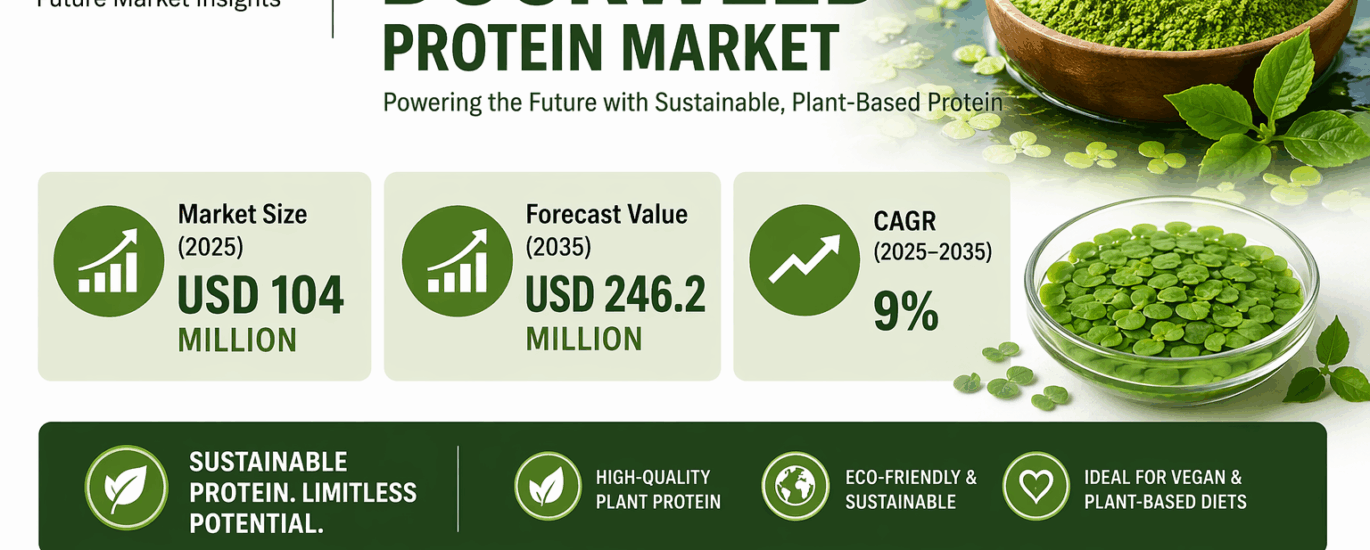
The global duckweed protein market is estimated at USD 104 million in 2025 and is projected to reach USD 246.2 million by 2035, expanding at a CAGR of 9.0% during the forecast period. Growth is being driven by rising consumer demand for sustainable, plant-based protein alternatives and increasing awareness around climate change, food security, and resource-efficient agriculture.
Duckweed protein, derived from fast-growing aquatic plants in the Lemnaceae family, is gaining attention for its strong nutritional profile, including protein content of up to 40% and a balanced amino acid composition comparable to soy and pea proteins. As plant-based diets move into mainstream consumption, duckweed protein is emerging as a promising ingredient across food, beverage, supplement, and feed applications.
Get detailed market forecasts, competitive benchmarking, and pricing trends: https://www.futuremarketinsights.com/reports/sample/rep-gb-14290
Strong Demand from Vegan Diets and Sustainable Agriculture
The increasing popularity of vegan, vegetarian, and flexitarian diets is creating strong demand for alternative proteins. Consumers are seeking ingredients that offer high nutritional value while supporting environmental sustainability goals. Duckweed protein stands out due to its rapid growth rate, low water usage, minimal land requirements, and ability to grow in nutrient-rich water systems.
Governments and sustainability-focused organizations are also supporting the market through research funding and alternative protein initiatives. Environmental policies promoting low-carbon agriculture and plant-based nutrition are encouraging greater investment in duckweed cultivation and commercial processing.
Powdered Duckweed Protein Dominates Product Demand
Powdered duckweed protein is expected to account for 66.3% of the total market share in 2025, making it the leading product form. Its dominance is linked to ease of storage, long shelf life, and versatility across food and beverage applications.
Powdered duckweed protein is widely used in protein shakes, bakery products, soups, nutrition supplements, and sports nutrition products. Manufacturers also prefer powdered forms because they are easier to transport and integrate into industrial-scale food formulations. Demand is also growing in animal feed applications where powdered duckweed is used to improve protein content in livestock and aquaculture diets.
Speak to Analyst : Customize insights for your business strategy – https://www.futuremarketinsights.com/customization-available/rep-gb-14290
Lemna Species Lead Production
Among species, Lemna is projected to hold 57% of the market share in 2025. Lemna species are preferred due to their fast growth cycles, high protein yields, and adaptability across different aquatic environments.
Their commercial importance is especially high in Europe, where they are commonly used in large-scale duckweed protein production systems. Research efforts are increasingly focused on improving Lemna cultivation efficiency, protein extraction methods, and controlled-environment farming systems to support higher yields and lower production costs.
Supply Chain Expansion Supports Commercialization
The duckweed protein supply chain begins with seed and cultivation technology providers, followed by aquatic farming operators, ingredient processors, extraction companies, and food manufacturers. Raw duckweed biomass is cultivated in ponds, vertical farms, or controlled aquatic systems before being harvested and processed into powder, concentrates, or isolates.
Processed duckweed protein is then supplied to food and beverage manufacturers, supplement companies, plant-based meat producers, and feed companies. Strategic partnerships between biotech firms, ingredient suppliers, and consumer brands are helping improve scalability and expand market reach.
Unlock 360° insights for strategic decision making and investment planning- https://www.futuremarketinsights.com/checkout/14290
Pricing Trends Reflect Premium Positioning
Duckweed protein remains a premium ingredient compared to traditional plant proteins due to limited commercial production, relatively high processing costs, and developing supply chains. Prices are influenced by cultivation technology, extraction methods, protein purity, and regional production capacity.
As production scales improve, pricing is expected to become more competitive with other plant proteins such as soy, pea, and rice protein. Premium pricing is likely to remain strongest in specialty nutrition, sports supplements, and clean-label food applications where consumers are willing to pay more for sustainable ingredients.
Regional Demand Continues to Strengthen
Europe and North America are expected to remain the largest markets for duckweed protein due to high awareness of plant-based diets and strong sustainability commitments. Supportive regulatory policies and consumer demand for eco-friendly proteins are reinforcing market expansion.
United States is projected to reach USD 36.9 million by 2035, supported by government research funding, alternative protein investment, and rising consumer interest in plant-based products.
Germany is expected to reach USD 24.6 million by 2035, driven by strong adoption of sustainable feed solutions and the growing use of duckweed in aquaculture.
Competitive Landscape and Future Outlook
Competition in the duckweed protein market is intensifying as companies invest in cultivation technology, protein extraction, and food-grade processing capabilities. Leading companies are focusing on improving taste, nutritional performance, and scalability while forming partnerships with food manufacturers and research institutions.
Major players include : Parabel USA Inc., Pontus Water Lentils, Barentz B.V., Hinoman Ltd., Plantible Foods, Inc., and Lempro Inc..
The future outlook remains highly positive as plant-based proteins continue to gain acceptance worldwide. Investment opportunities are expected to be strongest in vertical farming, protein extraction technology, aquaculture feed, and functional food applications. Companies that can scale production, improve affordability, and maintain strong sustainability positioning are likely to capture the greatest long-term growth.
About FMI
Future Market Insights (FMI) is a globally recognized provider of market intelligence, delivering actionable insights across industries including food and beverage, healthcare, chemicals, and advanced manufacturing. Through a combination of primary research, proprietary data models, and in-depth analysis, FMI empowers business leaders, investors, and policymakers to make informed strategic decisions in an increasingly complex global marketplace.
Contact Us
Future Market Insights Inc.
Christiana Corporate, 200 Continental Drive,
Suite 401, Newark, Delaware – 19713, USA
T: +1-347-918-3531
For Sales Enquiries: sales@futuremarketinsights.com
Website: https://www.futuremarketinsights.com
LinkedIn| Twitter| Blogs | YouTube